



 23 / 50

A D V A N C E D
M A T E R I A L S
&
P R O C E S S E S |
A P R I L
2 0 1 7
2 3
Fig. 4 shows a tractor production part
optimized through this approach, with
ubstantial cost reductions and attrac-
tive ROI.
Further, ICME predicts and in-
cludes effects of the manufacturing
process (e.g., residual stress from car-
burizing or shot peening) in the design
stage for optimal, robust components
leadership to have an impact on all four
OEM materials related decisions. Some
possibilities and real examples follow.
Materials research
. Generally, the
OEMmaterials engineering R&D team is
responsible for identifying appropriate
opportunities to introduce new materi-
als and processes to the organization.
The challenge is to identify newly ma-
ture technologies and specific compo-
nents and processes that could impart
business value. Mere generic identifi-
cation of technology trends, e.g., nano-
materials, additive manufacturing (AM),
or lightweighting, is not sufficient for
successful adoption by the organiza-
tion. For example, although AM is near
the required maturity level for business
implementation, the challenge lies in
specific organizational opportunities
where it can be successfully implement-
ed with sufficient value. Even at current
manufacturing cost levels, AM has been
successfully leveraged in low-volume,
high-performance critical aerospace
components that cannot be produced
using traditional manufacturing meth-
ods. Other AM applications include
low-volume production parts made
without investing in tooling costs, pro-
ducing agriculture machinery parts,
rapid prototyping in product develop-
ment, and making tool fixtures.
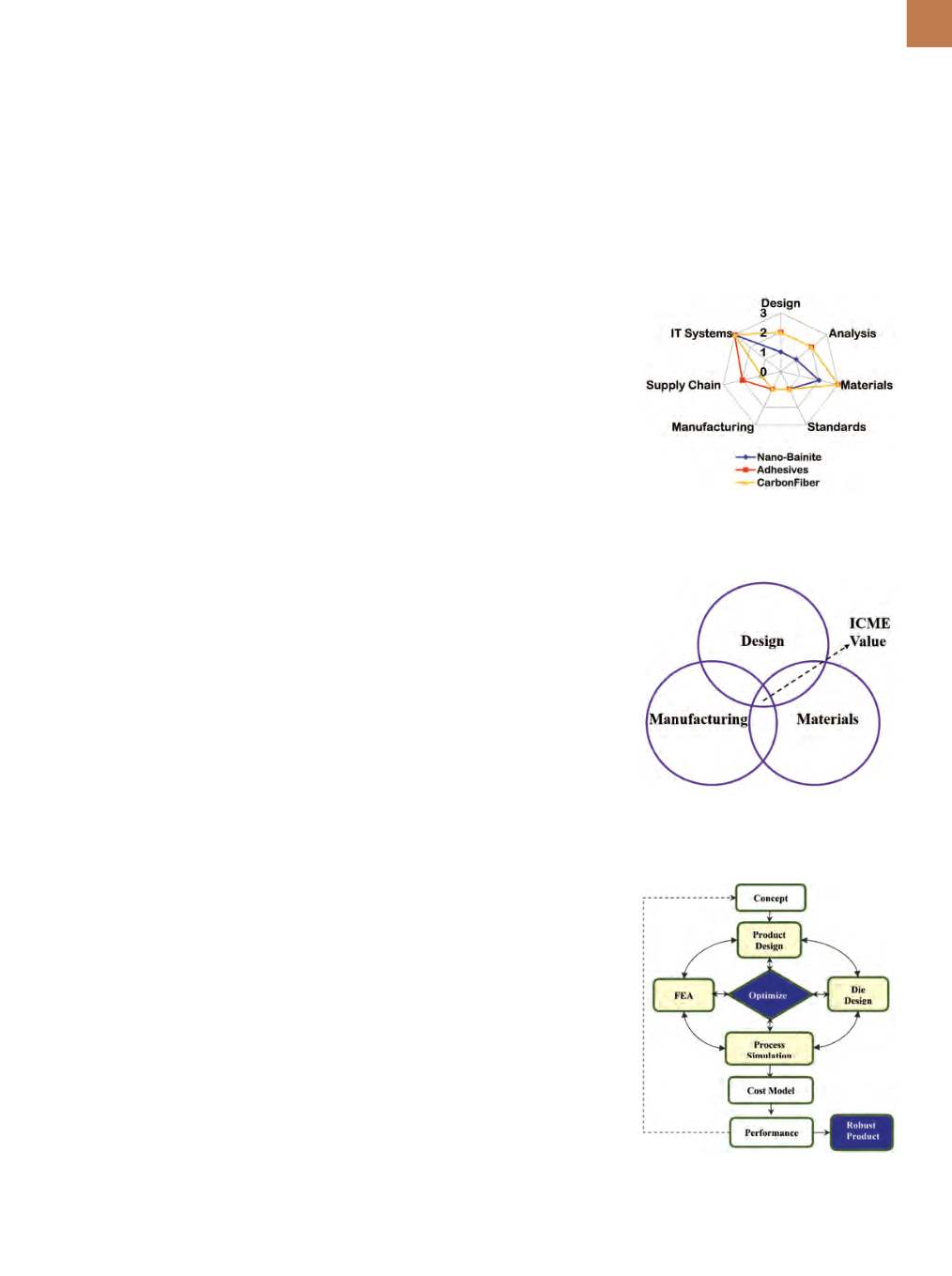
Another factor to consider before
adopting new materials or processing
technology is the simultaneous maturi-
ty of all associated functions
[1]
. Bottle-
necks for technology adoption many
times are due to functions other than
materials engineering. For example,
adopting nanobainitic steel (a steel
with extraordinary strength and ductili-
ty) requires a designer’s acceptance for
a specific application, a structural ana-
lyst’s acceptance in terms of materials
properties and failure criteria, accep-
tance of materials standards and qual-
ity criteria, the OEM’s ability to form
and handle this high strength material,
and possibly the most difficult aspect of
ensuring a supply chain to scale up the
use of the special material at an accept-
able cost (Fig. 1).
Similarly, adopting adhesives to
replace welded structures requires
changes in the OEM manufacturing line
with guidelines for failure criteria and
analytical procedures. Structural appli-
cations of carbon fiber-reinforced com-
posites include high-end sports cars,
boats, and aerospace components.
Carbon-fiber composites are also
used in agriculture machinery, such
as self-propelled sprayers with higher
boom width. The lightweight structure
results in significant weight reduction,
enabling a 25% increase in sprayer tank
capacity, which enhances productivity.
High customer value justifies the use of
this expensive material.
Product engineering
. Emergence
of integrated computational materials
engineering (ICME) provides opportuni-
ties for the materials engineering func-
tion to have an impact on OEM product
development. ICME is a computational
framework that integrates design, ma-
terials, and manufacturing during prod-
uct development and creates value at
their point of juncture (Fig. 2). Value
creation arises from engineering real-
ization through an accelerated devel-
opment cycle and/or reduced product
cost
[2]
.
ICME has been leveraged for func-
tional design of specific alloy grades
and functional coatings, as well as de-
sign optimization. The approach can be
leveraged at multiple scales including
efficient design of specific components.
Figure 3 shows an integrated ICME
framework, where design, process,
and product verification phases are
coupled to realize an optimal, robust
component
[3]
. In the framework, de-
sign and FEA steps are combined with
the correct tooling and process for the
purpose of optimization, which signifi-
cantly reduces the design-FEA iteration
cycle and enables optimal product de-
sign. Further, cost and performance
are incorporated for a holistic design
to evaluate multiple materials and de-
sign concepts. Instead of the prevalent
heuristic approach, the framework
also provides opportunities for ratio-
nal materials and process selection
for a specific component, resulting in
significant cost and weight reductions
in castings, welded fabrications, and
heat treated components. For example,
Fig. 1 —
Multifunctional maturity is required
to successfully adopt newmaterials and
processes.
Fig. 2 —
ICME value creation at the junction
of design, materials, andmanufacturing
through a computational framework.
Fig. 3 —
Integrated framework for design
optimization including simultaneous materi-
als andmanufacturing considerations
[3]
.