


 25 / 50

A D V A N C E D
M A T E R I A L S
&
P R O C E S S E S |
A P R I L
2 0 1 7
2 5
function. In multinational companies
with global operations and multiple
product platforms, the supply chain
network is very complex. Materials en-
gineering could strategically support
the standards group in rationalizing
material grades to be used for all prod-
ucts. In addition, by identifying equiv-
alent local grades at key supply chain
nodes, substantial cost reduction can
be achieved without incurring special
grade material cost. Further, advanced
analytics can identify similar parts,
comparing specific costs and detecting
cost-outliers with structural reduction
in direct materials cost.
Another issue is that commodity
prices of different materials undergo
significant price fluctuations. For exam-
ple, during the past decade the price of
nickel (a key element of drivetrain steel
grades) nearly tripled and then fell back
to lower levels. Materials engineers
could create dynamic preferred mate-
rials grades with criterion on material
cost cutoffs to trigger alternate grades
during a high commodity-price cycle,
acting as a safeguard against commod-
ity pricing swings. Multifunctional syn-
ergy among supply management, IT,
and materials engineering for a strate-
gic shift in data- and knowledge-based
sourcing strategy could unlock unprec-
edented OEM business value.
DEVELOPING FUTURE TALENT
As mentioned previously, future
materials engineering teams can sig-
nificantly influence and impact OEM
business results. However, different
competencies and skillsets must be
developed. There is a significant short-
age of skilled engineers in convention-
al areas (materials selection, physical
and mechanical metallurgy, casting
and solidification, heat treating, pow-
der metallurgy, ferrous and nonferrous
metals, polymers and elastomers, com-
posites, and special materials), which
are needed for successful OEMs. These
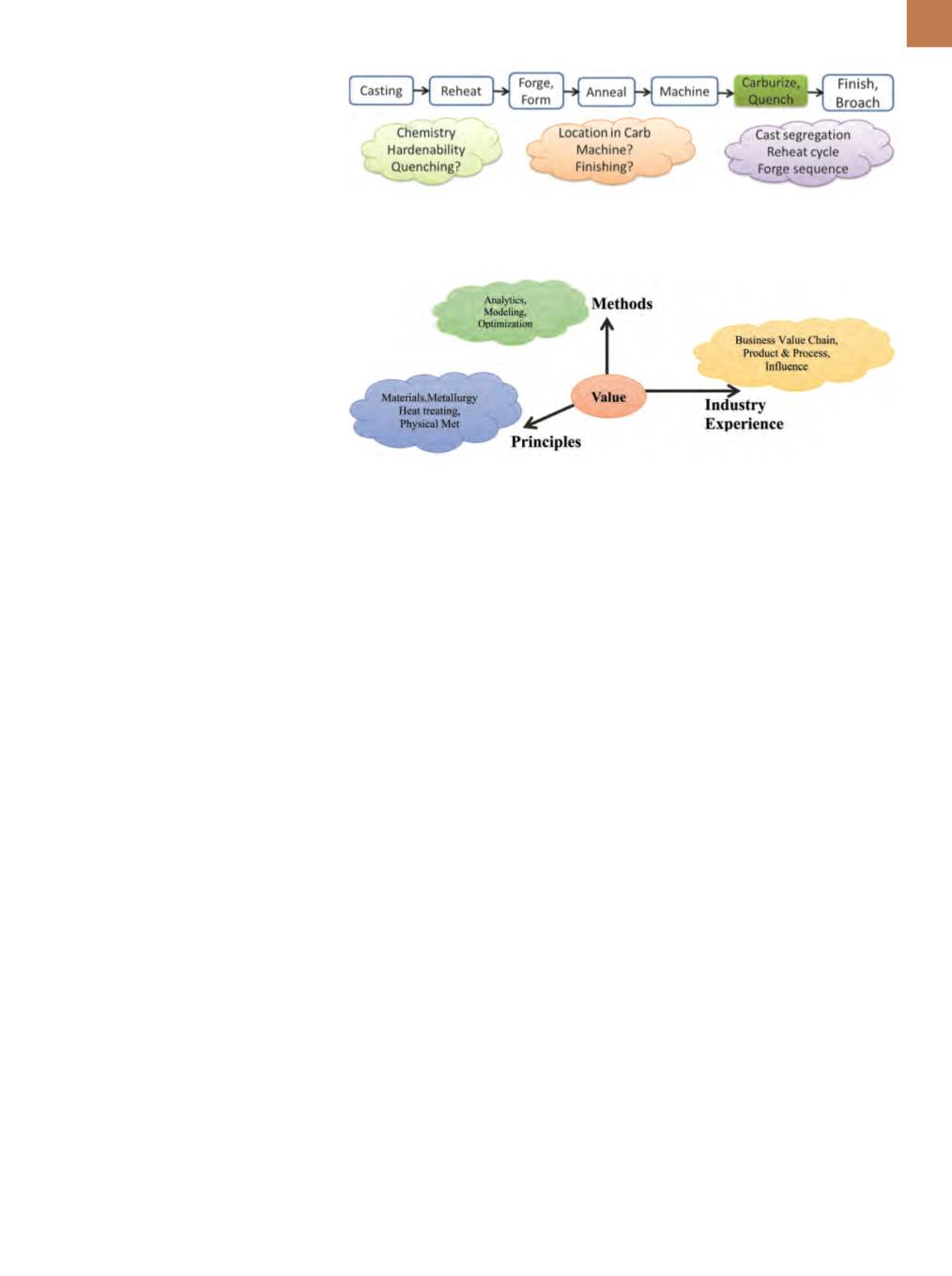
foundational capabilities must be revis-
ited with respect to new perspectives
of analytics, modeling, optimization,
IoT, and Industry 4.0 framework. Also,
a solid understanding of the business
value chain, product, and associated
functional influence is necessary to be
successful in a leadership role. Such a
skillset transformation (Fig. 8) would
make materials engineering more con-
temporary and exciting, and help with
effective management of functional
knowledge with an enhanced impact
on the organization.
SUMMARY
The materials engineering lead-
ership role within OEMs is expected to
transform into a role of influencer for
materials research, product engineer-
ing, manufacturing, and supply chain.
This requires new skillsets and compe-
tencies regarding analytics, modeling,
and optimization, which would sup-
plement the conventional approach of
experiments and experiential problem
solving. Leadership focus should aim
for proactive identification of opportu-
nities to bring structural changes in the
way materials are selected, specified,
used, manufactured, and sourced with-
in OEMs, which will have an unprece-
dented impact on business.
~AM&P
For more information:
Satyam S. Sa-
hay is a John Deere Fellow, materials
engineering, John Deere Technolo-
gy Center India, Tower 14, Cybercity,
Magarpatta City, Pune, India 411013.
satyamsahay@yahoo.com.
References
1. J.D. Evans and R.O. Johnson, Tools
for Managing Early-Stage Business
Model Innovation,
Res. Tech. Mgmt.
,
Sep-Oct, p 52, 2013.
2. M.F. Horstemeyer and S.S. Sahay,
Defining ICME,
ICME: Industrial Appli-
cations
, M.F. Horstemeyer (ed.), (in
preparation).
3. S.S. Sahay and M. El-Zein, Technol-
ogy Vision: Residual Stress Engineering
for Leaner, Greener And Safer Design,
Surf. Eng.
, 27, p 77-79, 2011.
4. S.S. Sahay,
ASM Handbook,
Volume
4D,
Heat Treatment of Gears
, p 204-218,
ASM International, 2014.
5. G. Mohapatra and S.S. Sahay,
ASM
Handbook
, Volume 18,
Friction, Lubrica-
tion and Wear Technology,
ASM Interna-
tional, (in press).
6. J.P. Scrivner, et al., Dual Function
Basecutters, U.S. Patent Application
Publication No. US 2016/0073580 A1,
March 17, 2016.
7. S.S. Sahay, Analytics, Modeling and
Optimization of Industrial Heat Treating
Processes,
Adv. Matls. & Proc.
, Vol 172,
No. 3, p 44-47, 2014.
8. S.S. Sahay, Industry 4.0 Meets Heat
Treating,
Adv. Matls. & Proc.
, Vol 174,
No. 10, p 59-61, 2016.
Fig. 7 —
Process chain for gearmaking, also showing the way heat treating operations are
integrated into the chain
[8]
.
Fig. 8 —
Modern materials engineering competencies needed to be successful within an OEM.