



 28 / 50

A D V A N C E D M A T E R I A L S & P R O C E S S E S | A P R I L 2 0 1 7
2 8
a strong resistance to biocides and anti-
biotics that would otherwise easily kill
them. Despite the many problems at-
tributed to biofilms, there are instances
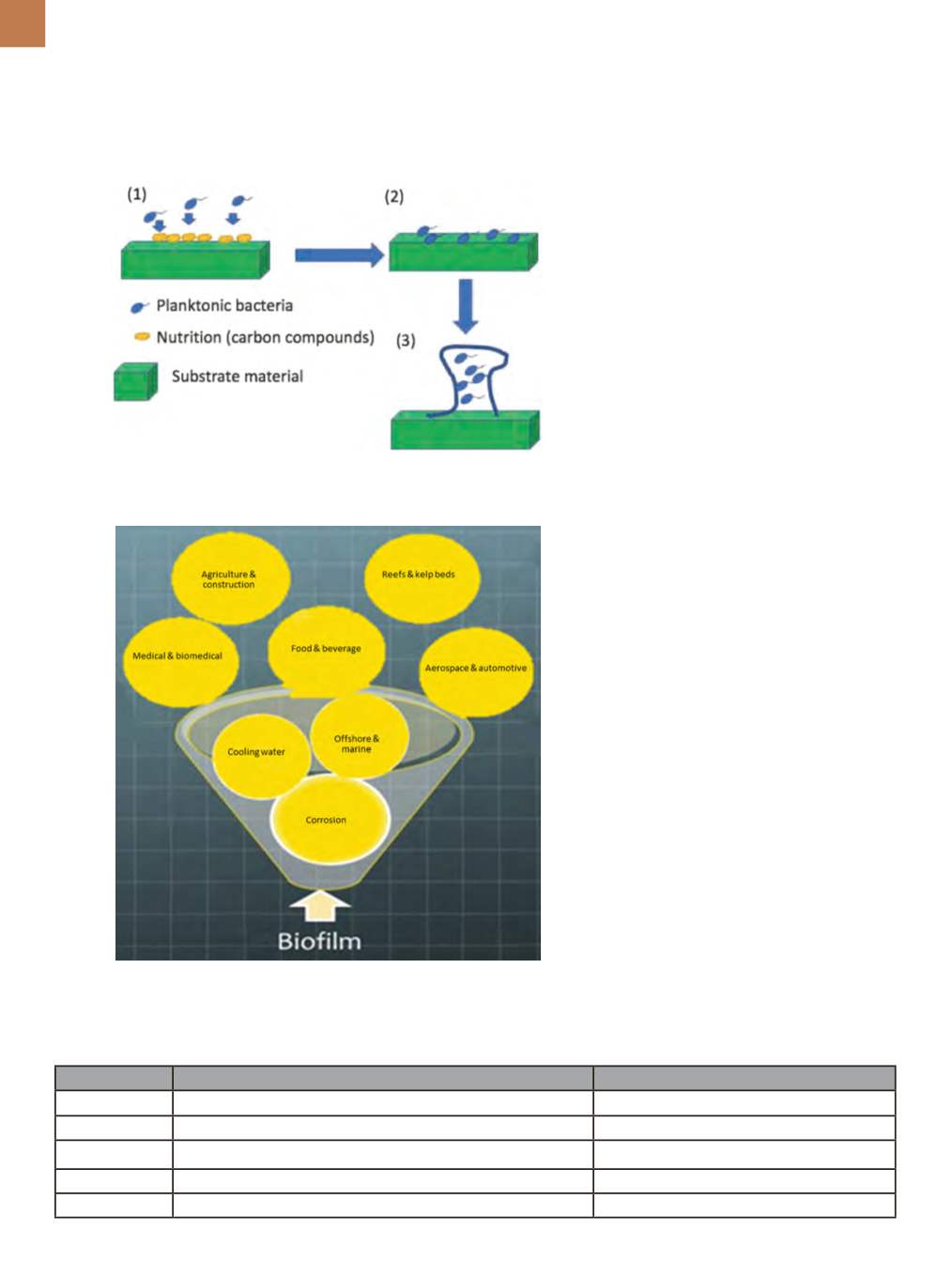
Fig. 4
– Bacteria drawn to organic compounds on material surfaces produce biofilms by excret-
ing polysaccharides when present in sufficient numbe s.
TABLE 2 – ASTM STANDARDS RELATED TO BIOFILMS
Standards
Purposes
Sources
E2562
Biofilm formation and quantification (continuous flow reactors)
www.astm.org/Standards/E2562.htmE2871
Evaluating disinfectant efficacy (single tube method)
www.astm.org/Standards/E2871.htmE2196
Biofilm formation and quantification (rotating disk reactors)
www.astm.org/Standards/E2196.htmE2647
Biofilm formation and quantification (drip flow reactors)
www.astm.org/Standards/E2647.htmE2799
Evaluating disinfectant efficacy (MBEC assay)
www.astm.org/Standards/E2799.htmFig. 5
– Biofilms are implicated in numerous problems plaguing industry and society in general.
They can also be employed for good, however, to protect beneficial microorganisms such as
those found on coral reefs and kelp beds.
where film development can have a
positive effect. For example, biofilms
on fish reefs and seaweed beds provide
protection from environmental threats.
Whether the goal is to prevent or
promote biofilm growth, the market
potential for materials that do one or
the other is huge with numerous appli-
cations (Fig. 5). The development path
for suchmaterials, however, is currently
impeded by a lack of standards for mea-
suring a material’s ability to control bio-
film formation and growth. Although a
few test standards associated with
biofilms exist, as noted in Table 2, they
do not apply to the rigorous R&D that
would be required to bring anti-biofilm
materials to market.
SETTING A NEW STANDARD
A few years ago, a standards com-
mittee organized by SIAA set out to ad-
dress the need for an anti-biofilm test
standard. Its two-fold objective was to
better understand the biofilm forma-
tion process as it relates to materials
and gain proficiency with test methods
that can reliably measure the degree of
fouling associated with biofilm growth.
The combination of process
knowledge and evaluation expertise is
essential to the development of new
anti-biofilm and anti-biofouling ma-
terials, as well as any standard that
would apply (Fig. 6). Such knowledge
and know-how is indeed evident in a
key background document describing
a series of investigations undertaken by
Kanematsu et al.
[5-7]
Several concepts
in the emerging standard are based on
this work, although the standard prom-
ises to be more universal and would ap-
ply to any organization in any market.
At the time of this writing, the com-
mittee is engaging in full-scale research
to finalize the first draft of the proposal.
The goal is to produce a standard that
can be used not only by engineers in
industry, but also by testing organiza-
tions and academic researchers.