



 27 / 50

A D V A N C E D
M A T E R I A L S
&
P R O C E S S E S |
A P R I L
2 0 1 7
2 7
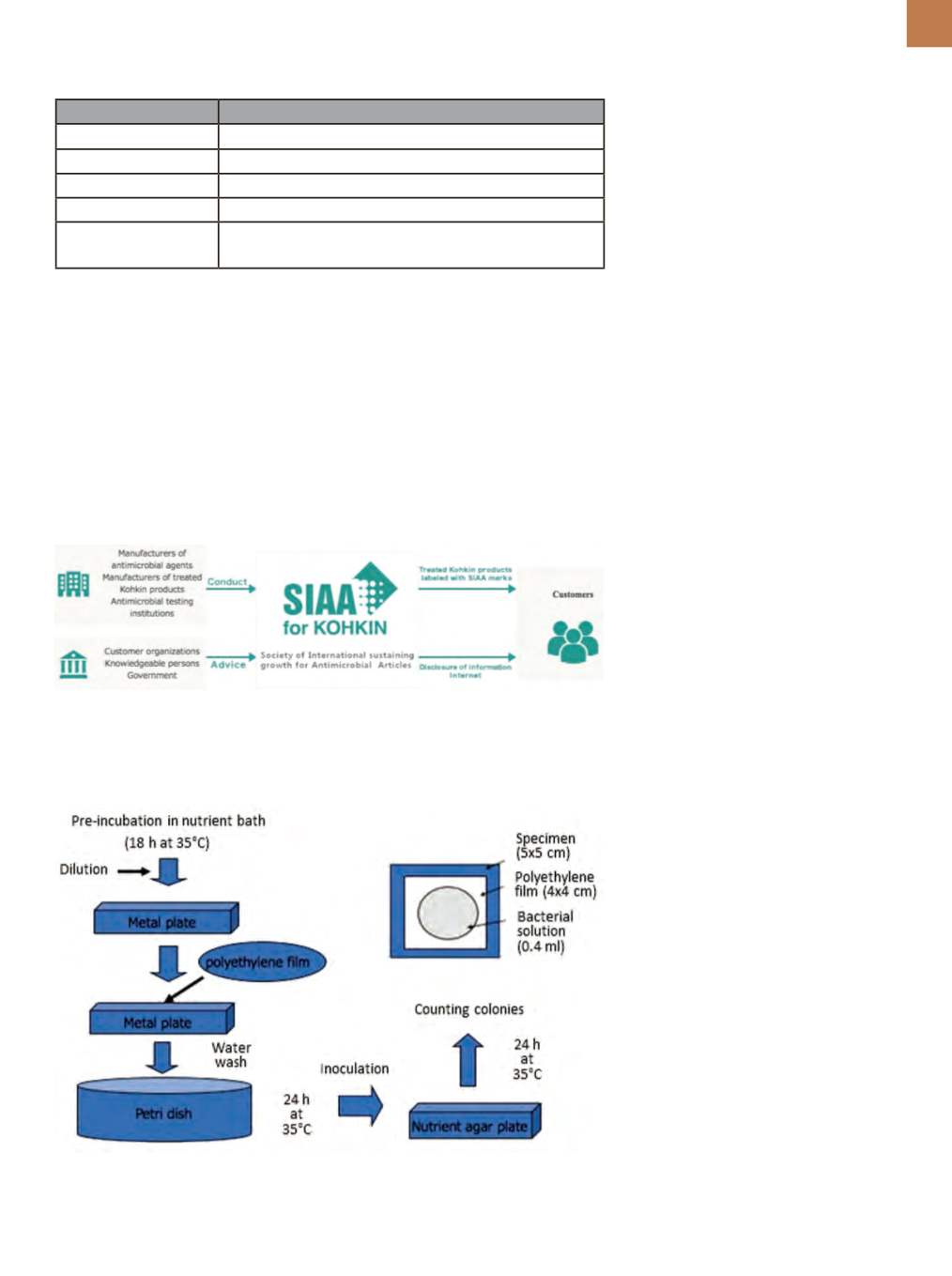
incubate as before. The number of colo-
nies that form per unit area is then used
to quantify the antibacterial properties
of the test material or treatment
[4]
.
BIOFILMS: A STICKY
SITUATION
Although the ISO 22196 test pro-
cedure is useful, and perhaps the only
international standard that measures
the antibacterial effect of materials, it
sheds only a limited amount of light on
the interactions between materials and
bacterial growth. For example, it can-
not fully answer why material surfaces
would lose their Kohkin (antibacterial)
effect over time or why different envi-
ronments would cause the antibacte-
rial properties of a material to change.
Nor can it explain the many surface ef-
fects where bacteria play a dominant
role but do not act alone. Such is the
case with a phenomenon known as
“stickiness” that has plagued mankind
for millennia.
Stickiness is a surface property
stemming from the development of
films due to bacterial activity. The for-
mation and growth of such films is il-
lustrated in Fig. 4. Organic compounds
that inevitably accumulate on mate-
rial surfaces are a target for bacteria,
which make their way to the nutritional
source through a process called che-
motaxis (Fig. 4-1). When the amount
of bacteria in a given region reaches a
certain level (Fig. 4-2), the organisms
simultaneously excrete polysaccharide,
producing a film consisting of bacteria,
exopolymeric substanes (EPS), and
water (Fig. 4-3). Although “biofilms” are
mostly water, the presence of EPS—a
combination of polysaccharides, pro-
teins, lipids, and nucleic acids—makes
them sticky.
This stickiness is behind some of
the most pervasive and costly problems
in industry, including corrosion and the
formation of scale on the inner walls of
pipes. It also has a significant impact on
the cost of healthcare because it makes
bacteria more difficult to control. Bac-
teria encased in a biofilm typically have
to scientifically verify product mar-
keting claims in regard to the Kohkin
effect. SIAA’s role in maintaining the
integrity of Kohkin products is shown
in Fig. 2, while the test procedure for
measuring antibacterial effectiveness is
presented in Fig. 3.
The accepted process for measur-
ing the Kohkin effect, often called the
“film covering method,” is so named
because test samples are coated with
a bacterial solution and covered with
a polymer film. Samples are incubat-
ed for 24 hours at 35°C, then bathed in
sterilized water to create a suspension
that is further diluted by a controlled
amount. To determine the number of
viable bacteria, lab technicians spread
a small amount of the dilution across
the surface of an agar medium, letting it
TABLE 1 – ANTIBACTERIAL EFFECTS AND THEIR DEFINITIONS
[1]
Technical term
Definitio
Kohkin
Inhibition of bacterial growth on product surfaces.
Sterilization
Broad killing of microorganisms.
Pasteurization
Killing of microorganisms such as bacteria and viruses.
Disinfection
Killing/elimination of all pathogenic microorganisms.
Eradication
Elimination of microorganisms from a certain substance or
limited space.
Fig. 2
– SIAA, an industry association, serves as a resource for product manufacturers, testing in-
stitutions, government and consumer organizations, and suppliers of antimicrobial, fungicidal,
and antibacterial agents, helping themmaintain test standards for antimicrobial effectiveness
and classification
[3]
.
Fig. 3
– The ISO 22196 test procedure, shown in schematic form, employs a process called the
“film covering method” that measures the antibacterial or Kohkin effectiveness of material
surfaces and treatments.