



 19 / 50

A D V A N C E D
M A T E R I A L S
&
P R O C E S S E S |
A P R I L
2 0 1 7
1 9
VOC/customer requirements deploy
throughout and establish quality mea-
sures for the requirements mentioned
previously. QFD helps to graphical-
ly clarify objectives, interactions, and
links derived from CPT. It documents
decisions made in early stages of con-
cept selection. QFD lists customer re-
quirements/VOC and determines pri-
oritization. It also identifies functional
product requirements, derives relation-
ships between VOCs and requirements,
calculates priorities for requirements,
and identifies technical correlations to
determine the benchmark (technical re-
quirements in this case).
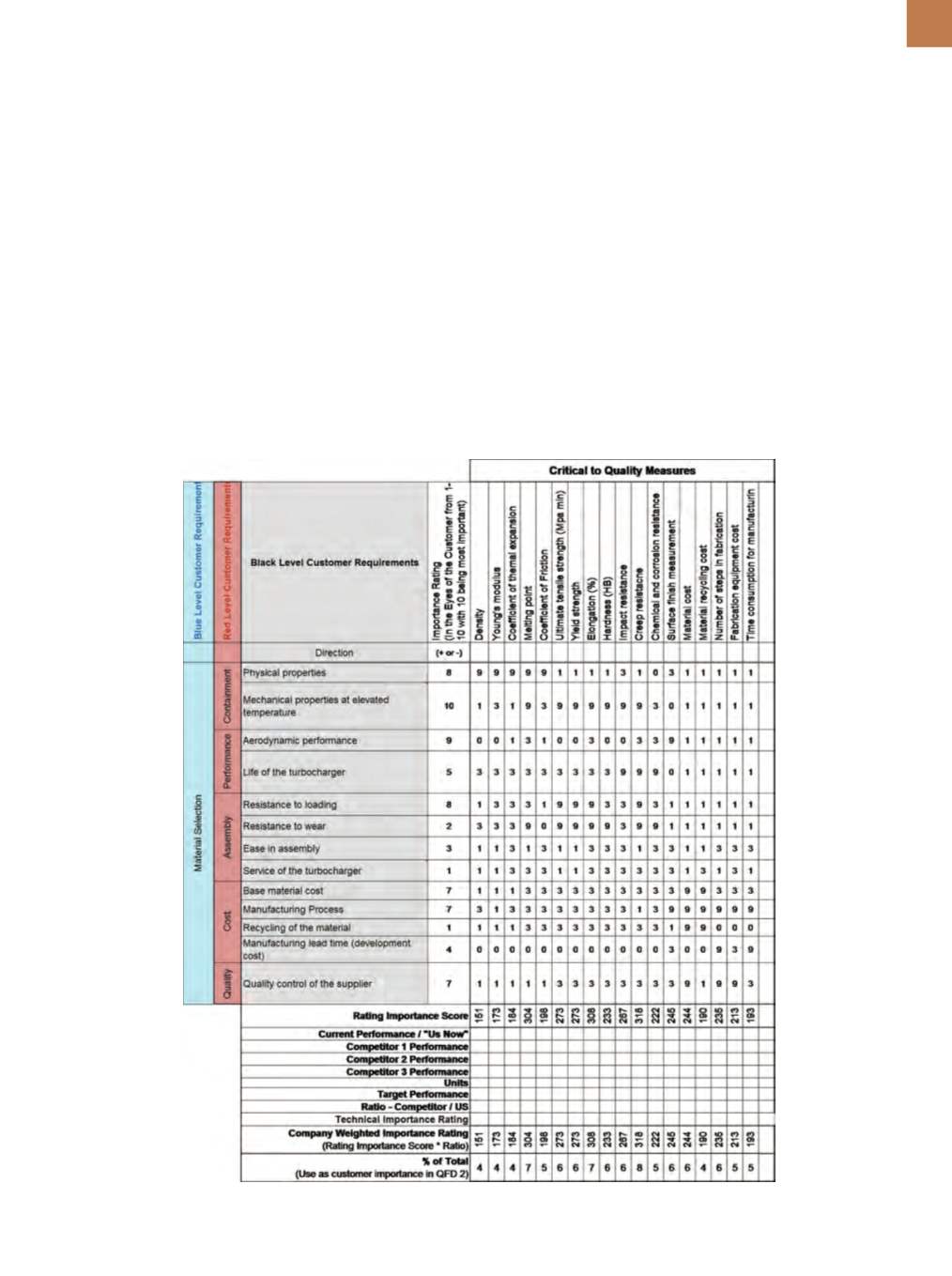
QFD sets targets for functional
product requirements (new materials
considered in this case) based on tech-
nical requirements from the VOC. The
vertical columns on the left of the QFD
(Fig. 3) show various requirement lev-
els. The blue level requirement is the
final goal of material selection. The red
level customer requirements show the
attributes of the application/product/
design. The black level customer re-
quirements show the relevant proper-
ties for the red level requirements, and
importance ratings (between 1 and 10)
are given for the black level require-
ments to formulate a customer’s pri-
ority of properties. The horizontal row
shows “critical to quality” measures,
which are the material’s physical and
mechanical properties rated by 0, 1, 3,
and 9 to create a wide spread of prop-
erties for comparison. Out-of-scope as-
pects of the selection process can be
rated with low scoring, and need not be
evaluated during material comparison
rating.
The QFDs in Figs. 3 and 4 are sep-
arated for ease of viewing in the article.
In general, a QFD is one matrix with all
the details. Based on the QFD matrix,
the benchmark section (Fig. 4) shows a
comparison of materials against tech-
nical requirements or current perfor-
mance. By this stage of the process, all
information about material choices has
been evaluated, material properties
provided by the supplier are verified by
in-house testing, and material concept
Fig. 3 –
Quality function deployment (QFD) template showing various levels of requirements and critical measures.