



 15 / 50

A D V A N C E D
M A T E R I A L S
&
P R O C E S S E S |
A P R I L
2 0 1 7
1 5
SURFACE ENGINEERING
SNEAKY SURFACE
BAMBOOZLES BLOOD
Engineers at Colorado State Uni-
versity (CSU), Fort Collins, developed a
specially grown, superhemophobic ti-
tanium surface that is extremely repel-
lent to blood. The material could form
the basis for medical implants with a
lower risk of blood clotting—a com-
plication that can ultimately lead to
heart attacks, embolisms, or rejection
by the body. Experiments on the titani-
um surfaces showed very low levels of
platelet adhesion, a biological process
that leads to clotting. After analyzing
different textures and chemistries, and
comparing the extent of platelet adhe-
sion and activation, researchers deter-
mined that fluorinated nanotubes offer
the best protection.
Biomedical scientists often use
materials that are “philic” (with affini-
ty) to blood to make them biologically
compatible. In a counterintuitive twist,
the CSU researchers created a surface
so repellent that it can actually trick
blood into believing it’s not even there.
“The reason blood clots is because it
finds cells in the blood to go to and at-
tach,” explains Ketul Popat, associate
professor of mechanical engineering
and biomedical engineering. “If we can
design materials where blood barely
contacts the surface, there is virtually
no chance of clotting.” The researchers
plan to continue examining other clot-
ting factors and eventually test actual
medical devices.
colostate.edu.
BIO-INSPIRED COATING
KEEPS IT CLEAN
Chemists at Johannes Gutenberg
University Mainz (JGU), Germany, de-
veloped a protective coating contain-
ing cerium dioxide nanoparticles to
prevent seawater fouling including the
growth of bacteria, algae, or mollusks
on marine vessels and structures. The
coating is inspired by a chemical de-
fense mechanism in algae, which uses
its own secondary metabolic products
to blockade receptors in other small
marine organisms, preventing the oth-
er organisms from attaching to them
Illustration of the mode of action of
bioinspired underwater paints: Like the
natural enzyme vanadiumbromoperoxi-
dase, ceriumdioxide nanoparticles act as
a catalyst for the formation of hypobro-
mous acid frombromide ions (contained
in sea water) and small amounts of
hydrogen peroxide that are formed upon
exposure to sunlight, yielding reduced
biofilm formation. Courtesy of Tremel
Research Group/JGU.
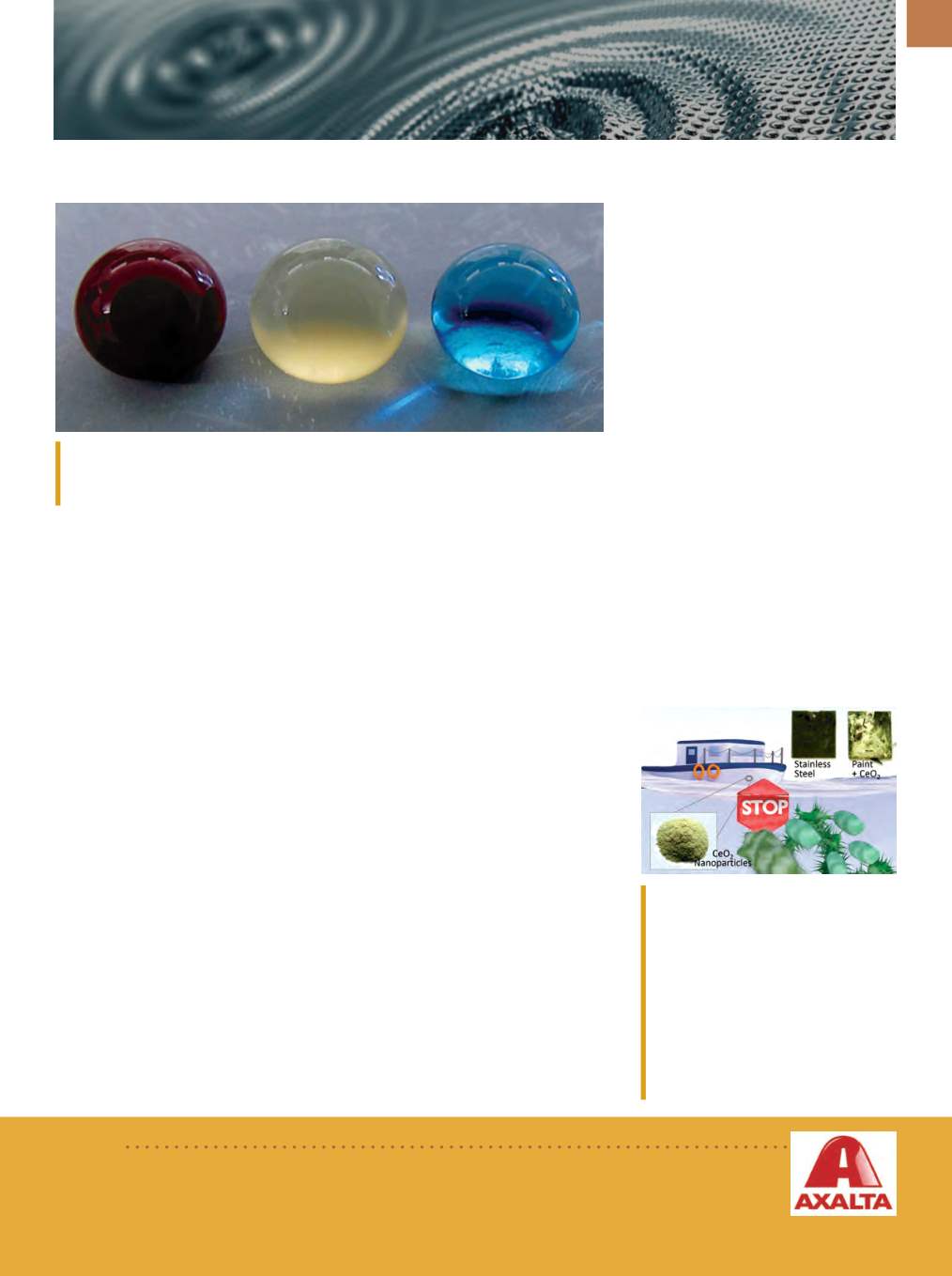
From left, blood, plasma, and water droplets beading on a superomniphobic surface. CSU
researchers created a superhemophobic titanium surface, repellent to blood, with potential
applications in biocompatible medical devices.
by suppressing biofilm creation. The
nontoxic, affordable, algae-inspired
coating could replace currently used
copper-base biocides, which are poi-
sonous, accumulate in the environ-
ment, and lead to resistance.
To test the newcoating, antifouling
paints with and without cerium dioxide
nanoparticles were applied to stainless
steel plates. The painted plates, along
with controls, were attached statically
to a boat bridge with direct exposure
to fresh water. After 52 days, the plates
without cerium dioxide nanoparticles
showed heavy fouling, but the plate
with cerium dioxide coating did not. In
addition to benefitting the shipping in-
dustry, which loses $200 billion a year
to damage associated with fouling,
cerium dioxide coatings could prove
revolutionary anywhere undesirable
biofilms can be found—from catheters
to roof coverings to food packaging.
www.uni-mainz.de/eng.BRIEF
Axalta Coating Systems,
Philadelphia, a global supplier of liquid and powder coatings, will acquire
Century
Industrial Coatings,
Jacksonville, Texas, a manufacturer of high performance industrial coatings for structural
steel, oil and gas, rail cars, and other OEM applications. Terms were not disclosed.
axaltacs.com.