



 14 / 50

A D V A N C E D M A T E R I A L S & P R O C E S S E S | A P R I L 2 0 1 7
1 4
ENERGY TRENDS
GRID STORAGE BATTERY HAS
GOOD CHEMISTRY
Chemists from The University of
Utah, Salt Lake City, and University
of Michigan, Ann Arbor, developed a
charge-storing molecule 1000 times
more stable than current compounds,
paving the way toward a better redox
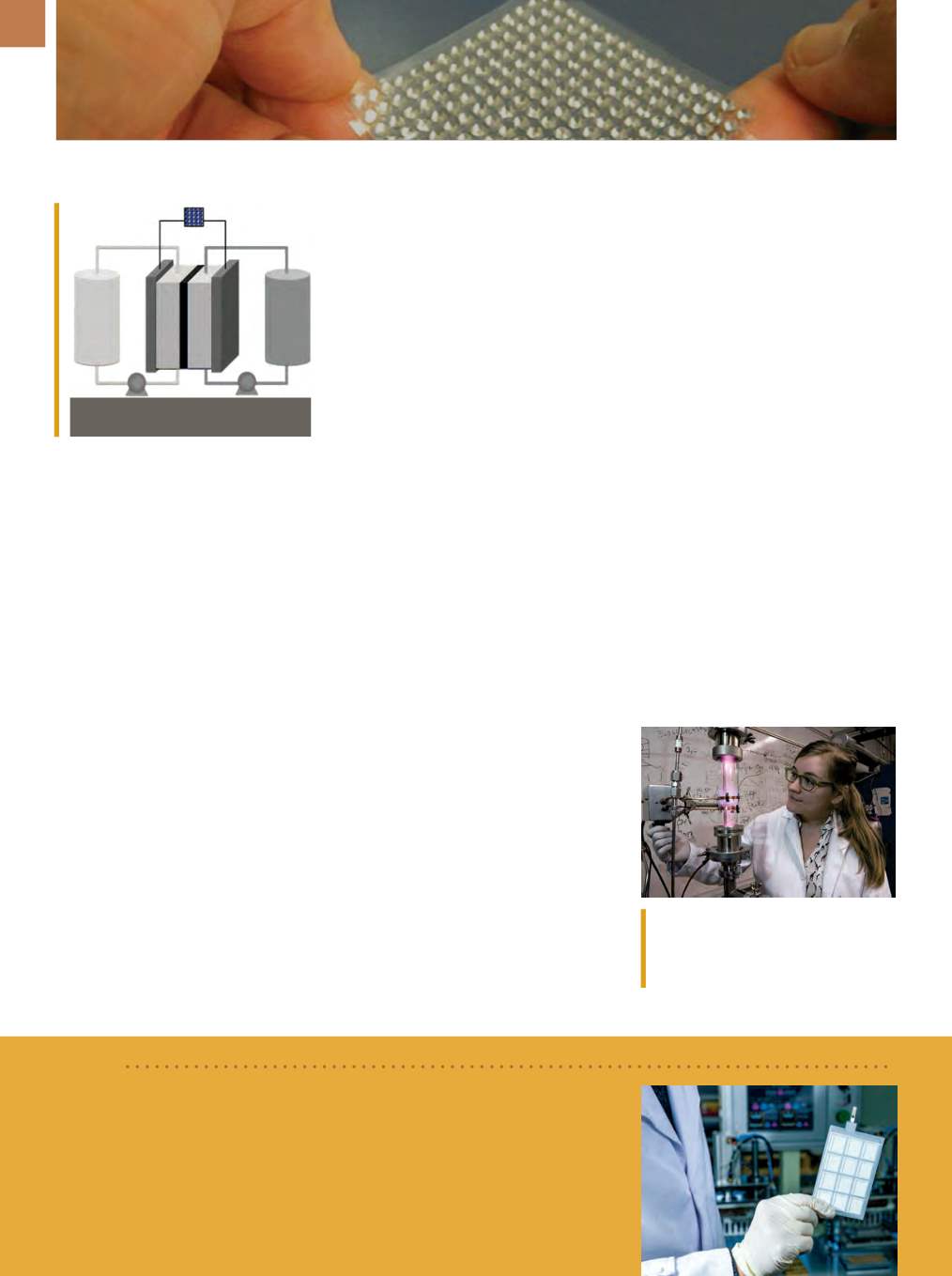
flow battery. In this type of battery,
anolytes and catholytes in solution are
housed in two storage tanks separated
by a central set of inert electrodes. As
the solutions flow past the electrodes,
they store or release charge. Because
molecules that can store more charge
tend to be less stable, choosing com-
pounds for these batteries has been a
challenge. Current redox flow batter-
ies incorporate costly—and potentially
toxic—vanadium.
To design and test other potential
electrolyte molecules, the researchers
enlisted a computational method com-
mon in pharmaceutical development
that uses the structural features of a
molecule to predict its properties. They
found that a candidate compound de-
composed when two molecules inter-
acted with each other, but by tuning a
factor describing the height of a certain
molecular component, they could place
a “deflector shield” around the can-
didate molecule: This shield prevents
the interaction and increases stability.
The team’s most promising anolyte is
based on the organic molecule pyridin-
ium. While other compounds exhibit
longer half-lives, this anolyte provides
the best combination of stability and
redox potential, which is directly re-
lated to energy storage capability. The
team is working to identify a catholyte
to pair with this and future molecules.
utah.edu, umich.edu.CLEAR IMPROVEMENT IN
SOLAR CELL WINDOWS
Researchers at the University of
Minnesota, Minneapolis, and Universi-
ty of Milano-Bicocca, Italy, developed a
new method for creating photovoltaic
windows using silicon. Instead of typi-
cal substances like indium, lead, or cad-
mium—which are either rare or poten-
tially toxic—the team embedded silicon
nanoparticles into luminescent solar
concentrators (LSCs). LSCs on a window
trap the useful frequencies of sunlight
and concentrate them to the edges
where solar cells hidden in the window
frame capture the energy. While silicon
BRIEF
Ulsan National Institute of Science and Technology (UNIST),
South Korea, secured
$5 billion in research funding over three years from
Korea Electric Power Corp.
and
Korea East-West Power Co. Ltd.
to develop cost-efficient, high-stability batteries that
store and produce electricity using seawater.
www.unist.ac.kr.
Samantha Ehrenberg uses a plasma
reactor to create silicon nanoparticles for
use in luminescent solar concentrators.
Courtesy of Patrick O’Leary.
is abundant in the environment and
nontoxic, it does not emit light in its
conventional bulk form. The research-
ers solved this problem by shrinking
the silicon crystals to a few nanome-
ters. At this size, silicon’s properties
change and it becomes an efficient light
emitter that does not reabsorb its own
luminescence.
The silicon nanoparticles—each
containing fewer than 2000 atoms—are
produced using a plasma reactor and
formed into a powder, which is then
used to make an ink-like solution. The
solution is embedded in a polymer,
which can be turned into a sheet of flex-
ible plastic material or used as a thin
film surface coating. The silicon par-
ticles are nearly perfectly compatible
with the industrial process for produc-
ing the polymer LSCs, which can cap-
ture more than 5% of the sun’s energy
at unprecedented low costs.
twin-cities.
umn.edu,
www.unimib.it.Seawater battery pack developed at UNIST.
Diagram of a redox flow battery.
Courtesy of Sharmila Samaroo.