


 17 / 50

A D V A N C E D
M A T E R I A L S
&
P R O C E S S E S |
A P R I L
2 0 1 7
1 7
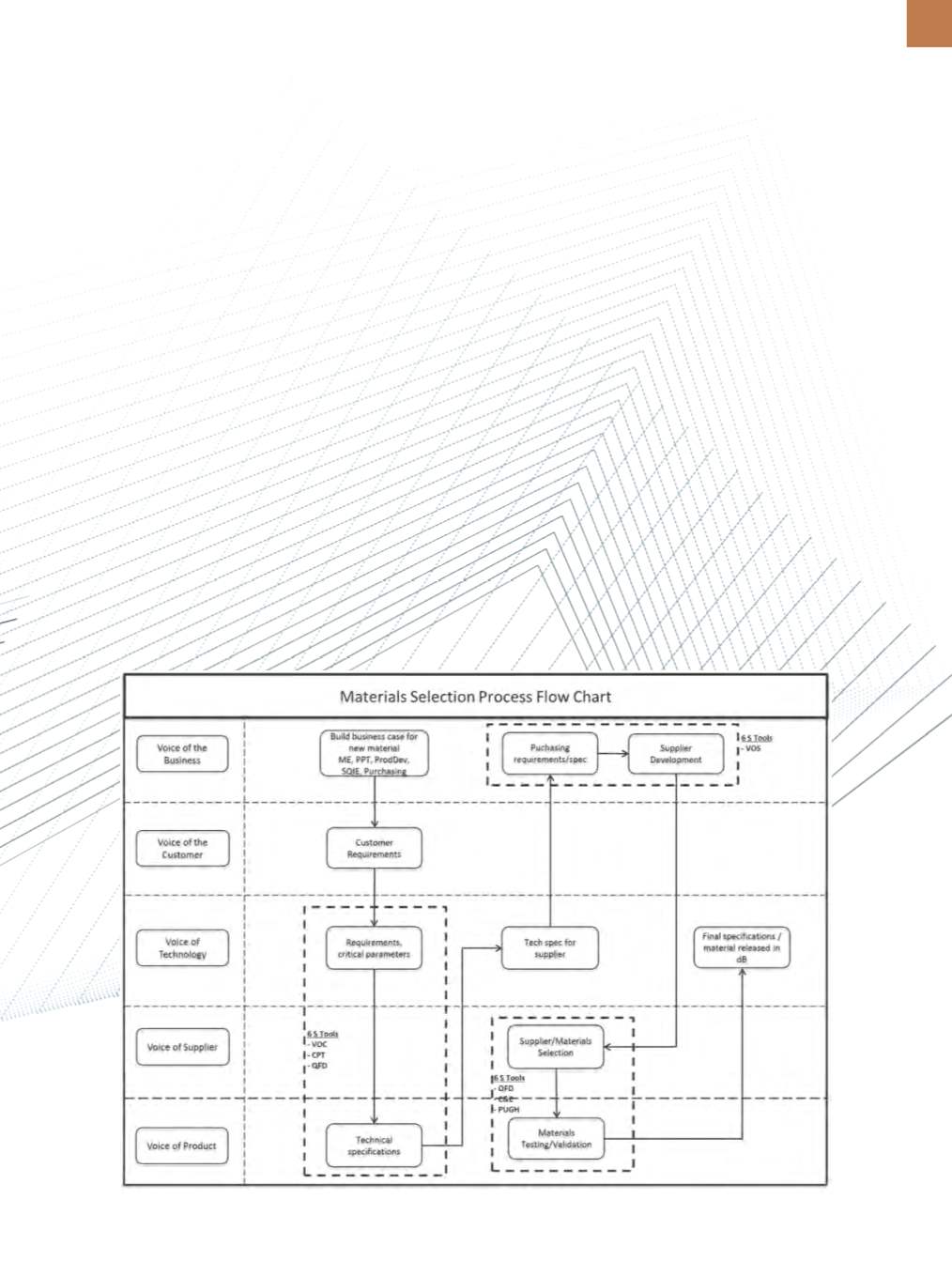
Fig. 1 −
Selection process template for materials.
K
ey factors to consider when select-
ing a new material for an applica-
tion include a clear understanding
of component and application require-
ments and component design aspects.
This requires input from customer appli-
cation experts and designers, which en-
hances the success of thematerials selec-
tion process.
MATERIALS SELECTION
PROCESS TEMPLATE
A template for the materials selec-
tion process is created by condensing
the overall process. The template is a
high-level flow chart designed to align
with business goals and depict the in-
volvement of different areas of the orga-
nization. It also identifies places where
statistical tools are used in the selection
process and exactly when each tool can
be used. Figure 1 shows an example of a
materials selection process flow chart.
VOICE OF CUSTOMER (VOC)
The VOC exercise is conducted to
understand key application and com
ponent requirements. The first step is
to create a customer selection matrix
that represents all organizational func-
tions related to producing the compo-
nent. Customer selection segments/
functions include mechanical, service,
and product engineering; quality con-
trol; manufacturing; reliability; market-
ing and sales, purchasing; and supplier
quality based on organization type and
size.
After creating the customer selec-
tion matrix, a questionnaire related to
component details is developed for use
in interviewing each stakeholder (VOC
interview). Interviews are conducted to
obtain critical information and require-
ments from each organizational func-
tion. VOC addresses:
•• Implications for customers
•• Limitations associated with materi-
al search or change
•• Customer needs and requirements
•• Properties (e.g., mechanical) and
service temperature capabilities
•• Production limits such as design,
assembly, and component manu-
facturing
•• Durability requirements such as
containment and component life
•• Physical requirements such as
weight, appearance, surface finish,
and material consistency
•• Current product strengths and
weaknesses
•• Product cost and performance
tradeoffs
This information forms the techni-
cal requirements for the new material
search initiative
[1]
. Interview responses
are compiled and clarified to create key
material requirements, which serve as
input for a critical parameter tree (CPT).
The voice of business is understood at
this stage.
Key requirements derived from
the VOC are translated into the CPT
[5]
,
which identifies application require-
ments and outlines measurable prop-
erties that are important to the ma-
terial selection. CPT branches are
straight and interact with each other.
These interacting branches between
critical measures provide key input for
the materials selection requirements
and technical specifications. Figure 2
shows a CPT used to select a material