


 13 / 50

A D V A N C E D
M A T E R I A L S
&
P R O C E S S E S |
A P R I L
2 0 1 7
1 3
HIGH-ENERGY HEALING
Scientists from Oak Ridge Nation-
al Laboratory, Tenn., and the Univer-
sity of Tennessee, Knoxville, discov-
ered that blasting silicon carbide with
high-energy ions did not damage the
material, but repaired preexisting de-
fects in its atomic structure instead.
The bombardment caused local heat-
ing along the ion path, resulting in a
significant reduction in structural dis-
order at the microscopic and atomic
scales. Typically, exposure of a material
to energetic particles, such as ions or
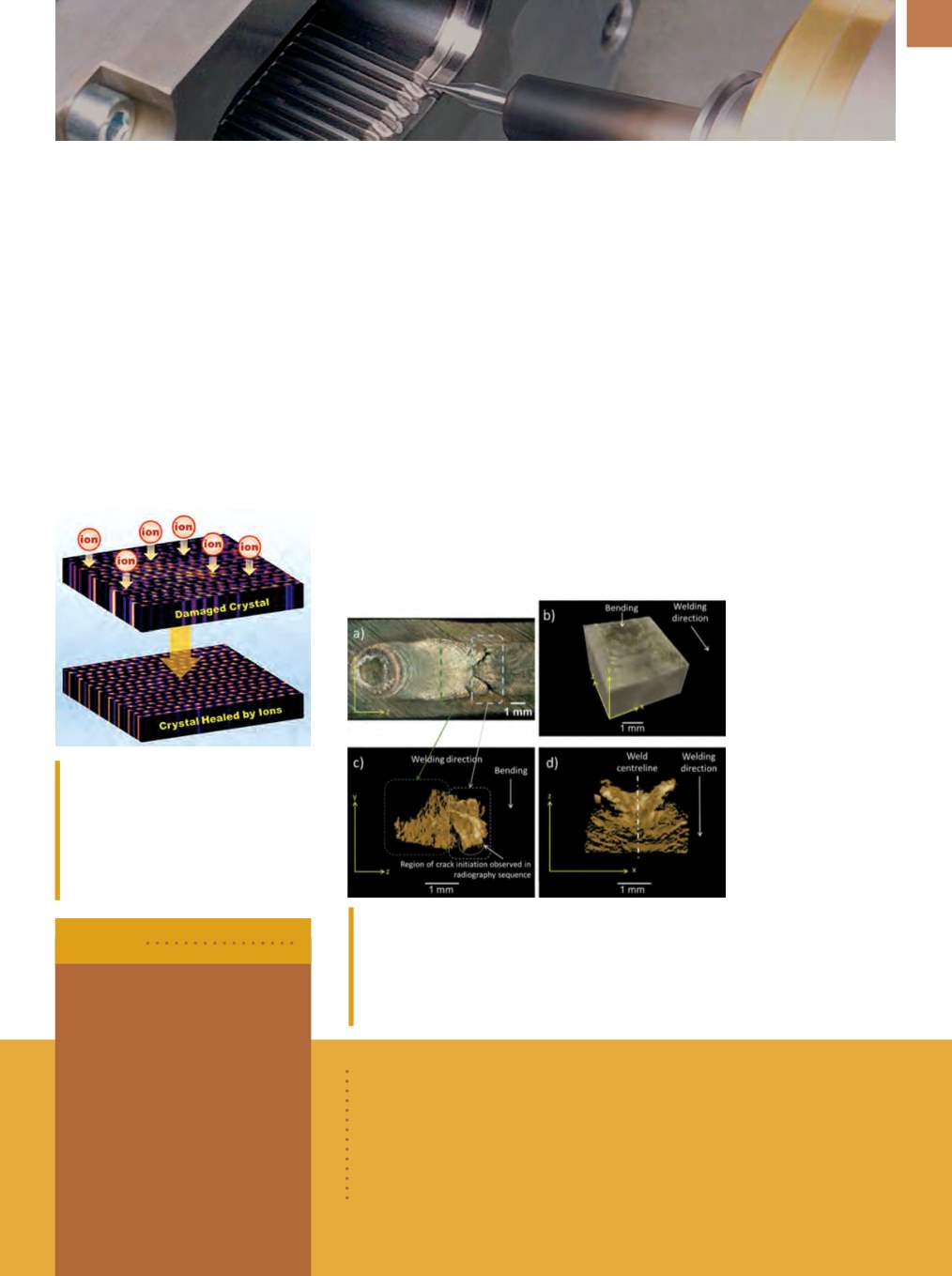
In this projected electron microscopy
image, the previously damaged crystal
(smeared spots in top slab) is bombarded
with high-energy ions. Surprisingly, this
process restores structural order (ordered
bright spots in bottom slab) by annealing.
Courtesy of ORNL.
neutrons, creates defects as the incom-
ing ions penetrate the material and
knock its atoms out of position in the
crystal structure. In this case, however,
experimentation and atomistic simula-
tions revealed that incoming high-ener-
gy ions lost energy not by colliding with
the atoms themselves, but by trans-
ferring energy to the electrons in the
atomic structure.
Harnessing the thermally acti-
vated healing process could lead to in-
operando repair of radiation damage
in silicon carbide components used in
nuclear and space applications. The
discovery could also be applied to de-
fects created by implantation doping
during the fabrication of advanced
electronic materials. Finally, the fun-
damental understanding of this energy
transfer could contribute to improved
performance predictions for materials
exposed to high-energy ions during the
manufacture of electronic devices and
engineered nanostructures.
ornl.gov, utk.edu.WELDING FAILURE PROCESS
OBSERVED
Researchers at the University of
Leicester, UK, discovered the process
by which solidification cracking occurs
during steel welding. Using a synchro-
tron x-ray beamline at the European
Synchrotron Radiation Facility, the sci-
entists witnessed that cracks grow by
linking microporosities in the meshing
zone in the solidifying
weld pool. It is the first
time solidification crack
formationwas observed
in real time.
“So l i d i f i ca t i on/
hot cracking is the most
common failure mode
during metal process-
ing—such as welding,
casting, and metal ad-
ditive manufacturing,”
explains
engineering
professor Hong Dong.
Insight into the pro-
cess could lead to
improvements in the
shipbuilding, pipeline,
automotive, aerospace,
defense, and construc-
tion industries
. le.ac.uk.The Industry Development Board
of the
Metal Powder Industries
Federation,
Princeton, N.J., rede-
signed the PickPM.com website
to showcase technical data, ap-
plication case studies, and white
papers, along with additional
resources. The site presents a
case for why component engi-
neers should opt for powder met-
allurgy over other metal forming
solutions.
mpif.org.
BRIEFS
Air Products,
Allentown, Pa., installed an advanced nitrogen supply
sytem at
Boeing’s
new 777X Composite Wing Center in Everett, Wash., for
the world’s largest autoclave. The system includes three 15,000-gallon
liquid tanks and a steam sparged water bath vaporization system used
to create the inert atmosphere and rapid pressure necessary to form and
cure carbon fiber composite wings for the new 777X commercial jetliners.
This is the third major autoclave project Air Products has completed with
Boeing in the past three years.
airproducts.com/aerospace,
boeing.com.
PROCESS TECHNOLOGY
3D tomographic reconstruction and characterization of weld
solidification cracks, showing: (a) macrograph of the sample
weld containing solidification cracks, (b) 3D reconstruction of
the crack containing volume, (c) Y-Z plane 2D view of the solid-
ification crack network, and (d) weld centerline and welding
direction. Courtesy of University of Leicester.