


 21 / 62

A D V A N C E D
M A T E R I A L S
&
P R O C E S S E S | F E B R U A R Y
2 0 1 6
2 1
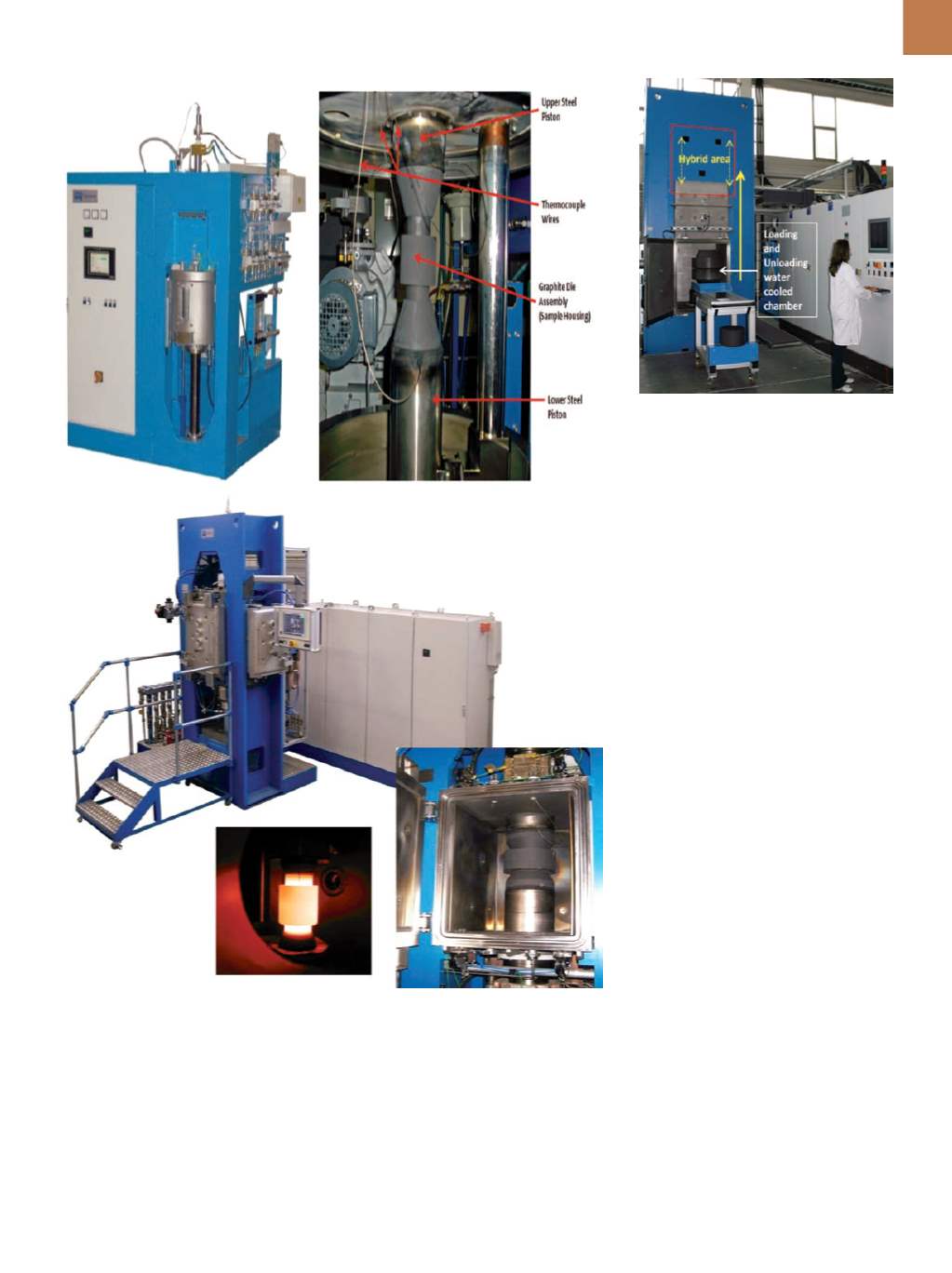
Fig. 2 —
Field-assisted sintering units:
(a) 25 ton, (b) 250 ton, (c) hybrid 320 ton.
(a)
(b)
(c)
of a sub-micron grain microstructure;
achieving 100% density; and energy
savings of 60-70%. Applications range
from hypersonic vehicles and optical
mirrors to cutting tools and aerospace
components. The technology enables
engineering of new materials and
design and development of prototype
components with features not econom-
ically feasible using conventional man-
ufacturing methods.
THERMALLY MANAGED
COMPONENTS
Space exploration is one endeav-
or where thermal management is of
critical importance. For example, NASA
is seeking thrusters with double the
thrust-to-weight ratio using advanced
propulsion techniques such as the Nu-
clear Thermal Propulsion (NTP) system
shown in Fig. 3. Requirements for the
NTP rocket nozzle include high thermal
conductivity, good mechanical proper-
ties, and light weight.
The thermal conductivity of dia-
mond is three to six times higher than
that of copper, whereas thermally
grown pyrolitic (TGP) graphite is four
times higher (in plane). Similarly,
thermal conductivities of multiwall
carbon nanotubes (MWCNT) and sin-
gle wall carbon nanotubes (SWCNT)
are about 10 times and 20 times high-
er than copper, respectively (Fig. 4).
Therefore, blending copper powder
with diamond, MWCNT, or SWCNT
significantly enhances the thermal
conductivity of thermally managed
components.
It is equally important that the in-
terface between the Cu matrix and sec-
ondary phase (e.g., diamond, MWCNT,
or SWCNT) is adequate for heat transfer.
Electrons dominate heat conduction in
copper, whereas phonons dominate in
second-phase materials including dia-
mond. Therefore, for good heat conduc-
tivity inmetal matrix composites (MMCs),
the energy heat transfer must coordinate
between electrons and phonons.
Other challenges in dealing with
copper and diamond are the large mis-
match in their coefficient of thermal
expansion (CTE) and no chemical bond-
ing, which results in a poor interface and