


 26 / 62

A D V A N C E D M A T E R I A L S & P R O C E S S E S | F E B R U A R Y 2 0 1 6
2 6
METALLURGY LANE
Metallurgy Lane, authored by ASM life member Charles R. Simcoe, is a continuing series dedicated to the early history of the U.S.
metals and materials industries along with key milestones and developments.
PIONEERS IN METALS RESEARCH—PART V
SAMUEL LESLIE HOYT WAS ONE OF THE EARLIEST METALLURGISTS TO RECEIVE HIS ADVANCED TRAINING IN EUROPE.
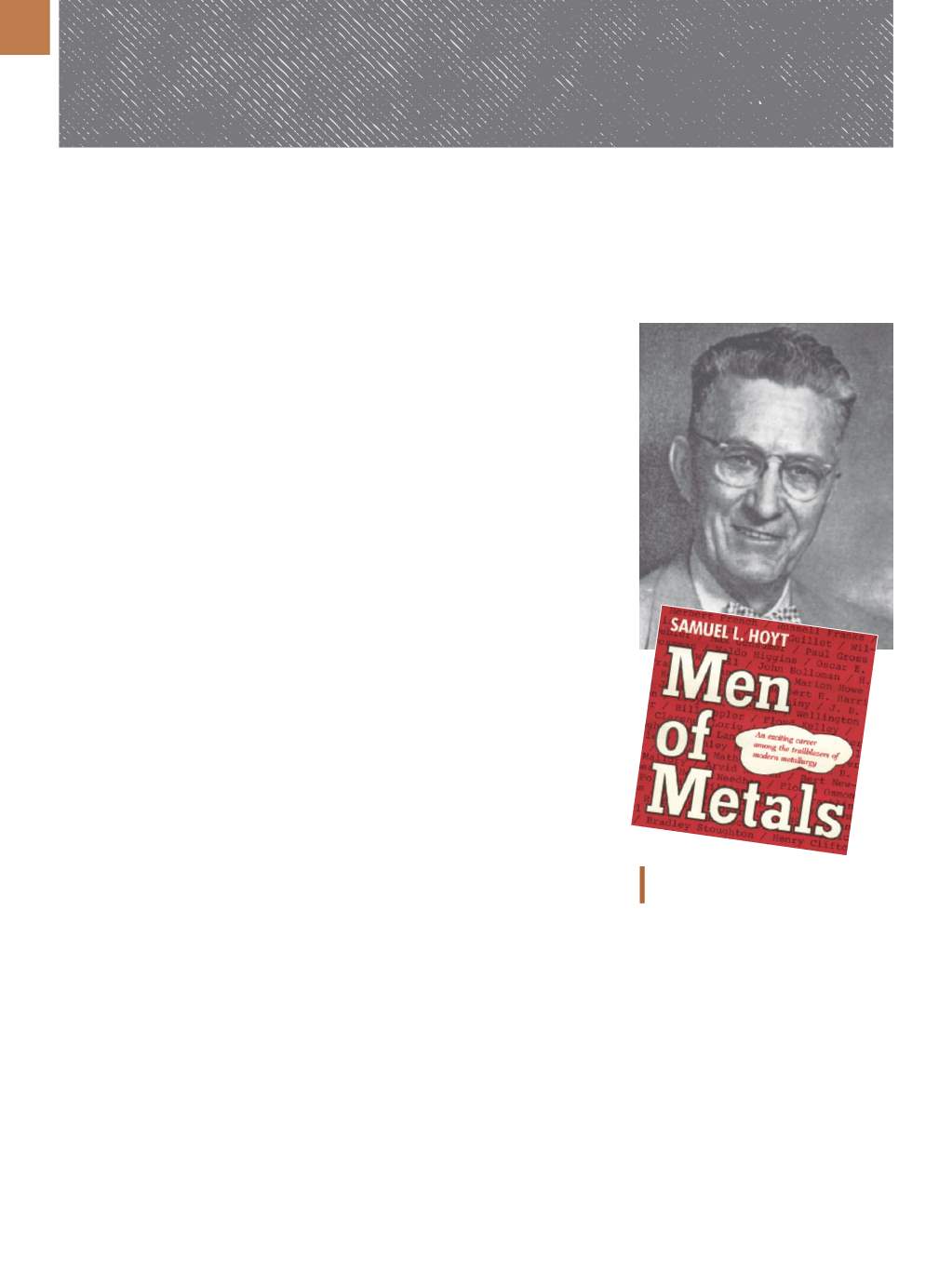
Samuel Leslie Hoyt and his book,
“Men of Metals.”
S
amuel Leslie Hoyt was a native of
Minnesota and graduated from
the University of Minnesota in
1909. His main interest at that time was
in geology, so he enrolled at Columbia
School of Mines to earn his graduate de-
gree. Here he was advised to take Henry
Marion Howe’s course in metallurgy and
metallography taught by William Camp-
bell under Howe. As with several other
students exposed tometallography, Hoyt
dropped geology in favor of a degree in
metallurgy. After two years at Columbia,
he enrolled in the Royal Institute of Tech-
nology at Charlottenburg, Germany, to
pursue advanced studies under some of
the best metallurgy professors in Europe.
His classmates included Paul Dyer Meri-
ca and several other Americans. He took
a field trip to visit steel mills with Merica
and a new acquaintance, Guillaume (Wil-
liam) Kroll, the inventor of a process for
making titanium.
EARLY CAREER
Hoyt returned to Columbia in 1913
where he received his doctorate in met-
allurgy. He then began his career as an
instructor at his old school, the Universi-
ty of Minnesota, teachingmetallography
and the new field of phase diagrams.
After six years, Zay Jeffries recruited
Hoyt to come to the GE Lamp Division
in Cleveland where he worked with Ed-
gar Bain who had joined GE at the same
time. During the next two years, Hoyt
conducted research on problems relat-
ed to manufacturing tungsten wire for
lamps. In 1921, he transferred to the GE
Central Research Laboratories at Sche-
nectady, N.Y., where he worked under
Willis Whitney, the lab’s first research
director. Here he had contact with Ar-
thur Compton of atomic bomb fame,
who had married a classmate of Hoyt’s.
Compton won the Nobel Prize in Phys-
ics in 1927. Hoyt also worked with Irving
Langmuir, who graduated from Colum-
bia School of Mines with a metallurgical
engineering degree and later won a No-
bel Prize in Chemistry.
EUROPEAN TRAVELS
In 1925, GE sent Hoyt to visit Eu-
rope to study developments in tung-
sten and lamp bulb manufacturing. He
used the opportunity to visit teachers
and classmates from his time at the
Royal Institute a decade earlier. He
discussed advances in precipitation
hardened aluminum with his favorite
teacher, Professor Guerther, who was
working on alloys in the aluminum-zinc
systemwith remarkable success at high
strength. Alloys in this system would
become the major high strength alloys
in the U.S. after WWII.
Hoyt also visited a classmate who
had been working on tungsten carbide
cemented with cobalt, which was used
in Germany as a cutting tool superior to
high-speed steel. Hoyt brought samples
back to GE and along with Zay Jeffries
helped convince GE to go into produc-
tion of tungsten carbide tools in a divi-
sion called Carboloy.
After a decade of working in the
most advanced research laboratory
in the U.S., Hoyt accepted a position
at A.O. Smith, a manufacturer of steel
pipelines, oil field equipment, and
chemical pressure vessels. Working
with steel vendors, he became ac-
quainted with metallurgists throughout
the industry. He was visited by some of
his classmates from Europe and by men
he had visited in England. Kroll also
came to see him on his trip to interest
U.S. companies in his process for mak-
ing titanium.
BATTELLE YEARS
In 1939, Hoyt accepted a position
as consultant to the president of Bat-
telle Memorial Institute in Columbus,
Ohio, the largest metals research lab-
oratory in the U.S. As a nonprofit orga-
nization, Battelle did contract research
for industry and the government. At
that time, many companies lacked the
facilities and staff to conduct their own
research. Hoyt broadened Battelle’s ac-
tivities by using his experience in weld-
ing, steel quality, and brittle fracture.
This was especially important when
all-welded ships began to rupture at