



 22 / 62

A D V A N C E D M A T E R I A L S & P R O C E S S E S | F E B R U A R Y 2 0 1 6
2 2
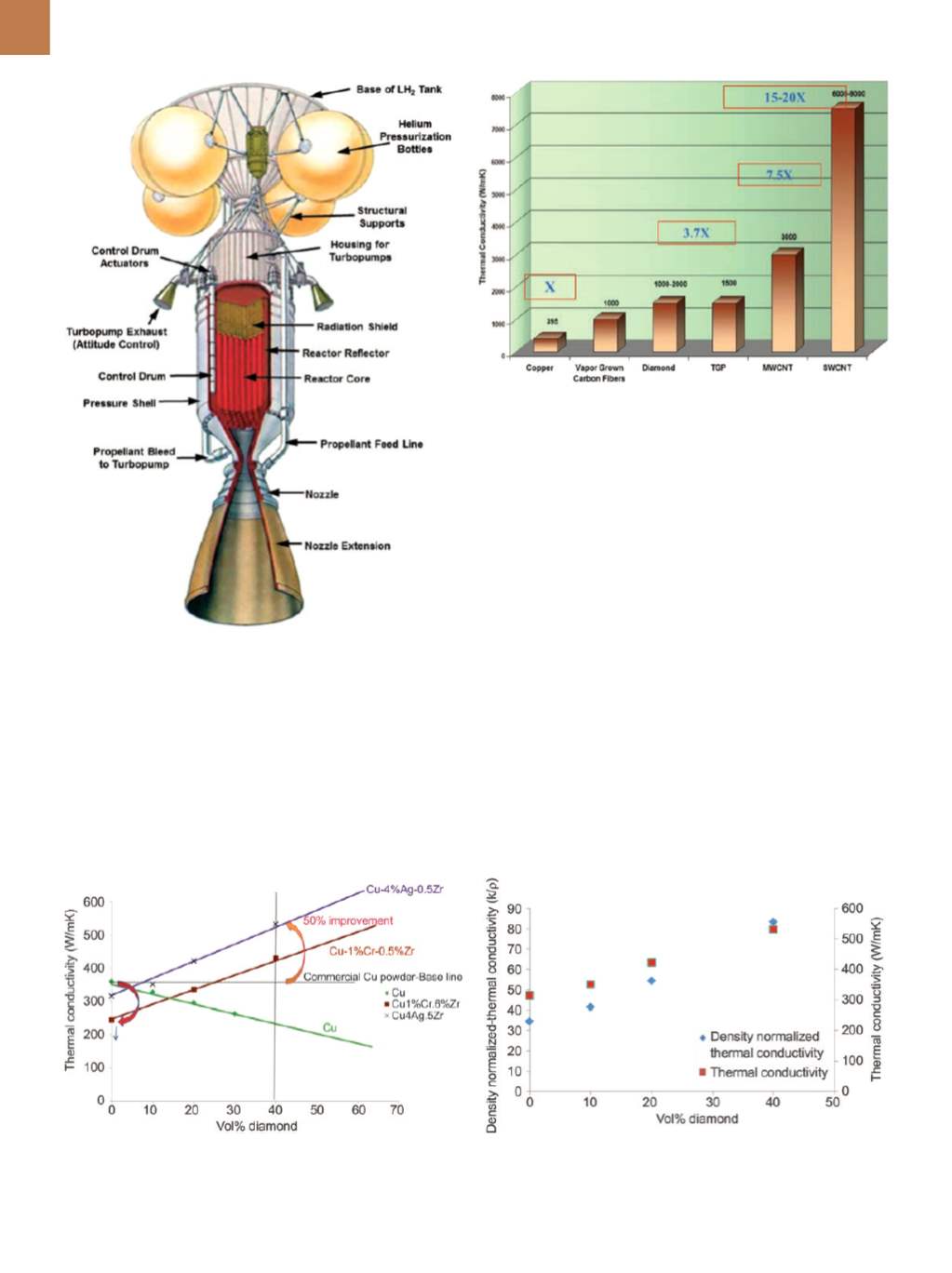
Fig. 3 —
Schematic diagram of advanced
nuclear thermal propulsion (NTP) system.
Fig. 4 —
Comparative thermal conductivities of Cu, diamond, MWCNT,
and SWCNT.
Fig. 5 —
Thermal conductivity enhancement in Cu-Ag-Zr-D
(NARloy-Z-D) composite.
Fig. 6 —
Thermal conductivity of NARloy-Z-D composites at room
temperature. Both thermal conductivity (
λ
) and density normalized
(
λ
/
ρ
) are also shown.
reduced thermal conductivity. Figure 5
shows that the thermal conductivity of
Cu decreases as the volume fraction
of diamond increases. This led to the
development of a copper alloy with
small volume fraction additions of
carbide-forming elements such as Zr,
Ti, and Cr, which form a
thin carbide layer between
diamond and copper during
sintering. This enhances
the interface, resulting in
improved thermal conduc-
tivity as shown in Fig. 6. Adding ap-
proximately 40 vol% of industrial dia-
mond (50 µm) to copper alloy NARloy-Z
(Cu-4%Ag-0.5%Zr) used in space rock-
et-engine applications increases ther-
mal conductivity by roughly 70% over
base line. The composite structure is
about 30% lighter than the NARloy-Z
material and, therefore, the density-
normalized thermal conductivity is
140% better. High thermal conductivity
enables increased turbopump power
and higher chamber pressure, resulting
in improved thrust and specific im-
pulse (Isp).
The manufacture of a near-net-
shape space rocket nozzle made of
NARloy-Z with 40-60 vol% diamond
composite is under development.
Figure 7 shows a composite ring made
of this material, which indicates the
uniform distribution of diamond in the
NARloy matrix.
NET-SHAPE TITANIUM
ALLOY COMPONENTS
Increasing application of titanium
and its alloys versus aluminum and
steel in the aerospace industry is due
to titanium’s lower density and higher
strength. In addition, the superior corro-
sion resistance of titanium and its alloys