


 24 / 62

A D V A N C E D M A T E R I A L S & P R O C E S S E S | F E B R U A R Y 2 0 1 6
2 4
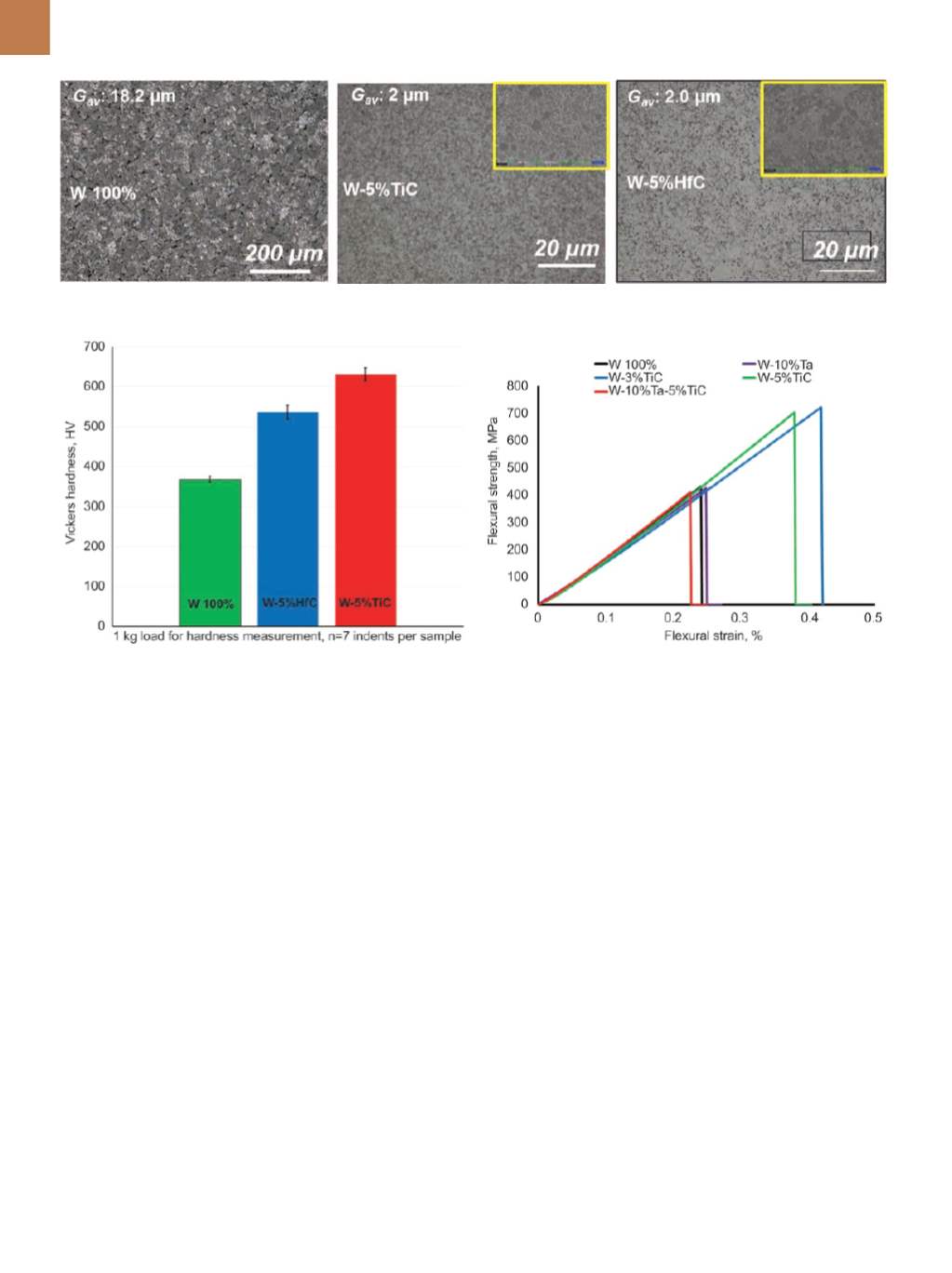
Fig. 11 —
Cross-section optical micrographs show reduction in sintering temperature and grain size, and improvement in density with increasing
volume fraction of inhibitor (TiC).
Fig. 12 —
Influence of TiC and HfC inhibitors on (a) hardness and (b) flexural strength of W and W-Ta alloy materials, respectively.
• Adding 1.6 wt% B to Ti 6-4 reduces
grain size from 600 to 100 µm, and
the material is 16% stronger than
rolled Ti 6-4 sheet
• 15% increase in hardness
• Faster processing cycle (less than
20 minutes compared with conven-
tional methods)
Further, significant weight savings can
be achieved by replacing conventional
Ti 6-4 alloy with Ti-6Al-4V-B alloy.
NET-SHAPE REFRACTORY
MATERIAL COMPONENTS
Rocket nozzles used in space ap-
plications are often made of W and
Ta-base refractory alloy materials.
Components are manufactured using
hot pressing followed by wire electri-
cal discharge machining (EDM). During
hot pressing, there is significant grain
growth, which is undesirable for high
(a)
(b)
grain growth inhibitors including TiC,
ZrC, WC, and HfC. Figure 11 shows that
grain size is significantly reduced from
22 to <2 µm. Sintering temperature
was also reduced for W from 2200° to
1800°C by adding up to 10 vol% TiC
with improved density (Fig. 11 insets).
In this study, TiC served as an inhibitor
and contributed to improved mechan-
ical properties (hardness and flexural
strength of W and Ta) associated with
uniform distribution of fine secondary
phases in the matrix and solid solution
strengthening (Fig. 12).
~AM&P
For more information:
Jogender
Singh is director, FAST-Center of Excel-
lence, Department of Materials Science
and Engineering, Pennsylvania State
University, University Park, PA 16801,
814.863.9898,
jxs46@psu.edu,
www. psu.edu.
temperature structural applications.
The vacuum plasma spray process is
also being explored to make net-shape
rocket nozzles using a graphite man-
drel followed by hot isostatic pressing
(HIP). Problems associated with HIP
include porosity at grain boundaries
that cannot be removed completely by
the process, which has a detrimental
effect on performance. In addition, vac-
uum plasma spray plus HIP results in a
long process cycle, large grain size, and
a high rejection rate associated with
dimensional changes. Approaches to
overcome these problems include de-
velopment of W and Ta alloys with mini-
mumgrain growth during sintering, and
manufacturing net-shape components
using FAST.
Significant progress has been
made in reducing grain growth during
sintering of W and Ta alloys by using