



 27 / 62

A D V A N C E D
M A T E R I A L S
&
P R O C E S S E S | F E B R U A R Y
2 0 1 6
2 7
low temperatures duringWWII. Through
his contacts at Battelle, Hoyt became
acquainted with many industrial metal-
lurgists, corporate executives, and gov-
ernment agencies.
At the end of WWII, army officials
asked Hoyt to help explore the metals
developments in Germany and occu-
pied areas of Europe. With his knowl-
edge of German, university contacts,
and his trip for GE in 1925, he was well
suited for the job. He saw the devas-
tation of European cities and learned
that many laboratories he had visited
were moved to temporary sites after
their original locations were destroyed
during bombing raids.
Upon returning to Battelle, he
worked on the institute’s plans for ex-
panding into Europe. Two sites were
selected for building laboratories, Frank-
furt, Germany, and Geneva, Switzerland.
Hoyt traveled to Europe again in 1952 to
survey themarket in steel researchwhere
he discovered many companies had
problems and programs beyond the ca-
pacity of their own staff. He found enough
potential research needs that Battelle
went forward with its European plans.
Hoyt worked with Zay Jeffries in
1951 on the World Metallurgical Con-
gress organized by ASM. He frequently
saw Jeffries during his time at Battelle,
as Jeffries was a trustee on the Board
of Directors. It had been 30 years since
they worked together at GE’s tungsten
wire plant in Cleveland.
CONSULTING WORK
Hoyt retired in 1953 and started
a consulting practice. The country was
just becoming aware of the serious
problem of brittle fractures, which de-
stroyed many structures, especially
ones constructed by welding. Once a
crack started, it could run to destruc-
tion as it did with all-welded ships. Add-
ing to the problem was the knowledge
that hydrogen in steel and in welds
could produce cracks large enough to
cause brittle failures. Most of his work
involved large structures, such as dam
gates and penstocks in hydroelectric
power plants, where welding of heavy
plate was both a steel quality issue and
a welding problem. Hoyt later became
involved in brittle failures in rocket
motor cases. These failures and the re-
sulting destruction of intercontinental
ballistic missiles upon launching set
back the U.S. defense effort by sever-
al years. It was brought under control
after research on steel cleanliness, im-
proved welding techniques, new tools
for nondestructive testing to locate
defects in the interior of metals, and a
new approach to fracture toughness
technology.
In 1959, Hoyt was again recruited
to travel to Europe for his fourth visit
since college. He represented NATO in
studying the European metals industry.
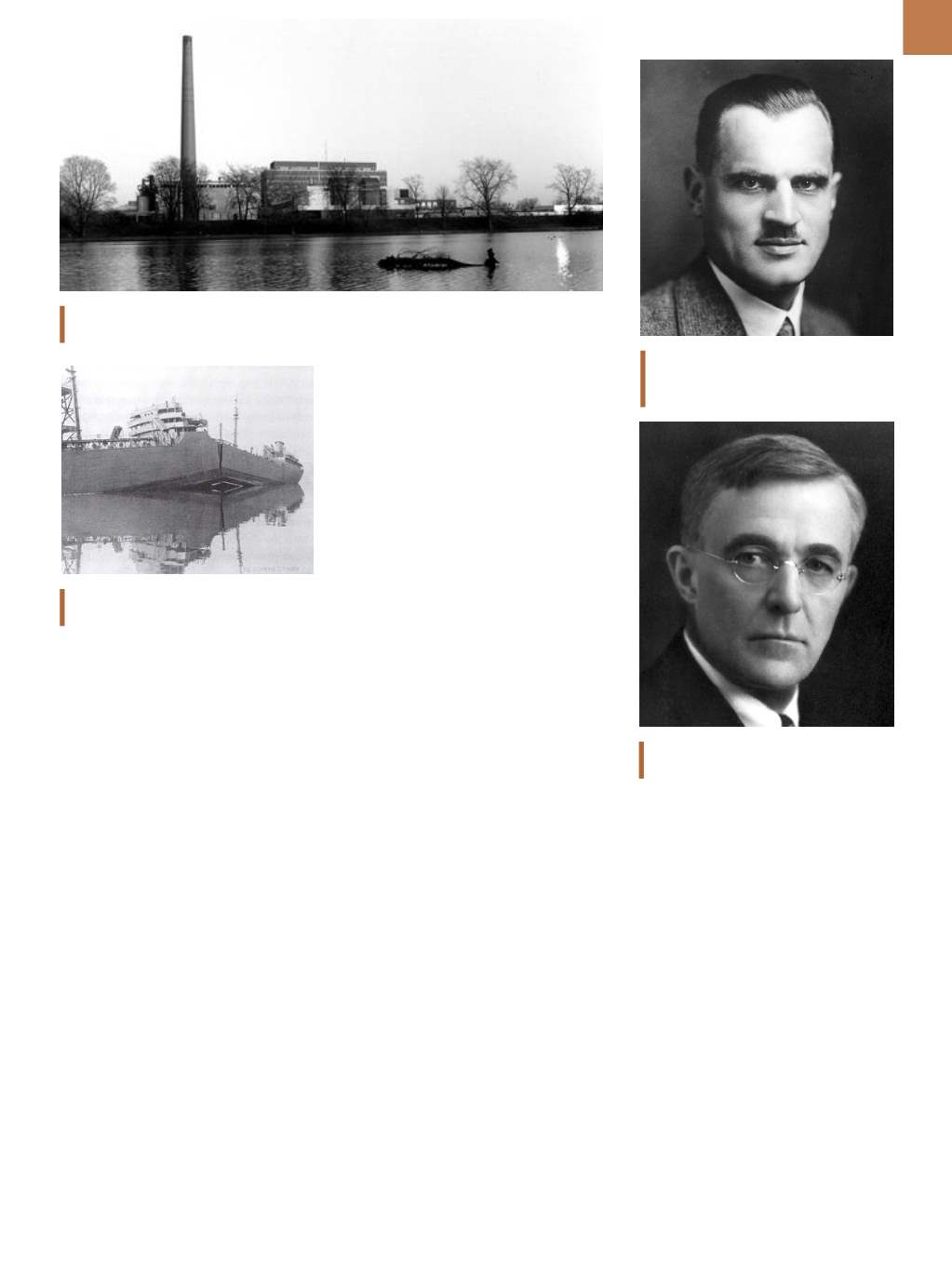
Arthur Compton of atomic bomb fame
worked with Samuel Hoyt at the GE
Central Research Labs.
Irving Langmuir of GE Labs won the
Nobel Prize in Chemistry in 1932.
SS Schenectady,
a welded tanker ship
that broke in half while docked in 1943.
Battelle headquarters viewed from the Olentangy River, Columbus, Ohio. Courtesy of Wikime-
dia Commons/Columbus Free Press.
By this time, Hoyt was well acquainted
with Europeans and was very conver-
sant in German. He continued consult-
ing throughout the 1960s and finished
with his autobiography, “Men of Met-
als,” published by ASM in 1979. He de-
scribed his career and all the men he
knew, from European pioneers such
as Le Chatelier, Guerther, and Adolf
Martens to those he knew from teach-
ing, working at GE, the steel industry,
research advising, and consulting. His
book contains more than 300 metals
men he knew during his career. As he
describes them, they were the leading
metallurgists of the first half of the 20th
century, the time period when the sci-
ence of physical metallurgy blossomed.
For more information:
Charles R.
Simcoe can be reached at
crsimcoe1@ gmail.com.