


 23 / 62

A D V A N C E D
M A T E R I A L S
&
P R O C E S S E S | F E B R U A R Y
2 0 1 6
2 3
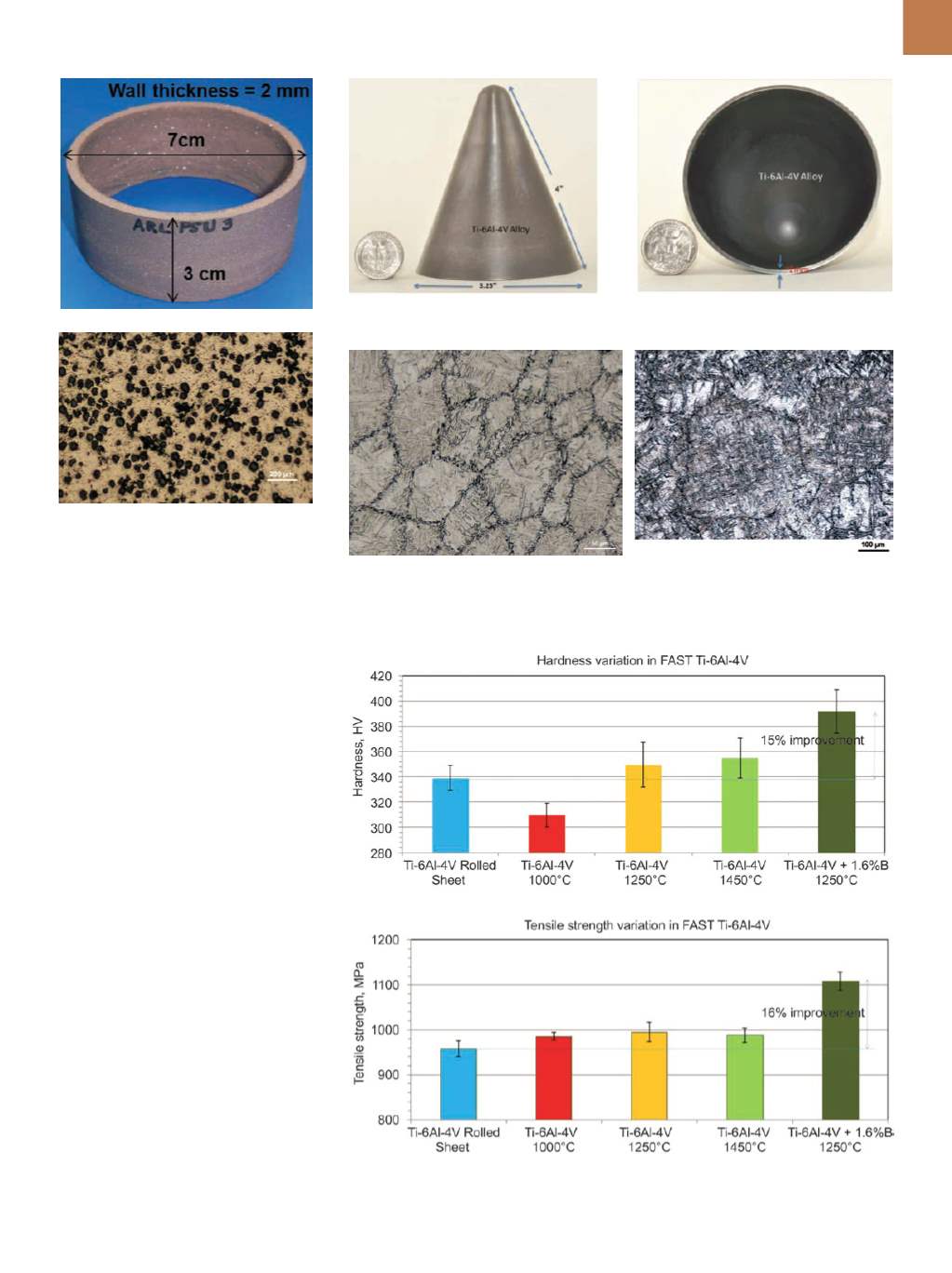
Fig. 7 —
(a) Fabrication of NARaloy-Z with
40 vol% diamond composite ring by FAST;
(b) microstructure of composite cross section.
Fig. 8 —
Fabrication of net-shape hollow cone made of Ti alloy produced by FAST (1200°C,
25 MPa, 5 min hold time).
Fig. 9 —
Optical micrograph of Ti-6Al-4V powder (a) with 1.6%B and (b) without B, sintered by
FAST at 1250°C, 45 MPa, 20 min.
Fig. 10 —
Variations in (a) hardness and (b) UTS for Ti-6Al-4V with and without B addition manu-
factured using FAST at different sintering temperatures.
makes them suitable for use in both ter-
restrial and marine environments. Four
categories of titanium alloys include
near alpha, alpha + beta, beta, and tita-
nium-aluminide intermetallics. Alpha
alloys are characterized by relatively low
strength (
≤
550 MPa UTS), with some al-
loys used in high temperature applica-
tions (up to 600°C). Beta alloys feature
1100 MPa UTS with significantly higher
ductility. Alpha-beta alloys offer higher
strength in combination with reasonable
levels of ductility. For example, Ti-6Al-
4V alloy exhibits 900 MPa UTS and 12%
elongation.
Net-shape components are made
cost effectively using powder metallur-
gy techniques (Fig. 8). Blending Ti 6-4
powder with a small volume fraction of
B enables producing sintered products
by FAST that exhibit a uniform fine-grain
microstructure and better mechani-
cal properties including hardness and
strength as shown in Figs. 9 and 10.
Benefits of manufacturing Ti 6-4
alloy by FAST include:
• 5% higher UTS of FAST Ti 6-4 than
commercially available rolled Ti 6-4
sheet
(b)
(a)
(a)
(b)
(a)
(b)