


 15 / 62

A D V A N C E D
M A T E R I A L S
&
P R O C E S S E S | F E B R U A R Y
2 0 1 6
1 5
retained austenite regions within the
HAZ at high heat inputs. In the absence
of coarse retained austenite, the weld
exhibits tensile properties that correlate
well with its hardness. A more complete
solution for welding these steels would
involve the use of specially designed
fillers, which will be discussed in future
work. Detailed studies should also be
conducted concerning the influence of
welding on the precipitates.
~AM&P
For more information:
Peter Kirbis is
a Ph.D. student at University of Maribor
in Slovenia,
kirbis.peter@gmail.com,
www.um.si/en.This article has been adapted from
a full length feature in
Metallography, Mi-
crostructure, and Analysis
4.6 (2015): 570-
578, DOI 10.1007/s13632-015-0234-0.
© Springer Science+Business Media New
York and ASM International 2015.
Acknowledgments
The authors thank colleagues at
Quicktig for preparing the coating for
A-TIG welding.
References
1. F.G. Caballero and H.K.D.H.
Bhadeshia, Very Strong Bainite,
Curr.
Opin. Solid State Mater. Sci.,
Vol 8,
No. 3-4, p 251-257, 2004.
2. H.K.D.H. Bhadeshia, The First Bulk
Nanostructured Metal,
Sci. Technol.
Adv. Mater.,
Vol 14, No. 1, p 1-7, 2013.
3. B.C. De Cooman, Structure-
Properties Relationship in TRIP Steels
Containing Carbide-Free Bainite,
Curr.
Opin. Solid State Mater. Sci.,
Vol 8, No.
3-4, p 285-303, 2004.
4. H.K.D.H. Bhadeshia, TRIP-Assisted
Steels?,
ISIJ Intl.,
Vol 42, No. 9,
p 1059-1060, 2002.
5. H.K.D.H. Bhadeshia, Nanostructured
Bainite,
Proc. R. Soc. A Math. Phys. Eng.
Sci.,
Vol 466, No. 2113, p 3-18, 2010.
6. W. Savage, E. Nippes, and E.
Szekeres, Hydrogen Induced Cold
Cracking in a Low Alloy Steel,
Weld.
Journal,
Res., 1976.
7. K. Fang, et al., Regeneration Technique
for Welding Nanostructured Bainite,
Mater. Des.,
Vol 50, p 38-43, 2013.
8. B.L. Bramfitt and A.O. Benscoter,
Metallographer’s Guide: Practices and
Procedures for Irons and Steels, Vol 95,
No. 2, 2003.
9. C. García-Mateo and F.G. Caballero,
The Role of Retained Austenite on
Tensile Properties of Steels with
Bainitic Microstructures,
Mater. Trans.,
Vol 46, No. 8, p 1839-1846, 2005.
10. J. Wang and S. Zwaag, Stabilization
Mechanisms of Retained Austenite
in Transformation-Induced Plasticity
Steel,
Metall. Mater. Trans. A,
Vol 32,
No. 6, p 1527-1539, 2001.
11. D. Tjahjanto, et al., A
Micromechanical Study of the
Deformation Behavior of TRIP-Assisted
Multiphase Steels as a Function of
the Microstructural Parameters of the
Retained Austenite,
Adv. Eng. Mater.,
V
ol 11, No. 3, p 153-57, 2009.
12. E. Keehan, et al., Microstructural
and Mechanical Effects of Nickel and
Manganese on High Strength Steel
Weld Metals, ASM Proc. Int. Conf.
Trends Weld. Res., p 695-700, 2002.
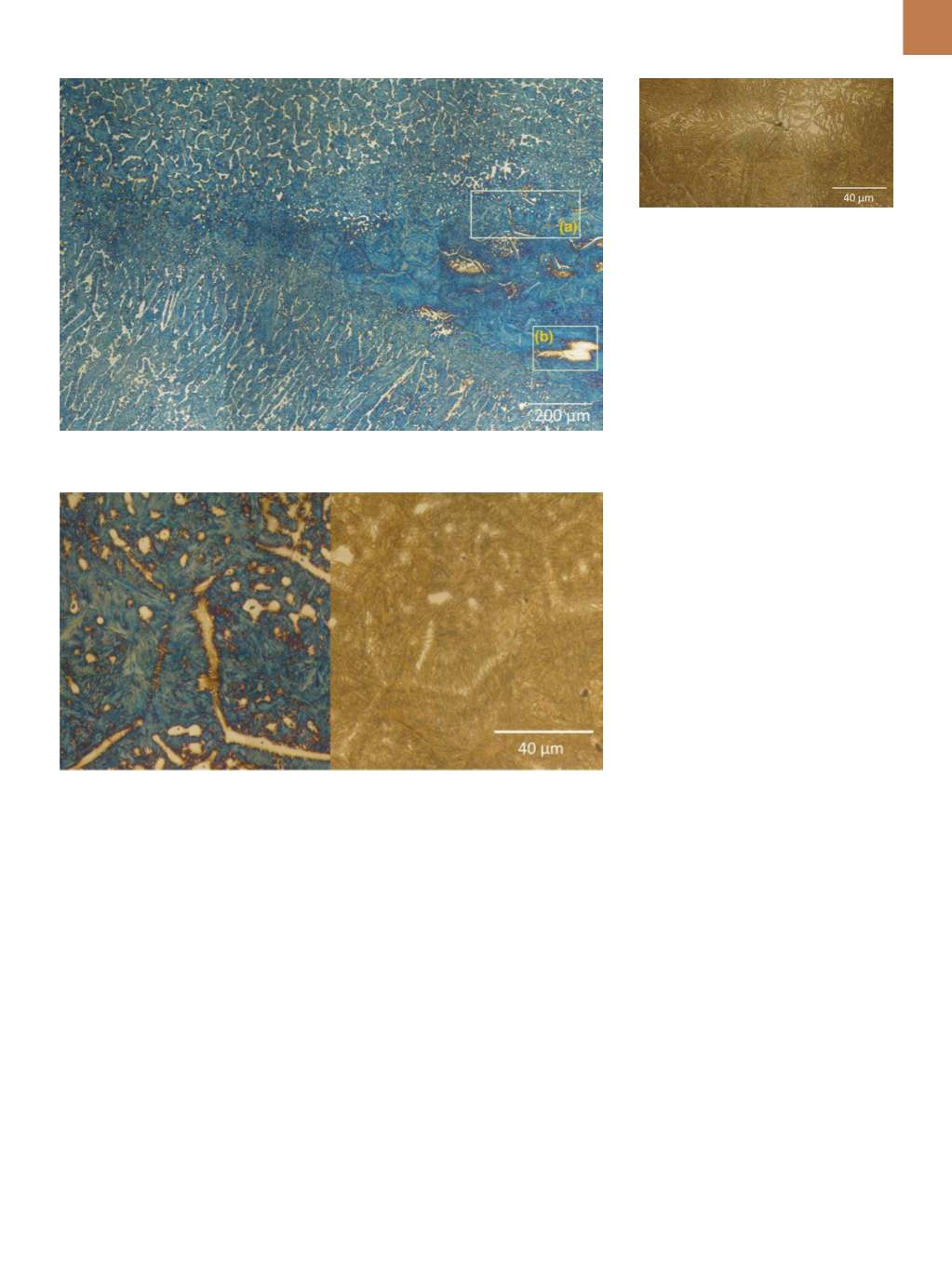
Fig. 6 —
Weld intersection of Weld 2 shows the dendritic structure of the weld and the reausten-
itized region. Etched with 7% aqueous Na
2
S
2
O
5
.
Fig. 7 —
LOMmosaic image of Detail (a) in Fig. 6 shows segregations and grain growth within
the reaustenitized region of Weld 2. Left side is etched with 7% aqueous Na
2
S
2
O
5
; right side is
etched with Vilella’s reagent.
Fig. 8 —
LOMmosaic image of Detail (b)
in Fig. 6 shows coarse retained austenite
regions. Etched with Vilella’s reagent.