



 11 / 62

A D V A N C E D
M A T E R I A L S
&
P R O C E S S E S | F E B R U A R Y
2 0 1 6
1 1
EMERGING TECHNOLOGY
UNDERGROUND BATTERY
COULD CLEAN UP ENERGY
A team of researchers from Law-
rence Livermore National Laboratory
(LLNL), Ohio State University, Univer-
sity of Minnesota, and TerraCOH Inc.
developed a subsurface system that
stores energy from renewable sources
and dispatches it to the grid throughout
the year like a massive underground
battery, all while storing CO
2
from fossil
fuel power plants.
The intermittency of wind and
sunshine is one of the biggest challeng-
es to widespread integration of renew-
able energy into electric grids, while the
cost of capturing CO
2
and storing it per-
manently underground is a major chal-
lenge for decarbonizing fossil energy.
This large-scale system could overcome
both obstacles.
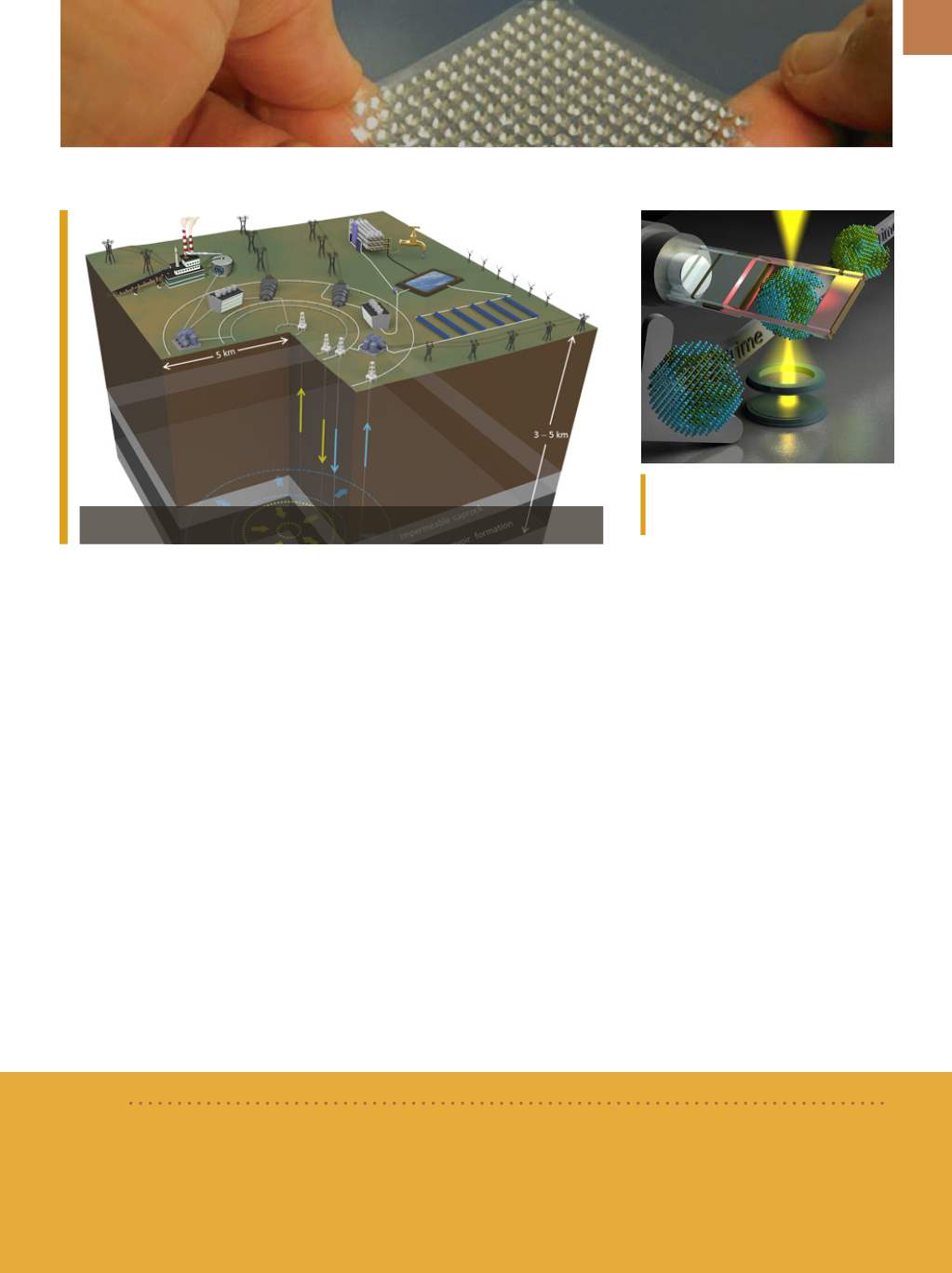
The process involves inject-
ing liquid-like CO
2
into underground
reservoirs in sedimentary rock, creating
a pressurized plume that pushes brine
up production wells to the surface.
The brine would then be heated and
reinjected into the reservoir, storing
thermal energy. The resulting pressur-
ized CO
2
would enable the system to
be charged or discharged depending
on supply and demand. When there
is insufficient renewable energy, the
pressurized CO
2
and brine could be re-
leased and converted to power. Accord-
ing to computer models, the amount of
CO
2
that could be stored underground
by the system would be at least four
million tons per year over 30 years,
the equivalent of the CO
2
impact of a
600 MW coal plant
. energy.gov.INDIVIDUAL NANOPARTICLES
TRACKED AT ATOMIC LEVEL
Researchers at McMaster Univer-
sity, Canada, in conjunction with sci-
entists at National Research Council
This integrated systemwould store CO
2
in an underground reservoir.
ENER Y TRE DS
Canada and Shanghai Jiao Tong Univer-
sity, have taken atomic-level images of
individual nanoparticles during heating.
Using advanced electron microscopic
techniques, the team was able to track
the atomic rearrangement of an individ-
ual platinum-iron nanoparticle as it was
annealed inside the microscope.
The work could have significant
impact in the automotive industry,
where there has been a surge of inter-
est in developing alternative energy
sources, particularly fuel cell technol-
ogy. Fuel cell devices are far more ef-
ficient and environmentally friendly
than conventional combustion tech-
nologies. However, they have typically
relied on pricey platinum nanoparti-
cles as catalysts, making them too ex-
pensive for widespread commercial-
ization. The new process could enable
development of less expensive cata-
lysts, such as platinum-iron nanoparti-
cles.
www.eng.mcmaster.ca.
A Titan 80-300 Cubedmicroscope was
used for the catalyst research. Courtesy of
Stephen MacIntyre.
BRIEF
Florida State University,
Tallahassee, researchers are working to make solar cells more effective. Through a soaking
procedure, researchers assembled two molecules, an acceptor and sensitizer, on a surface. The molecules work to-
gether to perform photon upconversion, combining two low energy, green photons to generate a higher energy, blue
photon, which is used generate electricity. Using this process in optimized solar cells can increase maximum efficien-
cy from 33% to more than 45%.
fsu.edu.