



 13 / 62

1 3
A D V A N C E D
M A T E R I A L S
&
P R O C E S S E S | F E B R U A R Y
2 0 1 6
L
ow temperature, carbide free bain-
itic steels are capable of achieving
tensile strengths to 2500MPawhile
maintaining reasonable values of duc-
tility and fracture toughness
[1,2]
. Their
mechanical properties are derived from
a very fine scale of bainitic ferrite plates
with thicknesses of 20-50 nm. Plates are
formed at low temperatures between
200°C to 300°C within steels where the
precipitation of cementite is inhibit-
ed by alloying additions of roughly
1.5%Si or Al, thus enriching the retained
austenite with carbon. This provides
sufficient stability for it to undergo a
stress/strain induced transformation
into martensite, which retains the work
hardening capacity and is known as
the transformation induced plasticity
(TRIP) effect
[3,4]
.
To ensure low transformation tem-
peratures, these alloys contain concen-
trations of carbon close to 0.8%. When
TABLE 1—STEEL COMPOSITION (WT%)
C Si
Mn Mo Cr
V Al
Ni
Bs
Ms
0.82 1.2 2.5 0.6 1.8 0.22 1.5
1 240°C 51°C
such steels are welded, they are suscep-
tible to cold cracking, due to formation
of brittle martensite within the weld
and reaustenitized heat affected zones
(HAZ)
[6]
. Therefore, these steels must be
preheated before welding, after which
prolonged isothermal holding treat-
ments are applied to regenerate the
bainitic microstructure within the weld
and reaustenitized regions. These treat-
ments can last from several hours to a
few days. The endeavor of welding such
steels is nevertheless encouraging, as
it has been shown that the welds can
achieve tensile strengths comparable
to those of the base materials
[7]
.
The authors’ research has led to
development of a newgrade of low tem-
perature bainitic steels—named Kineti-
cally Activated Bainite (KAB) steels—
with exceptionally rapid transformation
kinetics at temperatures below 200°C.
This is achieved by creating kinetical-
ly suitable conditions at a higher tem-
perature via a precipitation reaction. If
such a rapid formation of bainite can be
obtained during welding, determining
how welding parameters influence the
microstructure and mechanical proper-
ties of the weld is of great interest.
MATERIALS AND METHODS
The alloy’s chemical composition,
along with the critical temperatures of
the bainite start (Bs) and martensite
start (Ms), are shown in Table 1. Upon
air cooling to room temperature af-
ter a hot rolling treatment, the newly
developed steel forms a microstructure
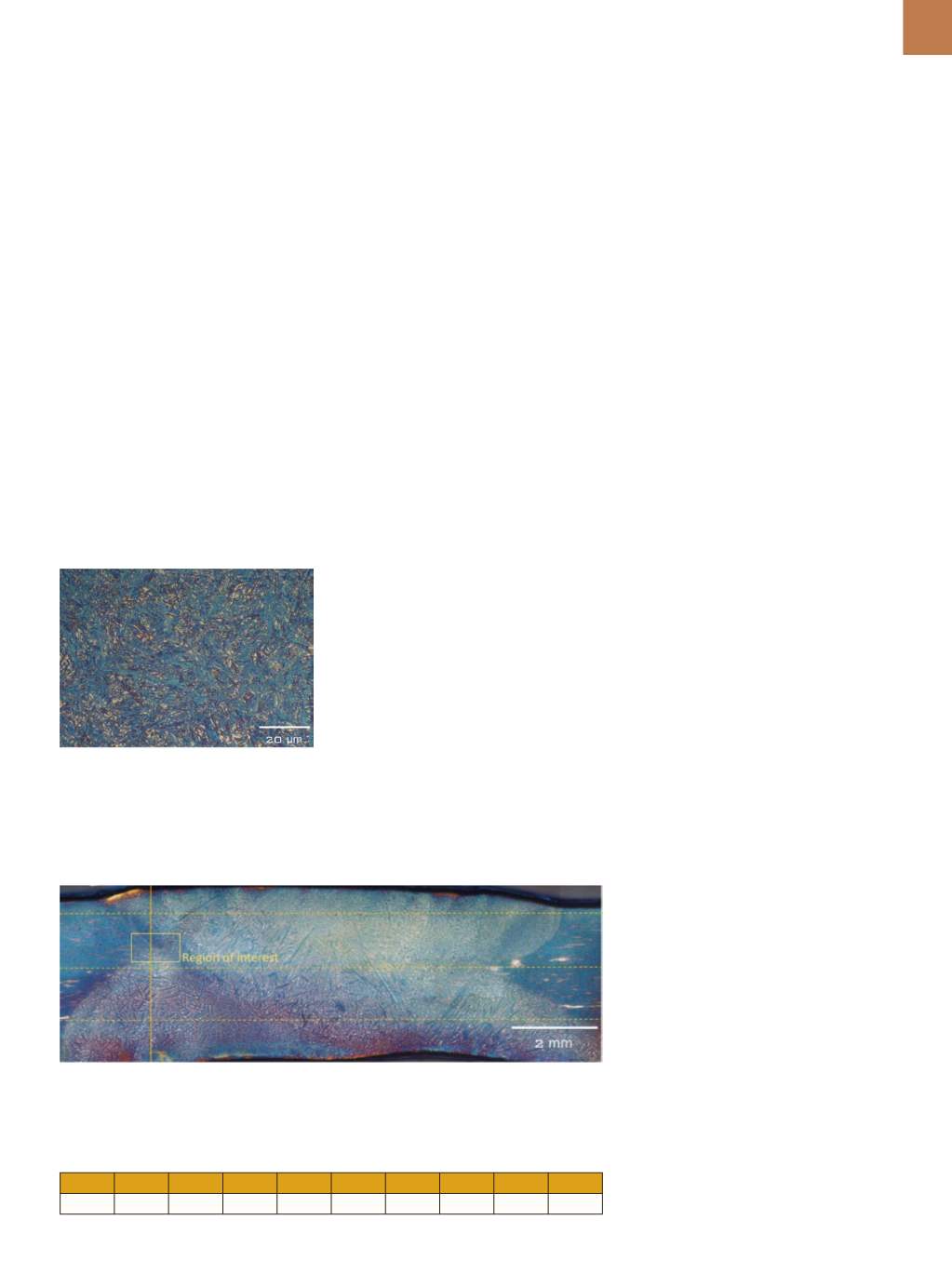
of carbide-free lower bainite (Fig. 1). Mi-
crostructures were investigated by etch-
ing with 7% aqueous Na
2
S
2
O
5
, which is
known to respond by coloring bainitic
regions blue and martensite brown,
whereas retained austenite etches white
or in a slight purple
[8]
. In this condi-
tion, the steel has a Vickers hardness of
660 HV, coinciding with a yield strength
of 1800 MPa and tensile strength of
2800 MPa. Because no suitable fillers
for welding this steel are commercially
available, welds were produced using
the activated tungsten inert gas (A-TIG)
process with variable heat inputs. The
region of interest is the one that experi-
ences the highest heat input and is indi-
cated with a square in Fig. 2.
RESULTS
The initial trial involved a rela-
tively high heat input. Weld 1 develops
a high hardness and exhibits a coarse
microstructure (Fig. 4), while the mi-
crostructural features of interest are
shown in greater detail in Fig. 5. The
presence of coarse austenite and so-
lidification porosity is thought to be
the main cause of the modest 850 MPa
tensile strength. Heat input was then
reduced during formation of Weld 2, in
which a more refined microstructure
develops (Fig. 6). A more detailed view
is provided in Fig. 7(a), where appre-
ciable segregations within the HAZ are
still visible, but to a lesser extent than
Weld 1. The grain boundary enriched re-
gion was additionally etched with Vilel-
la’s reagent, as shown in Fig. 7(b). This
etchant delineates a thinner austenite
layer with additional bainitic sheaves
growing into the enriched region.
Figure 8 presents a mosaic image of
Detail (b) of Weld 2, showing coarse re-
tained austenite regions.
The tensile properties of Weld 2
are appreciably higher, reaching values
up to 1200 MPa. Heat input was fur-
ther decreased during the third weld-
ing test. The microstructure of Weld 3
indicates that films of austenite at the
grain boundaries no longer occur. How-
ever, some martensite is present within
the segregated region in the HAZ. The
parameters used for the production of
Fig. 1 —
Polarized LOM of initial bainitic
microstructure before welding shows fine
sheaves of bainitic ferrite separated by
regions of retained austenite. Etched with
7% aqueous Na
2
S
2
O
5
, mag. 1000×.
Fig. 2 —
Polarized LOMmosaic image of a weld with investigated region marked by a square.
Dotted lines represent points where hardness measurements were performed. A marked segre-
gation appears at the edge of the fusion zone boundary, indicated by color change.