


 31 / 58

T
hixomolding is an
environmentally clean and
safe commercial process for
semi-solid injection molding of
magnesium alloys. The process is
similar to plastic injection molding
but with higher temperature
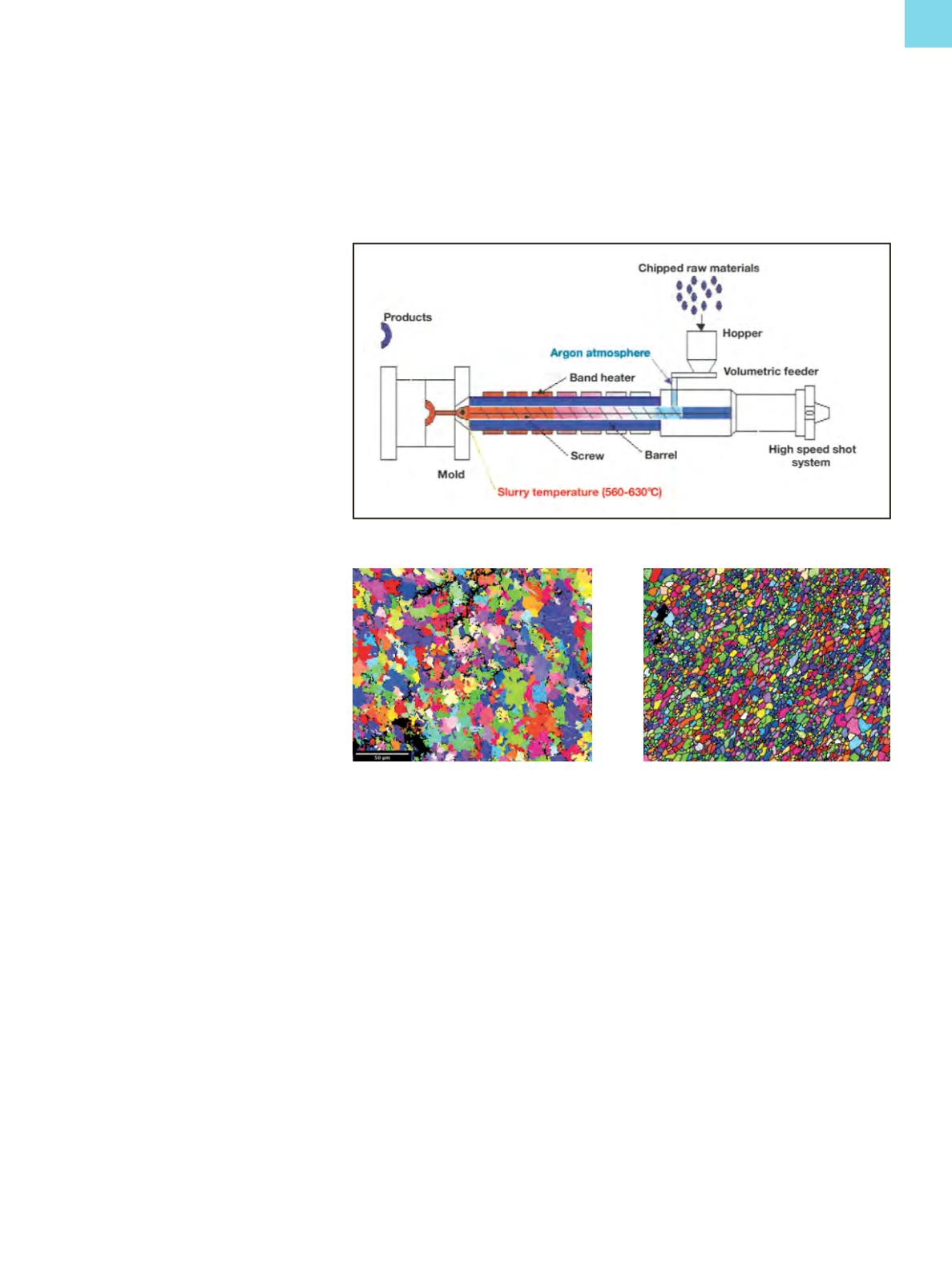
and faster shot velocity (Fig. 1).
It was introduced in the 1990s
by Thixomat Inc., Ann Arbor,
Mich., and cofounders
[1]
and
is based on semi-solid metals
discoveries made by Merton
Flemings and his students, Robert
Mehrabian and David Spencer,
at Massachusetts Institute of
Technology, Cambridge
[2]
. It was
further adapted to Mg by basic
patents held by researchers
at The Dow Chemical Co.,
Midland, Mich.
[3]
Today more
than 465 Thixomolding machines
have been built and sold by
Japan Steel Works for use in 13
countries.
[4]
ADVANTAGES AND
APPLICATIONS
Since the Thixomolding
process was first commercialized
more than 20 years ago, several
advantages have been identified
in comparison to conventional
casting. The most important are
environmental friendliness and
safety, due to no open foundry,
no SF6 cover gas, and no sludge
or dross. In addition, net shaping
of complex parts requires little or
no machining. The process offers
tight dimensional control, long
die life (due to 80°C cooler metal
temperatures than die casting),
low porosity, and higher ductility
and fatigue strength. The process
also offers flexibility in part design
with the potential to consolidate
several parts into one, and
features fine as-molded grain size
of roughly 5 µm (Fig. 2). Further,
Thixomolding is portable—the
integrated melting and molding
machine can be easily moved to
a new site and quickly resume
production.
Electronic and communication
(E/C) applications in Japan, such
as laptop computers, cameras,
DLP projectors, and cell phones
drove Thixomolding’s early use.
In the U.S., parts for machine
and hand tools, automotive
applications, and sports
equipment have supplemented
the business in E/C parts. Many
commercial applications for this
technology exist (see sidebar).
Lightweighting is the dominant
driver for Thixomolded Mg part
use and is supplemented by its
TECHNICAL SPOTLIGHT
ENVIRONMENTALLY-FRIENDLY INJECTION
MOLDINGPROCESSMAKES STRIDES
Fig. 1 —
Schematic of Thixomolding machine.
Fig. 2 —
EBSD as Thixomolded: Grain
size – 5 µm, yield strength – 140 MPa,
elongation – 6%, fatigue strength –
70 MPa, toughness – 15 MPam
0.5
,
texture – MRD of 1.8 max. Courtesy of
Tracy Berman.
Fig. 3 —
EBSD Thixomolded +
thermomechanically processed +
annealing: Grain Size – 2 µm, yield
strength – 250 MPa, elongation – 12%,
fatigue strength – 150 MPa, toughness –
28 MPam
0.5
, texture – MRD of 3.7 max.
Courtesy of Tracy Berman.
3 1
A D V A N C E D
M A T E R I A L S
&
P R O C E S S E S | J A N U A R Y
2 0 1 5