


 34 / 58

A
new welding process known as
hybrid induction arc welding
(HIAW) or high deposition arc
welding (HiDep) uses a hybrid
approach to reduce—or even
eliminate—weld distortion and
greatly increase productivity.
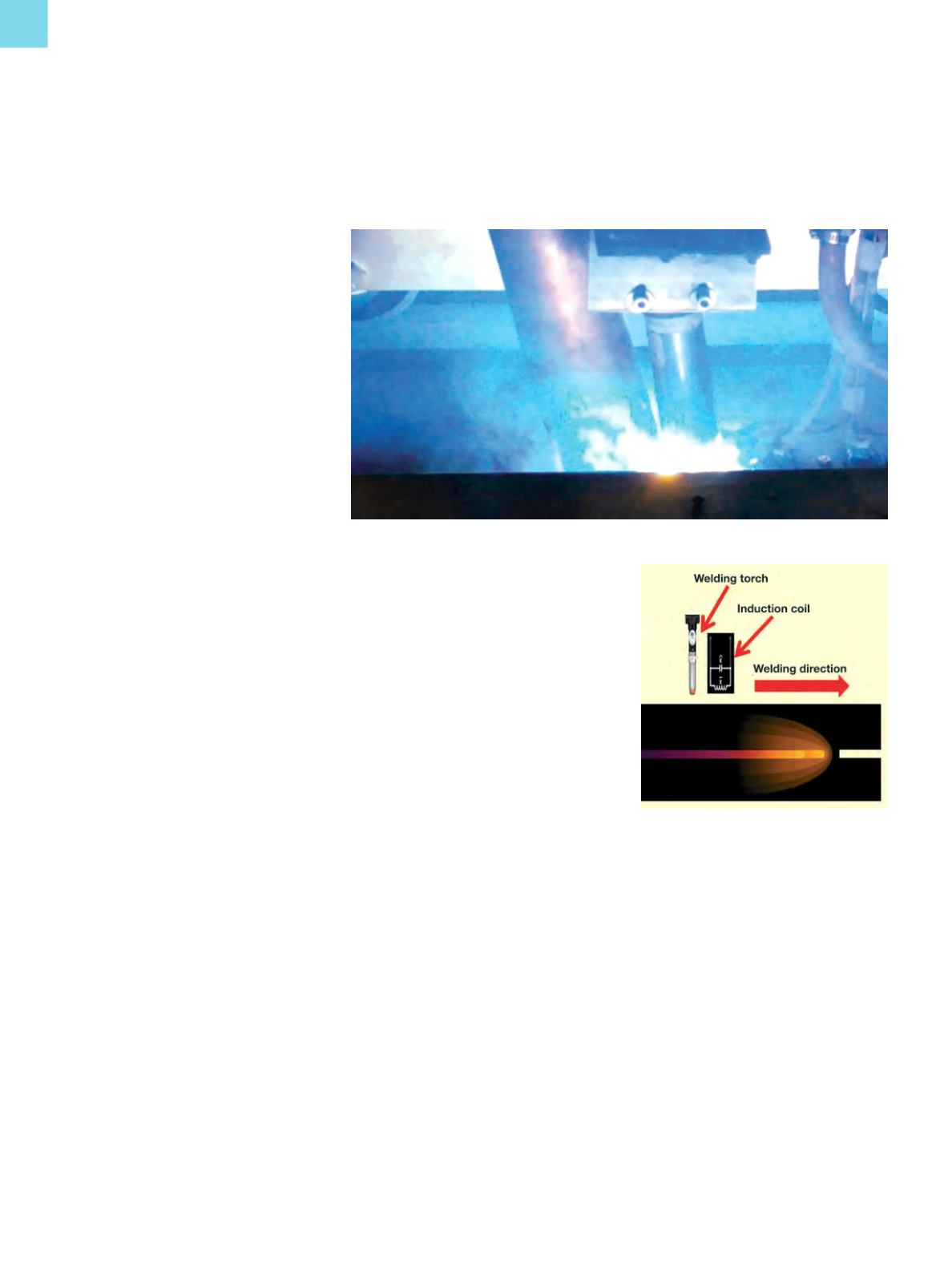
Operating directly in front of the arc
welding torch, a portable induction
coil heats the surfaces of the weld
to, or near, the melting point
(Fig. 1). Heat generated by the
welding arc is primarily used to melt
the welding wire. This novel process
operates at speeds two to four
times faster than conventional arc
welding and substantially reduces
weld distortion. The technique
uses a simple square joint for butt
welding, so there is no need for
weld joint preparation (such as
beveling) for butt joints, even in
thick parts.
There has been recent interest
in adding auxiliary heat sources
such as industrial lasers, arc plasma
torches, and multiple arc welding
wires/torches to traditional arc
welding processes due to their
improvement over conventional
arc welding for both reducing
distortion and increasing welding
speed. Systems that use lasers or
plasma are referred to as hybrid
arc welding processes (e.g., laser
hybrid arc welding). For the HiDep
system, induction is the best
auxiliary heating method because
it is much more economical than
using a laser, features better
performance characteristics, and
incurs significantly lower operating
and maintenance costs. A portable
induction heating system widely
used to remove weld distortion
and form metal was modified to
develop the new system.
The basic HiDep process
features two components—an
induction heating coil and an arc
welding torch. The high frequency
induction heating process uses
a metal conductor or coil, which
is placed close to the surface
of the metal part to be heated.
The ac current flowing through
the coil induces a current in the
part, similar to how a transformer
operates. The induced flow
of electricity, or eddy current,
generates heat by electrical
resistance. Water cooling
passages inside the coil allow the
use of very high current and heat
generation is up to 95% efficient.
Induction power levels of 35 to
140 kW are possible, so the heat
generated by induction can be
equal to—or significantly higher
than—the welding arc heat.
The new process has been
used on steel for butt weld
joints up to 0.75 in. thick. For
conventional arc welding, this
would require a V-groove or
bevel edge preparation, but the
HiDep system can weld simple
square joint configurations,
significantly reducing the time
and cost of weld preparation. In
higher strength/higher fracture
toughness steels, such as EH-
36 marine steel or A709-Gr 50
structural steels, the strength,
ductility, and fracture toughness of
the weld and heat-affected zone
(HAZ) exceed typical code and
standards requirements.
TECHNICAL SPOTLIGHT
HYBRID INDUCTIONARCWELDING
REDUCESWELDDISTORTIONANDBOOSTS PRODUCTIVITY
HiDep weld in progress—5/8-in. EH-36 marine steel, butt joint 1/8-in. weld gap.
Fig. 1 —
Schematic diagram of the
HiDep welding process.
3 4
A D V A N C E D M A T E R I A L S & P R O C E S S E S | J A N U A R Y 2 0 1 5