


 29 / 58

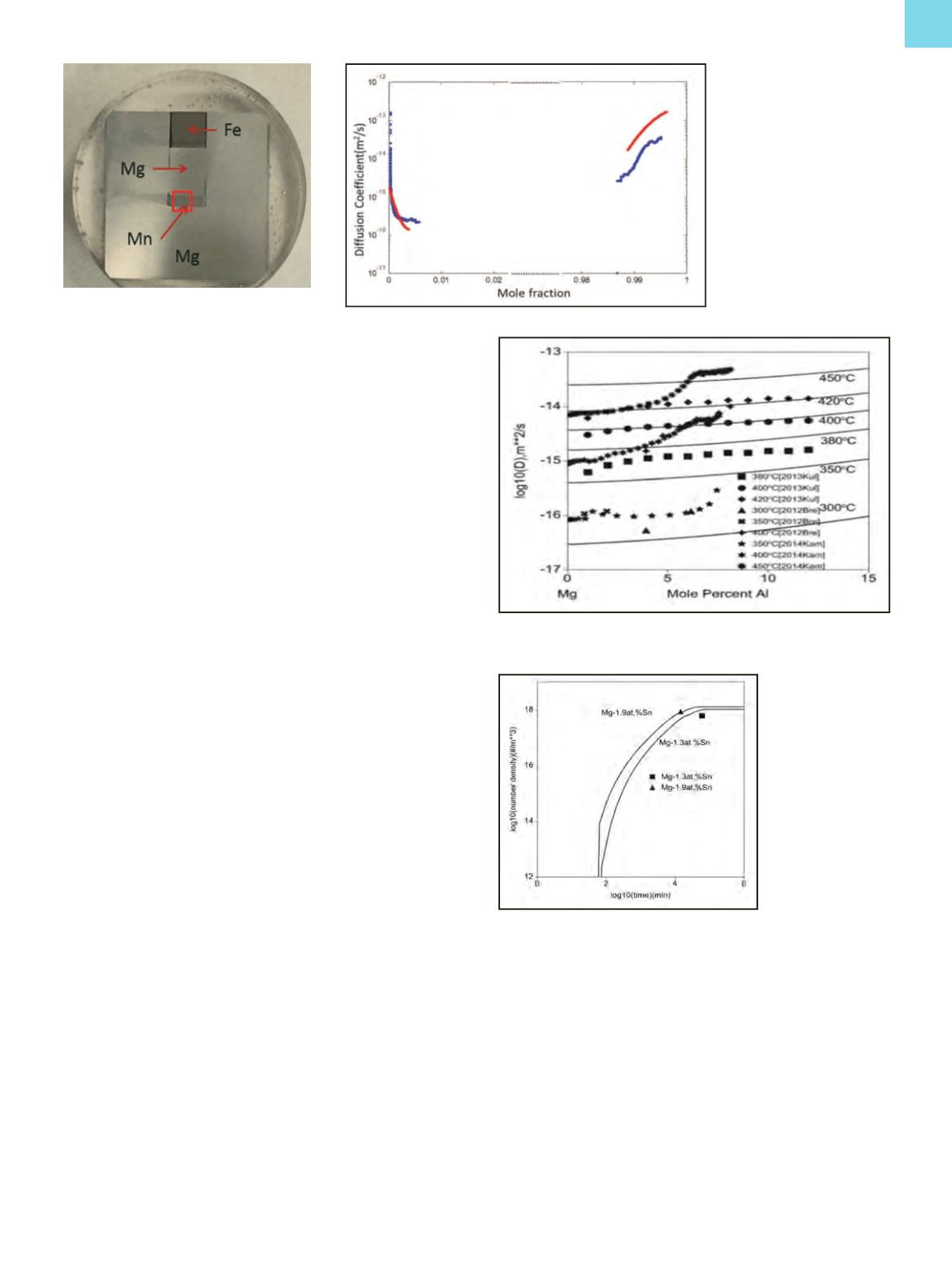
is observed and the concentration profile is measured
across the Mg-Mn interface using EPMA (electron
probe micro-analysis). By using the forward simulation
method
[13]
, the interdiffusion coefficients are extracted,
as shown in Fig. 2(b). This is thought to be the first
time that the interdiffusion coefficients of the hcp
(Mg) phase of an Mg-Mn system are reported. Results
clearly show that the forward simulation method can
be used to extract impurity diffusion coefficients,
whereas the Sauer-Freise method
[14]
shows wide scatter
of data near pure Mg.
A preliminary atomic mobility database of
Mg alloys of the Mg-Al-Zn-Mn-Sn-Ca-Sr system is
established based on assessment of diffusion data
in the literature using the CALPHAD approach. The
self-diffusion, impurity diffusion, and interdiffusion
coefficients are input to generate the atomic mobility.
Empirical methods for estimating the self-diffusion
and impurity diffusion coefficients are used to obtain
the unavailable data. Most of the literature data are on
the diffusion of the Mg-Al binary system below 420
o
C.
Impurity diffusion coefficients of Zn and Sn in hcp (Mg)
are reported. For Mn, Ca, and Sr, no experimental data
exist yet. Because Al, Mn, Ca, Sn, and Sr do not have
a stable hcp structure, the related atomic mobility
parameters are estimated using empirical methods.
Due to the scarcity of literature data, this preliminary
database is still at its early stage and will be improved
with ongoing diffusion experiments. Figure 3 shows
the calculated interdiffusion coefficients in the Mg rich
region of the Mg-Al system along with experimental
data. It clearly demonstrates the need for more
diffusion experiments to clarify the discrepancy.
Precipitation simulation using KWNmodel
The classic KWN (Kampmann-Wagner-numerical)
precipitation model
[18]
implemented in the
PanPrecipitation module of the Pandat software is
used to simulate the precipitation of magnesium
alloys during the aging process. This model features
the capability of simulating nucleation, growth, and
coarsening simultaneously. The PanMagnesium
thermodynamic database and the preliminary atomic
mobility database are used to generate driving
force, phase equilibria, and diffusivity for quantitative
simulation.
Coupling to the PanMagnesium thermodynamic
database and the preliminary atomic mobility
database described above, the precipitation of
Mg
2
Sn at 200
o
C in two supersaturated Mg-Sn alloys is
simulated. The shape of the Mg
2
Sn precipitate is not
Fig. 2(a) —
Mg-Mn diffusion multiple.
Fig. 2(b) —
Comparison
of interdiffusion
coefficients obtained
from the forward
simulation
[13]
(red lines)
with those obtained
by the Sauer-Freise
method
[14]
(blue lines).
Fig. 3 —
Calculated interdiffusion coefficients in the Mg rich
region of Mg-Al system along with experimental data
[15,17]
.
Fig. 4(a) —
Predicted
number density
of Mg
2
Sn
precipitate in
Mg-1.3 at%
Sn and Mg-
1.9 at% alloys
along with
experimental
data
[19]
.
2 9
A D V A N C E D
M A T E R I A L S
&
P R O C E S S E S | J A N U A R Y
2 0 1 5