


 24 / 58

play a major role in determining
hardness, strength, toughness,
corrosion resistance, and wear
resistance
[2]
. Because a higher
percentage of spheroidal carbide
was formed at a low heat input,
maximum increase in hardness was
observed in this coupon. The black
solid line shows the typical hardness
range of AISI 420.
Mechanical properties
of AISI 4140
Ultimate tensile strength, 0.2%
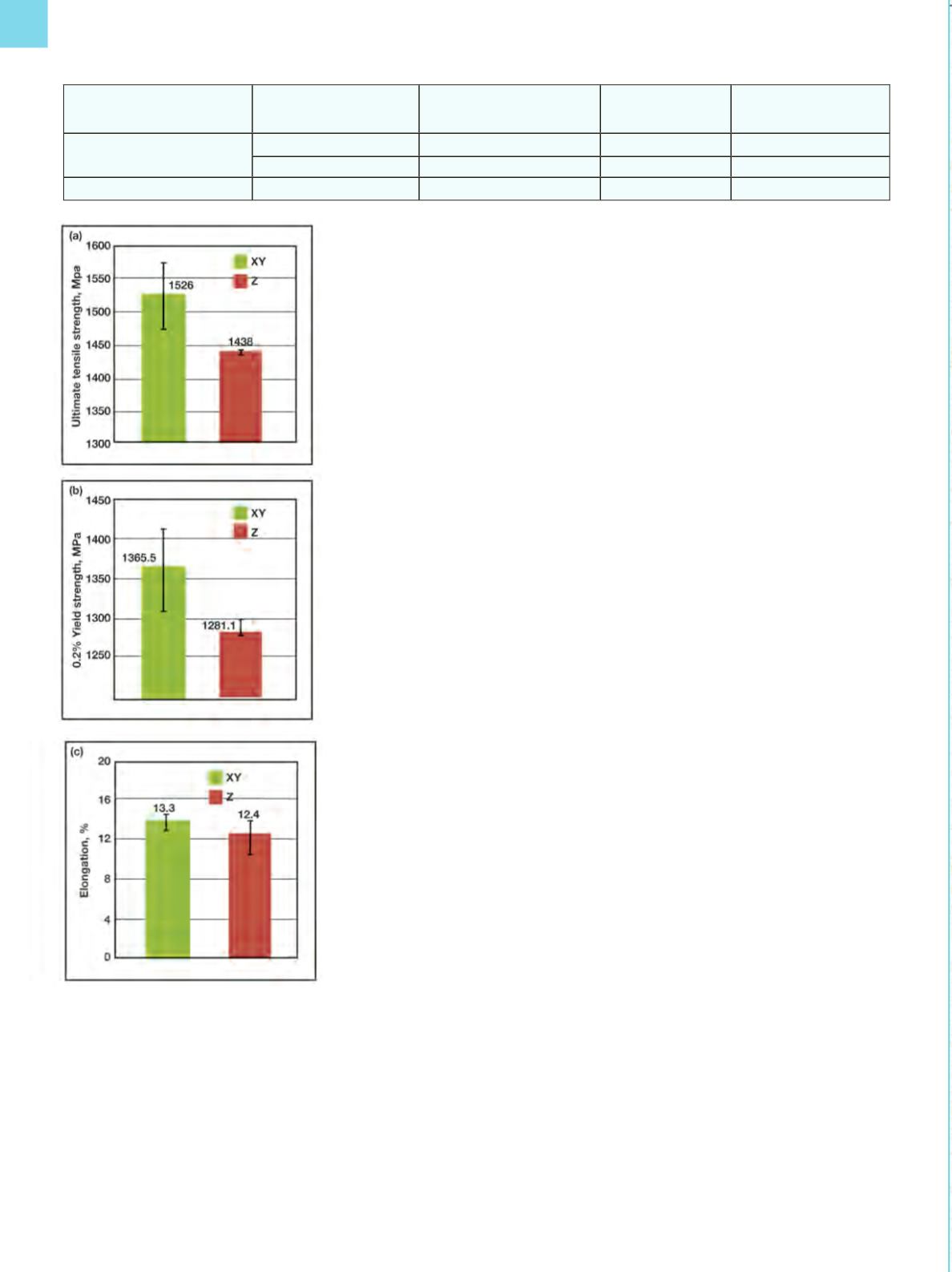
yield strength, and elongation (%)
were measured and compared along
the
Z
and normal to
XY
of the build
direction (Fig. 5). The difference in
mechanical properties is related to the
establishment of a unidirectional heat
transfer along the build direction in the
AM of metals. As a result, elongated
grains form along the build direction.
Table 4 compares the mechanical
properties of additively manufactured
AISI 4140 with those of conventional
AISI 4140. As-built additively
manufactured AISI 4140 exhibits
mechanical properties equivalent or
superior to conventionally processed
(and heat treated) steel. Based on
initial microstructural characterization,
the formation of small solidification
grains and ultrafine cell structures
in AM AISI 4140 steel improves
mechanical properties. Future work
will focus on the microstructural
characteristics of an AM AISI 4140.
Conclusions
Studying the additive
manufacturing of AISI 420 stainless
steel and AISI 4140 steel using a
laser powder bed-fusion (L-PBF)
process helped develop the
corresponding process windows
regarding the structural integrity
of coupons, where systematic
defects such as lack of fusion and
porosity were minimized. In both
cases (AISI 420 and AISI 4140),
densities exceeding 99% theoretical
were produced. Through precise
control of the L-PBF parameters, it
is possible to produce the desired
shape of martensitic stainless steel
grade 420 with an acceptable
microstructure and hardness values.
A heat treatment cycle that results
in the formation of a fine martensite
microstructure with precipitation of
spheroidal carbides was designed
and implemented. Initial studies
of the microstructure reveal a
relationship between the formation
of an ultrafine microstructure and
improved mechanical properties in
AISI 4140.
~AM&P
For more information:
Mahdi Jamshidinia is an applications
engineer – additive manufacturing, EWI,
1250 Arthur E. Adams Dr., Columbus,
OH 43221, 614.688.5153,
mjamshidinia@ewi.org, www.ewi.org.
Acknowledgment
This work was funded under EWI’s
internal research and development
program.
References:
1.
http://www.eos.info/en.2. A. Rajasekhar, et al., Influence
of Austenitizing Temperature on
Microstructure and Mechanical
Properties of AISI 431 Martensitic
Stainless Steel Electron Beam Welds,
Materials & Design
, Vol 30, p 1612-1624,
2009.
Fig. 5 —
Anisotropy in mechanical
properties of AM AISI 4140:
(a) ultimate tensile strength; (b) 0.2%
yield strength; and (c) elongation, %.
2 4
A D V A N C E D M A T E R I A L S & P R O C E S S E S | J A N U A R Y 2 0 1 5
TABLE 4—INFLUENCE OF MANUFACTURING PROCESSES ONMECHANICAL PROPERTIES OF AISI 4140
Yield strength (MPa)
Tensile strength (MPa)
Elongation (%)
Toughness (Charpy
energy, J)
L-PBF 4140 steel (as-built)
1365 (XY)
1526 (XY)
13.8 (XY)
34.8 (XY)
1281 (Z)
1438 (Z)
12.4 (Z)
32.1 (Z)
Conventional 4140 steel
420-900
610-1050
12-15
28-50