


 27 / 58

Commercial cast and wrought magnesium alloys
(AZ91, AM60, and AZ31) contain less than 10% Al,
and the microstructure of these Mg-Al based alloys is
generally characterized by formation of the Mg
17
Al
12
phase. The low eutectic temperature (436°C) of
the Mg
17
Al
12
phase limits the application of Mg-Al
alloys to temperatures below 125°C, above which
the discontinuous precipitation of the Mg
17
Al
12
phase leads to substantial creep deformation
[2]
.
Therefore, possible approaches for improving creep
resistance in Mg-Al based alloys include: suppressing
the formation of the Mg
17
Al
12
phase; pinning grain
boundary sliding; and slowing solute diffusion in the
magnesium matrix.
Mg-Al-Ce system
Earlier experimental work
[6, 7]
shows that adding
rare earth elements (RE) in the form of mischmetal
can improve the creep resistance of Mg-Al based
alloys, especially when aluminum content is low (less
than 4%). This led to the development of AE series
alloys, AE42 (Mg-4Al-2RE) and AE44 (Mg-4Al-2RE),
where the mischmetal RE generally contains more
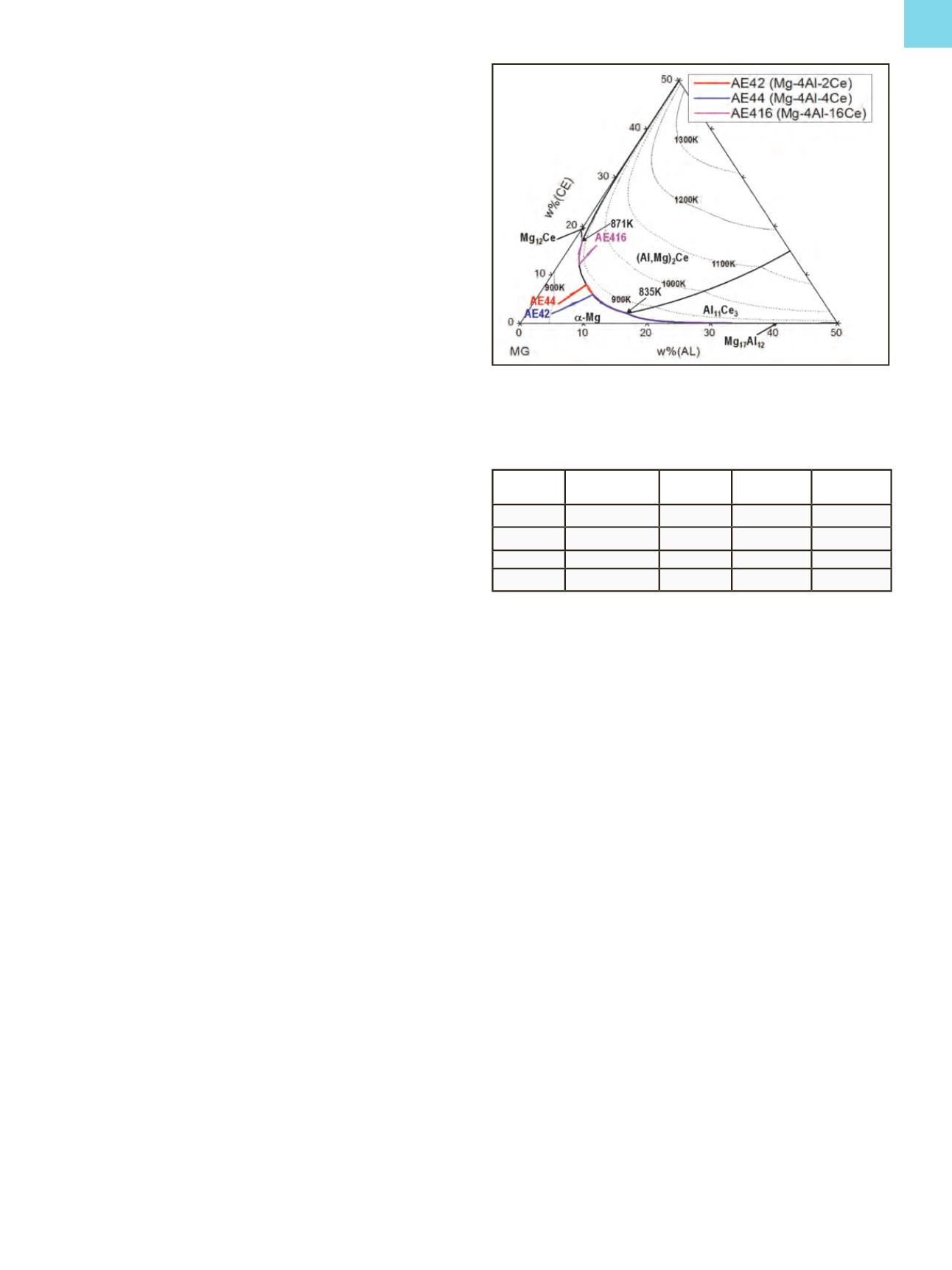
than 60% Ce (balance La, Nd, and Pr). Figure 1(b)
shows the calculated liquidus projection of the Mg-
Al-Ce system in the Mg-rich corner. Generally, the
liquidus temperature decreases with Al addition (up
to at least roughly 10%) and Ce (also up to at least
roughly 10%), with the following two type II invariant
reactions marked at 871K (598°C) and 835K (562°C),
respectively:
1) 598°C L + (Al,Mg)
2
Ce —> Mg + Mg
12
Ce
2) 562°C L + (Al,Mg)
2
Ce —> Mg + Al
11
Ce
3
The calculated solidification paths of AE42 and
AE44 alloys using the Scheil model, based on the
assumption of complete mixing in the liquid but no
diffusion in the solid, are superimposed in the phase
diagram shown in Fig. 1(b). Based on simulation
results, the solidification sequence for both alloys is
as follows:
1) Nucleation of primary magnesium: L —> L + Mg
2) Binary eutectic reaction: L —> L + Mg +
(Al,Mg)
2
Ce
3) Type II invariant reaction:
L + (Al,Mg)
2
Ce —> L + Mg + Al
11
Ce
3
4) Ternary eutectic reaction:
L —> Mg + Al
11
Ce
3
+ Mg
17
Al
12
Adding 2-4% Ce to Mg-Al alloys results in the
formation of Al
11
Ce
3
in addition to the Mg
17
Al
12
phase
in the Mg-Al binary system. More detailed calculation
shows that 15% Ce is required to completely suppress
the formation of the Mg
17
Al
12
phase in the Mg-4Al alloy
based on the Scheil model
[8]
, which can be used as
guidance to design the ternary alloy, avoiding Mg
17
Al
12
phase formation in elevated temperature applications.
Figure 1(b) also shows the solidification sequence of
the AE416 (Mg-4Al-16Ce) alloy as follows:
1) Nucleation of (Al,Mg)
12
Ce phase:
L —> L + (Al,Mg)
2
Ce
2) Binary eutectic reaction:
L —> L + Mg + (Al,Mg)
2
Ce
3) Type II invariant reaction:
L + (Al,Mg)
2
Ce —> L + Mg + Mg
12
Ce
4) Binary eutectic reaction: L —> Mg + Mg
12
Ce
The eutectic temperatures for Al
11
Ce
3
, (Al,Mg)
2
Ce,
and Mg
12
Ce phases are calculated as 560°C, 622°C,
and 867°C, respectively, which are all significantly
higher than that of the Mg
17
Al
12
phase (436°C). The
Scheil model was also used to calculate the fraction
of phases formed in the three AE alloys according
to the above solidification paths. Calculation results
are summarized in Table 1 and compared with
commercial AM50 (Mg-5Al-0.3Mn) alloy. In AE alloys,
4-5% Al is generally needed for die castability, while
it is very expensive to use 16% Ce (e.g., AE416
alloy) to suppress formation of Mg
17
Al
12
. On the
Fig. 1(b) —
Calculated Mg-Al-Ce liquidus projection and
solidification paths of experimental Mg-Al-Ce alloys.
TABLE 1 — SCHEIL SIMULATION (VOL%) OF
MG-AL-CE ALLOYS (BASELINE: AM50 ALLOY)
Alloy (Al,Mg)
2
Ce Al
11
Ce
3
Mg
17
Al
12
Mg
12
Ce
AM50
— — 4.3
—
AE42
0.9
0.2
1.8
—
AE44
2.0
0.1
1.0
—
AE416
9.5
0
0
0.7
2 7
A D V A N C E D
M A T E R I A L S
&
P R O C E S S E S | J A N U A R Y
2 0 1 5