


 28 / 58

other hand, AE44 alloy has a significantly lower
fraction of Mg
17
Al
12
, and thus, much better high-
temperature strength compared with AE42 or AM50
alloy. Therefore, the AE44 alloy was selected for
the Corvette engine cradle application where the
operating temperature approaches 150°C
[9]
.
Mg-Al-Ca system
The Mg-Al-Ca system was investigated to replace
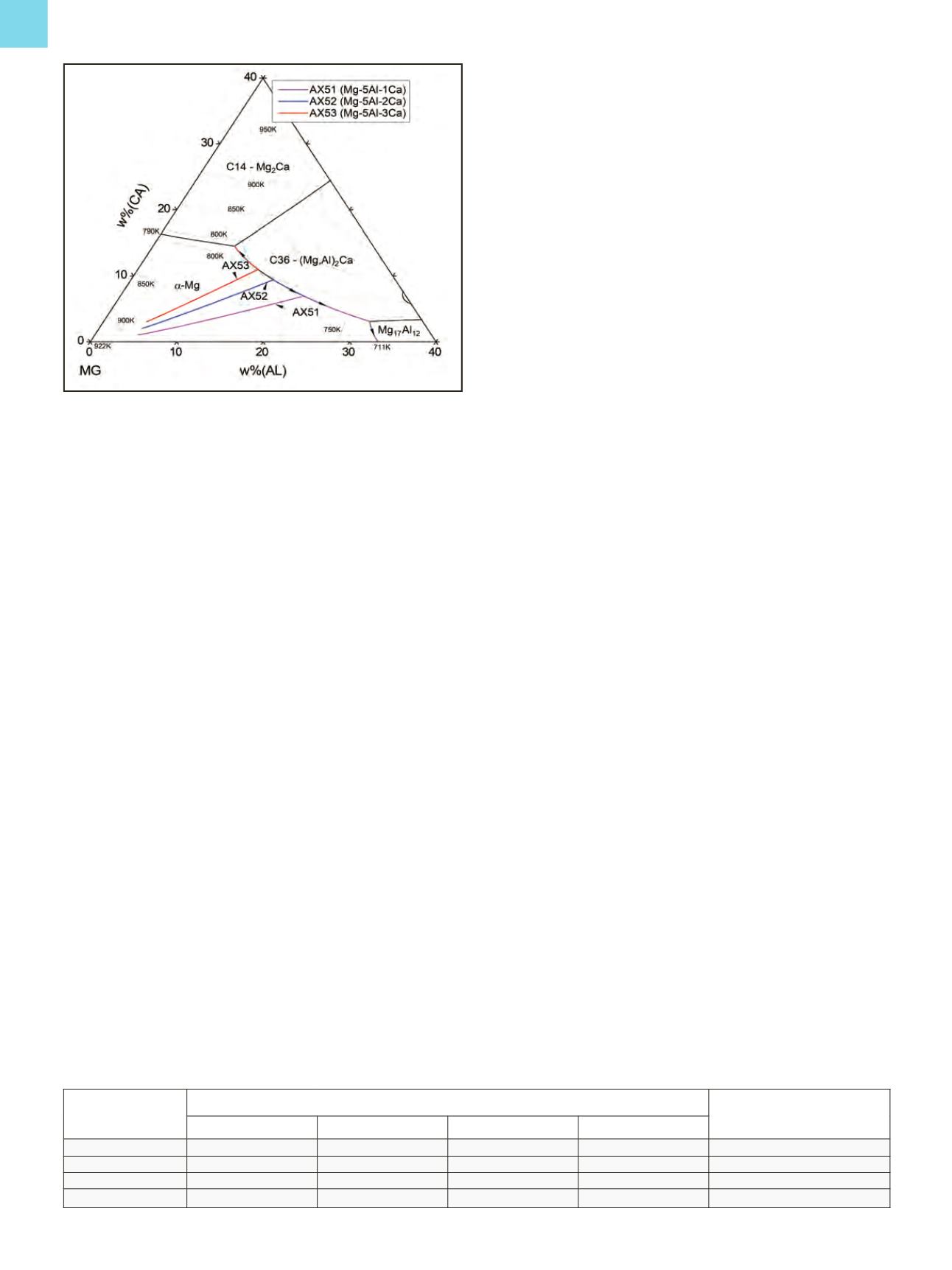
the more expensive AE alloys. Figure 1(c) shows
the calculated liquidus projection of the Mg-Al-Ca
system, superimposed by the solidification paths
of three Mg-Al-Ca alloys, AX51 (Mg-5Al-1Ca), AX52
(Mg-5Al-2Ca), and AX53 (Mg-5Al-3Ca), calculated
using the Scheil model. Based on simulation results,
the solidification sequence for AX51 and AX52 alloys
are as follows:
1) Nucleation of primary magnesium: L —> L + Mg
2) Binary eutectic reaction: L —> L + Mg + (Mg,Al)
2
Ca
3) Type II invariant reaction:
L + (Mg,Al)
2
Ca —> L + Mg + Mg
17
Al
12
4) Binary eutectic reaction: L —> Mg + Mg
17
Al
12
AX53 alloy has a different ternary eutectic reaction
where Mg
2
Ca is formed instead of Mg
17
Al
12
, resulting
in a slightly different solidification path:
1) Nucleation of primary magnesium: L —> L + Mg
2) Binary eutectic reaction: L —> L + Mg + (Mg,Al)
2
Ca
3) Ternary eutectic reaction :
L —> Mg + (Mg,Al)
2
Ca + Mg
2
Ca
Both (Mg,Al)
2
Ca (C36) and Mg
2
Ca (C14) phases have
high eutectic temperatures and are beneficial to the
creep resistance of Mg-Al-Ca alloys, likely due to the
grain boundary strengthening mechanism
[10]
.
The Scheil model was also used to calculate the
fractions of (Mg,Al)
2
Ca, Mg
2
Ca, and Mg
17
Al
12
phases
formed in all the AX alloys according to the above
solidification paths, and results are summarized in
Table 2. It only requires 2.8% Ca to completely
suppress the formation of Mg
17
Al
12
in the Mg-5Al
alloy
[3]
, which compares to 15% Ce needed in the
Mg-4Al alloy. Therefore, Ca is more effective (and less
expensive) than rare earth elements (such as Ce) in
suppressing the Mg
17
Al
12
phase formation in Mg-Al
based alloys. AX53 alloy is presently being evaluated
by General Motors for automotive powertrain
applications.
High-throughput diffusionmultiples for
atomicmobility database development
While the thermodynamic characteristics and
equilibrium phase diagrams for magnesium and its
alloys are reasonably well understood, the phase
transformation and diffusion behavior of these alloys
is not yet clear
[11]
. Diffusion multiples can be used
to generate plenty of diffusion data to fill this gap.
A diffusion multiple is an assembly of several metal
blocks arranged in a predesigned geometry to allow
many diffusion couples and triples to be assembled in
a single sample
[12,13]
.
To study major magnesium alloy systems, diffusion
multiples provide large amounts of binary diffusion
profiles for nine binary systems (Mg-Al, Mg-Zn, Mg-
Sn, Mg-Ca, Mg-Sr, Mg-Mn, Al-Zn, Al-Mn, and Mn-Zn)
as input to diffusivity extraction. Figure 2(a) shows
an example of an Mg-Mn diffusion multiple heat
treated at 600
o
C for 48 hours. No intermetallics layer
Fig. 1(c) —
Calculated Mg-Al-Ca liquidus projection and the
solidification paths of the experimental Mg-Al-Ca alloys.
TABLE 2 — SCHEIL SIMULATION AND EXPERIMENTAL RESULTS OF SECOND PHASES
OF MG-AL-CA ALLOYS (BASELINE: AM50 ALLOY)
Alloy
Scheil calculation, vol%
Measurement, vol%
Total fraction
(Mg,Al)
2
Ca
Mg
2
Ca
Mg
17
Al
12
Total fraction
AX51
2.0
0
2.7
4.7
5.5
AX52
4.1
0
0.9
5.0
5.8
AX53
5.8
0.1
0
5.9
6.2
AM50
—
—
4.3
4.3
4.8
2 8
A D V A N C E D M A T E R I A L S & P R O C E S S E S | J A N U A R Y 2 0 1 5