


 26 / 58

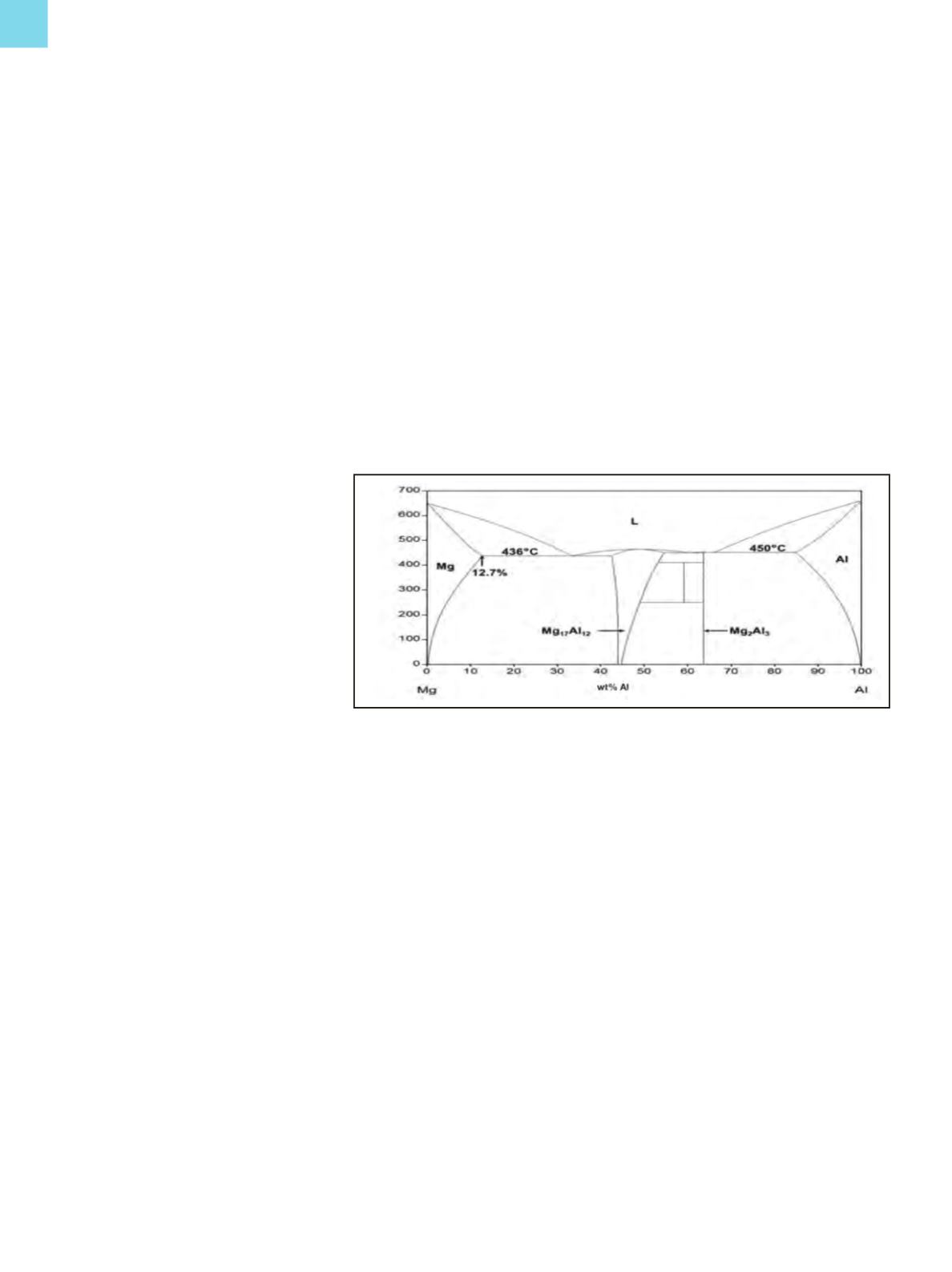
Fig. 1(a) —
Calculated Mg-Al phase diagram.
COMPUTATIONAL
THERMODYNAMICS AND
KINETICS FORMAGNESIUM
ALLOY DEVELOPMENT
2 6
Computational thermodynamics and CALPHAD modeling prove useful
for selecting and developing new magnesium alloys.
Alan A. Luo, FASM*, Weihua Sun, Wei Zhong, and Ji-Cheng Zhao*, The Ohio State University, Columbus
L
ightweighting is a well-known
strategy for increasing
energy efficiency and reduc-
ing greenhouse gas emissions.
Magnesium, the lightest structural
metal, will thus see increased
use in a wide range of structural
and functional applications for
energy generation and storage,
propulsion, and transportation
[1]
.
Current industrial applications for
magnesium alloys are confined to
nonstructural or semi-structural
components, due to the limited
mechanical properties of conven-
tional Mg-Al-based alloys such
as AZ91 (Mg-9Al-1Zn) and AM60
(Mg-6Al-0.3Mn). New magnesium
alloys are being developed with
higher strength, ductility, and
creep resistance at room and
elevated temperatures
[2-3]
.
This article summarizes an
ongoing effort to establish
a scientific foundation of
computational thermodynamics
and kinetics of magnesium alloys
to achieve accelerated design
and optimization of these alloys
for weight reduction in the
transportation industries. All
*Member of ASM International
compositions are listed as wt%
unless otherwise stated.
Computational
thermodynamics
and alloy design
Originated from the early work
of Kaufman and Bernstein
[4]
, the
CALPHAD (CALculation of PHAse
Diagrams) technique—based on
computational thermodynamics
of alloy systems—has matured
over the past few decades. Many
commercial software packages,
such as Thermo-Calc, FactSage,
and Pandat, have become
important integrated
computational materials
engineering (ICME) tools used
in the development of new
materials and products
[4]
. This
section demonstrates examples
of applying computational
thermodynamics and CALPHAD
modeling in the development of
new creep-resistant magnesium
alloys using the Pandat code and its
PanMagnesium database
[5]
.
Mg-Al system
Aluminum is the most widely
used alloying addition in
magnesium for strengthening
and castability. Figure 1(a) shows
the calculated Mg-Al phase
diagram. Two eutectic reactions are
important to the phase constitution
of Mg-Al binary alloys:
1) 450°C L —> Al + Mg
2
Al
3
2) 436°C L —> Mg + Mg
17
Al
12
A D V A N C E D M A T E R I A L S & P R O C E S S E S | J A N U A R Y 2 0 1 5
T,
o
C