


 21 / 58

A
dditive manufacturing (AM)
is commonly defined as the
production of a functional
engineering component built one
layer at a time from computer aided
design (CAD) data. Applicable metal
AM technologies produce a volume
of material in a layerwise fashion
by melting a material feedstock
(powder, wire) with an energy source
(laser, electron beam, electric arc)
that follows a tool path derived from
the CAD model.
The ability of AM processes such
as laser powder bed fusion (L-PBF)
to create complex geometries has
caused rapid growth in a number of
industries. Energy savings, less ma-
terial waste, faster design-to-build
time, design optimization, reduction
in manufacturing steps, and product
customization are the most import-
ant advantages of AM.
Manufacturers can purchase
turnkey solutions from equipment
providers that include the machine,
process parameters, and even pow-
der. This approach enables produc-
tion of complicated parts quickly,
but the choice of materials available
is very limited. Demand for addition-
al materials and a desire to explore
other applications requires devel-
opment of material parameters with
an understanding of welding metal-
lurgy, laser powder interaction, and
post-process manufacturing steps
such as heat treatment. This article
describes the outcomes of process
development of a steel and stain-
less steel alloy that are not standard
materials for L-PBF equipment.
Two steel alloys including AISI
420 and AISI 4140 were fabricated
by an L-PBF process. The influence
of both processing parameters and
heat treatment on the microstruc-
tural characteristics of AISI 420 were
investigated. The mechanical prop-
erties of AISI 4140 produced by AM
were also measured and compared
with properties of the conventionally
manufactured alloy.
Methods andmaterials
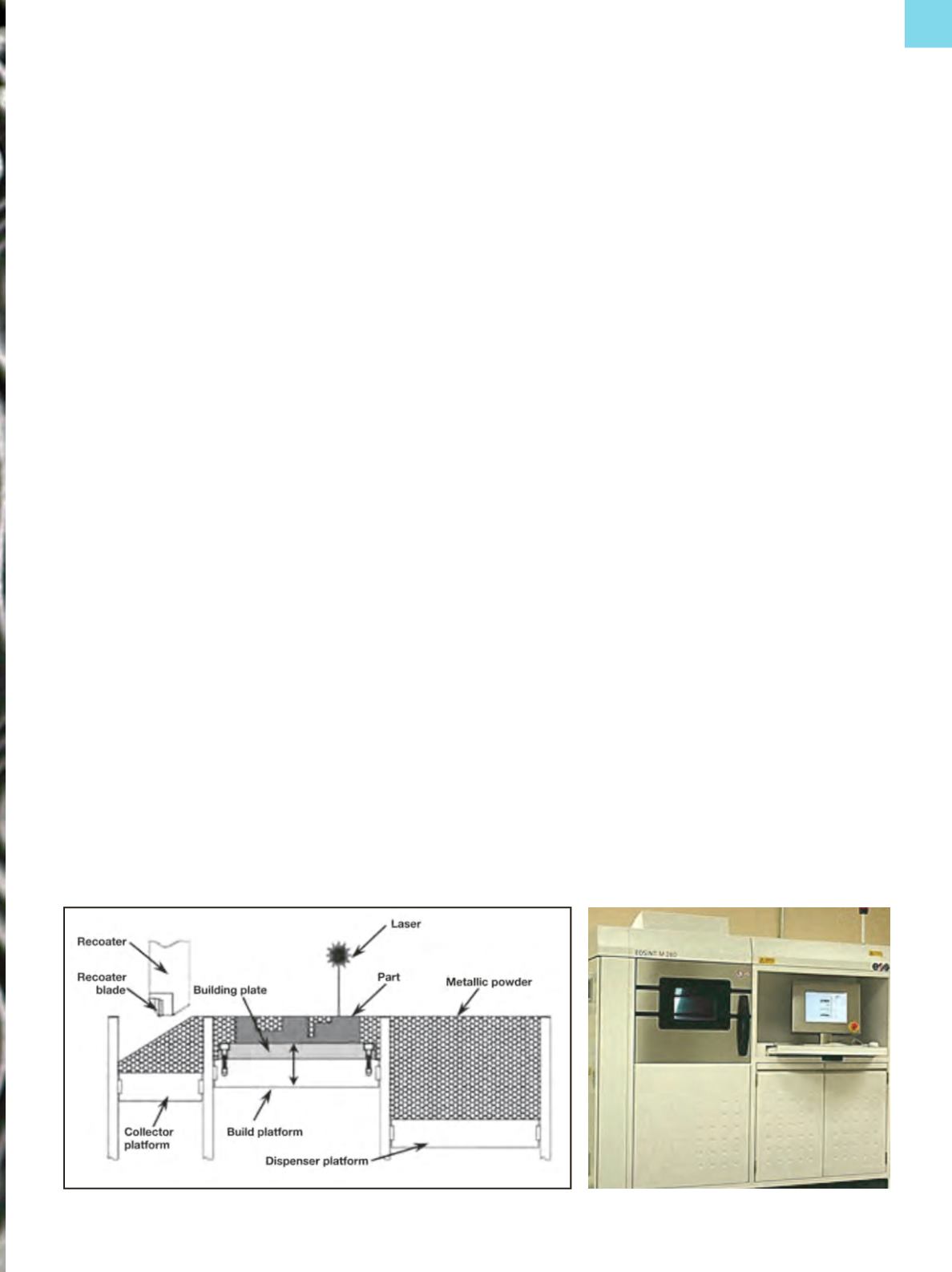
A schematic of the L-PBF process
or direct metal laser sintering (DMLS)
equipment is illustrated in Fig. 1
[1]
.
The build platform is preheated to
a temperature that is usually below
100°C and a recoating system
spreads a thin layer (20-80 µm) of
powder over the platform. Next,
a laser beam scans the powder
bed according to a tool path
generated from the part’s 3D CAD
model. Depending on the L-PBF
machine, laser power outputs range
from 200 to 1000 W of maximum
continuous output. The absorption
of laser energy melts the metal
powder, resulting in a metallurgical
bond between the current and
pre-deposited layers. This process
continues until the complete
3D design is manufactured layer-by-
layer.
Coupon fabrication was
performed using a commercially
available L-PBF machine (M280
Direct Metal Laser Sintering from
EOS, Germany) in EWI’s AM
laboratory. A liquid argon dewar
provided the shield gas and the
oxygen level in the process chamber
was maintained below 0.1%.
Powders were also screened through
an 80 µm sieve for use in the M280.
General parameters used for the
two materials in this study are shown
in Table 1.
AISI 420 coupons were heat
treated and hardened by heating to
1000°C±10°C with a heating rate of
12°C/min, and holding time of 15
minutes, followed by oil quenching.
Tempering at 550°C for 30 minutes
achieved high hardness.
Tensile testing of AISI 4140
was performed at room temperature
according to ASTM E8 standard
using a 0.25-in. diameter gage
specimen, with a loading rate of
0.02 in./min (1.27 mm/min). The
Charpy notched bar impact test
was performed at -18°C according
to ASTM E23. Both the tensile
and Charpy impact tests were
investigated along and normal to
the build direction. All tensile and
Charpy impact tests were conducted
A D V A N C E D
M A T E R I A L S
&
P R O C E S S E S | J A N U A R Y
2 0 1 5
2 1
Fig. 1 —
Schematic of L-PBF process (left); EOSINT M280 (right)
[1]
.