


 16 / 58

BRIEFS
A123 Systems LLC,
Livonia, Mich., a manufacturer of advanced Nanophosphate
lithium-ion batteries and systems, completed the sale of its facilities for the
production of certain battery materials to Johnson Matthey, UK, a specialty
chemicals manufacturer. The facilities in Changzhou, China, produce lithium iron
phosphate (LFP), the cathode material that A123 has historically used across its
product portfolio.
a123systems.com,
matthey.com.
FIGURINGOUT
WHY RECHARGEABLE
BATTERIES FAIL
Michigan Technological University,
Houghton, researcher Reza Shahbazian-
Yassar wants to better map lithium
ion’s journey from cathode to anode
and back again with an ultimate aim to
make better batteries, with more power
and a longer life. Using transmission
electron microscopy, Anmin Nie, a senior
postdoctoral researcher in Shahbazian-
Yassar’s research group, recently
documented what can happen to anodes
as lithium ions work their way into them.
“We call it atomic shuffling,” says
Shahbazian-Yassar. “The layered structure
of the electrode changes as the lithium
goes inside, creating a sandwich structure.
There is lots of localized expansion and
contraction in the electrode crystals,
which helps the lithium blaze a trail.”
The atomic shuffling not only helps
explain how lithium ions move through
the anode, in this case a promising new
material called zinc antimonide, but also
provides a clue as to why most anodes
made of layered materials eventually
fail. “We showed that the ions cause a
lot of local stress and phase transitions,”
says Nie.
For more information: Reza
Shahbazian-Yassar, 906.487.3581,
reza@mtu.edu,
www.mtu.edu.
INEXPENSIVE REPLACEMENT
FORRAREMETAL AS FUEL-CELL
CATALYST
Graphene quantum dots created at Rice
University, Houston, grab onto graphene
platelets like barnacles attach themselves
to the hull of a boat. But they enhance
the base material’s properties while doing
so, making them better than platinum
catalysts for certain reactions within fuel
cells.
The Rice lab of chemist James Tour
created dots known as GQDs from coal
last year and now combined these
nanoscale dots with microscopic sheets
of graphene to create a hybrid that could
greatly cut the cost of generating energy
with fuel cells.
Researchers discovered that boiling down
a solution of GQDs and graphene oxide
sheets (exfoliated from common graphite)
combined them into self-assembling
nanoscale platelets that could then be
treated with nitrogen and boron. The
hybrid material combines the advantages
of each component—an abundance of
edges where chemical reactions take
place and excellent conductivity between
GQDs provided by the graphene base. The
boron and nitrogen collectively add more
catalytically active sites to the material
than either element would contribute
alone.
For more information: James Tour,
tour@rice.edu, jmtour.com.
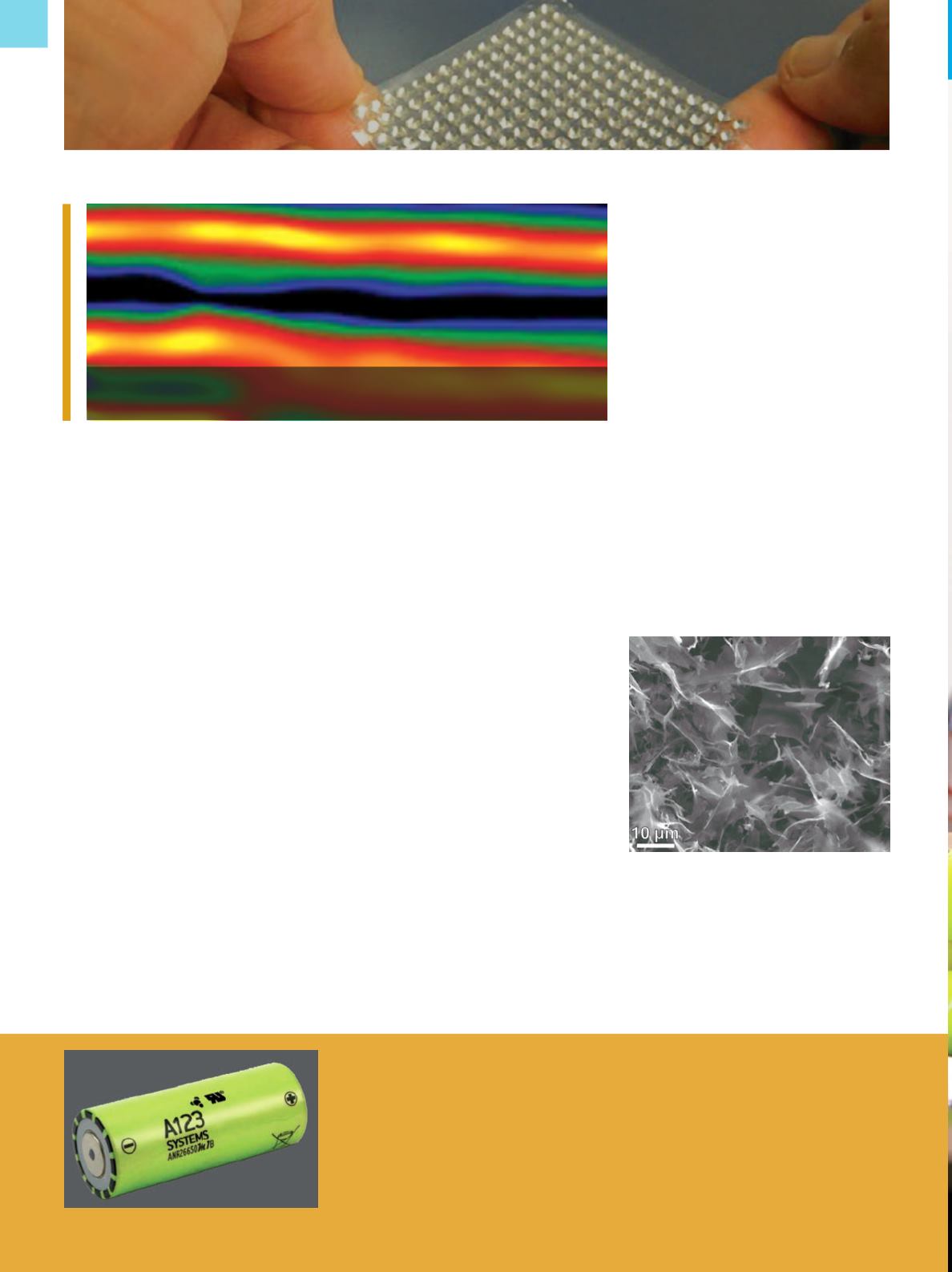
Color-enhanced image reveals how the structure of zinc-antimonide changes as
lithium ions enter the anode. Courtesy of Anmin Nie.
A D V A N C E D M A T E R I A L S & P R O C E S S E S | J A N U A R Y 2 0 1 5
1 6
ENERGY TRENDS
Electron microscope image shows flake-
like nanoplatelets made of graphene
quantum dots drawn from coal and
graphene oxide sheets, modified with
boron and nitrogen. The nanoplatelets
feature enough edges to make them
suitable as catalysts for applications like
fuel cells. Courtesy of the Tour Group.