


 18 / 58

BRIEFS
Researchers at the
Vienna University of Technology, Austria,
developed a new
type of optical switch by coupling gold nanoparticles to ultra-thin glass fibers.
They used the property of spin-orbit coupling of light, which enables light to be
focused in a single direction. The nanoparticles emit light into these fibers in a
specific manner so that the light travels in either the left or right direction.
www.tuwien.ac.at/en.
ELECTRICMOTORDESIGN
REPLACESCOPPER IN
WINDINGS
Researchers at Lappeenranta University
of Technology (LUT), Finland, constructed
the world’s first prototype electrical motor
using electrically conductive carbon
nanotube yarn in the motor windings,
potentially significantly enhancing
performance. The test motor has an
output power of 40 W, rotates at
15,000 rpm, and achieves almost 70%
efficiency.
“If we keep the electrical machine
design parameters unchanged and
only replace copper with future
carbon nanotube wires, it is possible
to reduce the Joule losses in the
windings to half the present-day
machine losses. Carbon nanotube
wires are significantly lighter than
copper and also environmentally
friendlier. Therefore, replacing
copper with nanotube wires should
significantly reduce the CO
2
emissions
related to the manufacturing and
operation of electrical machines,” says
professor Juha Pyrhönen.
www.lut.fi/web/en.COUPLEDWAVEGUIDESON
CHIPS ENHANCE QUANTUM
COMPUTING
Commercial devices capable of
encrypting information in unbreakable
codes are only possible due to recent
quantum optics advances, especially
the generation of photon pairs—
tiny entangled particles of light. An
international team of researchers, led by
professor Roberto Morandotti of INRS-EMT
in Canada, is introducing a new method
to achieve a different type of photon pair
source that fits into the tiny space of a
computer chip.
The method, which generates “mixed
up” photon pairs from devices that are
smaller than 1 mm
2
in area, could form
the core of next-generation quantum
optical communication and computing
technology. One of the properties of
light exploited within quantum optics
is photon polarization, essentially the
direction in which the electric field
associated with the photon oscillates.
The research team set out to find a way
to directly mix up, or cross-polarize, the
photons via a nonlinear optical process
on a chip.
To generate the cross-polarized photons,
researchers used two different laser
beams at different wavelengths—
one vertically polarized and another
horizontally polarized. The approach,
however, came with a potential pitfall: The
classical process between the two pump
beams could destroy the photons’ fragile
quantum state. To address this challenge,
the team pioneered a new approach
based on a micro-ring resonator—a tiny
optical cavity with a diameter on the order
of tens to hundreds of micrometers—
that operates in such a way that energy
conservation constraints suppress
classical effects while amplifying quantum
processes.
For more information: Roberto
Morandotti, 514.228.6924,
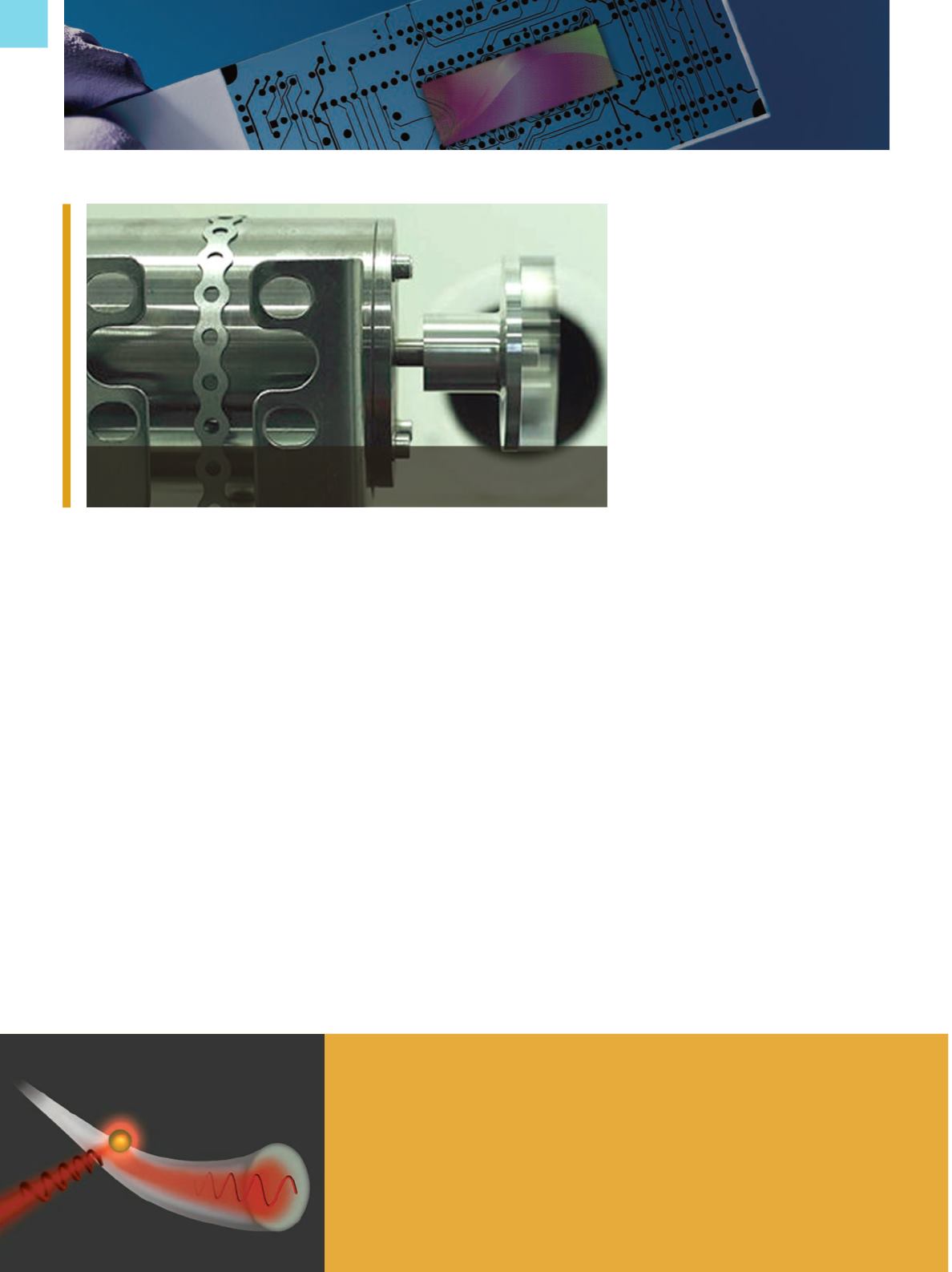
roberto.morandotti@emt.inrs.ca, www.inrs.ca.LUT’s prototype motor has an output power of 40 W and achieves nearly 70%
efficiency. Courtesy of LUT.
A D V A N C E D M A T E R I A L S & P R O C E S S E S | J A N U A R Y 2 0 1 5
1 8
NANOTECHNOLOGY
Light hits a gold particle, which then
emits light into a glass fiber—in only
one direction. Courtesy of TU Vienna.