


 22 / 58

on samples with a machined surface
finish. Hardness was measured
according to ASTM E18 by using a
normal load of 150 Kg.
Materials characteristics
Both the AISI 420 stainless steel
and AISI 4140 steel powders were
produced by Carpenter Powder
Products, Reading, Pa. Table 2
shows the chemistry, particle
size characteristics, and packing
characteristics of the AISI 4140
powder (from vendor certification).
A LECO CS400 analyzer performed
carbon and sulfur analysis. Nitrogen
and oxygen were measured by
the inert gas fusion method. The
powder had a distribution of -270
mesh/+22µm. Chemical analysis and
powder size distribution of AISI 420
are shown in Table 3.
AISI 420 results
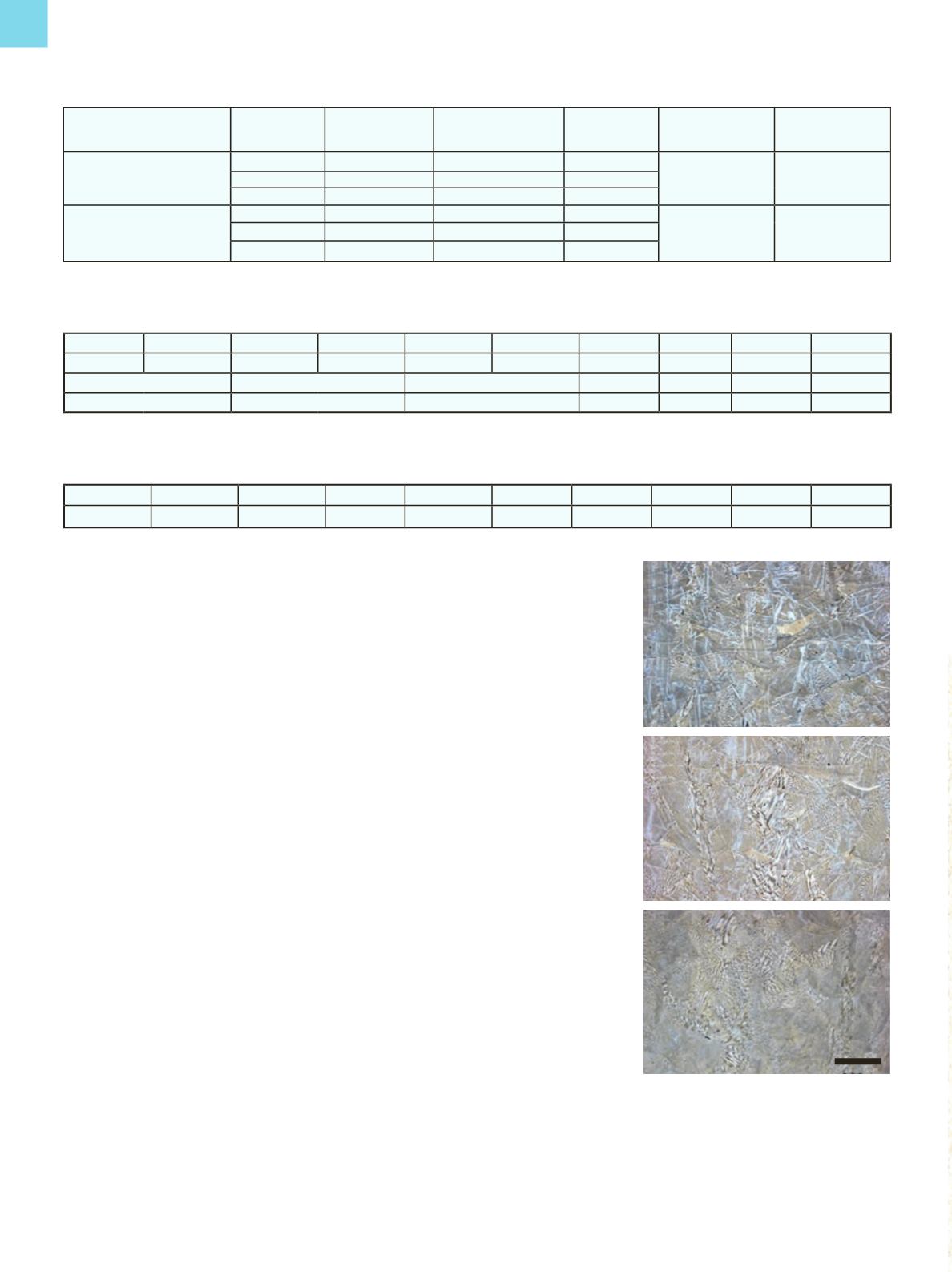
Figure 2 compares the
microstructure of the as-built AISI
420, where the a, b, and c indexes
represent coupons fabricated
by low, moderate, and high heat
input, respectively. Each individual
laser scan is indicated in the
metallographic cross-sections by
a solidification line. The as-built
microstructure exhibits homogenous
cellular dendrite structure, which
grew epitaxially along the build
direction. Some columnar dendrites
were large enough to traverse
several individual layers.
The as-built microstructure
was martensitic in all cases, with
some retained austenite. However,
depending on the level of heat
input, various amounts of austenite
were formed with different
morphologies. The moderate heat
input sample retained much more
austenite in the shape of separated
longitudinal islands. Each feature
consisted of very fine, parallel
cylindrical retained austenite grains.
The microstructure of AISI 420
coupons after quench and temper
heat treatment is shown in
Fig. 3. Heat treatment eliminates
the original dendrite structure
and fusion boundaries resulting in
formation of recrystallized grains. All
A D V A N C E D M A T E R I A L S & P R O C E S S E S | J A N U A R Y 2 0 1 5
2 2
Fig. 2 —
Effect of heat input on
microstructure of as-built AISI 420
stainless steel: (a) Low heat input
(P=200 W, v=1000 mm/s);
(b) Moderate heat input (P=300 W,
v=1000 mm/s); and (c) High heat input
(P=300 W, v=800 mm/s).
100
m
m
(a)
(b)
(c)
TABLE 1—PROCESS PARAMETERS USED FOR L-PBF OF AISI 4140 STEEL
AND AISI 420 STAINLESS STEEL
Material
Coupon ID Power, P (W) Scanning speed,
v (mm/s)
P/v (J/mm)
Layer
thickness (µm)
Preheat temp.
(°C)
AISI 420 stainless steel
a
200
1000
0.200
30
35
b
300
1000
0.300
c
300
800
0.375
AISI 4140
a
317
1000
0.317
40
80
b
350
867
0.403
c
283
600
0.471
TABLE 2—CHEMICAL COMPOSITION (WT%), PARTICLE SIZE
AND PACKING CHARACTERISTICS OF AISI 4140 POWDER
C
Mn
P
S
Si
Cr
Mo
Fe
N
O
0.44
0.9
<0.01
<0.02
0.21
1
0.21
bal
0.03
0.02
Tap density
4.8 g/cm
3
>270 Mesh
D10
D50
D90
<22 µm
Apparent density
4.0 g/cm
3
5%
34.3 µm 42.2 µm 72.7 µm 0%
TABLE 3—CHEMICAL COMPOSITION (WT%), PARTICLE SIZE
AND PACKING CHARACTERISTICS OF AISI 420 POWDER
C
Si
Mn
P
S
Cr
Ni
Mo
N
Fe
0.42
0.54
0.33
0.014
0.01
13.3
0.37
0.06
0.092
bal