


 11 / 58

1 1
A D V A N C E D
M A T E R I A L S
&
P R O C E S S E S | J A N U A R Y
2 0 1 5
PHOTOCONTEST
CELEBRATESMICROSCOPY
The University of Cambridge, UK,
announced the 2014 winners of its
Department of Engineering photo
competition sponsored by ZEISS,
headquartered in Germany. The
annual competition aims to show the
breadth of engineering research at the
university, from nanoscale objects to
major infrastructure. First place was
awarded to Indrat Aria, for his image
entitled
Asteroidea Electrica,
pictured
on the cover of this issue. The Electron
Microscopy Prize was given to Tanvir
Qureshi for his image of a bridge forming
in self-healing concrete. The sample was
collected from the cement’s self-healing
zone, where flowerlike bridges effectively
expand and heal the cracks.
www.cam. ac.uk, zeiss.com.
TESTING | CHARACTERIZATION
BRIEFS
Neil Sarkar, a researcher at the University of Waterloo’s Centre for Integrated RF
Engineering (CIRFE), Ontario, received the Douglas R. Colton Medal for Research
Excellence from CMC Microsystems for research and development of the world’s
first single-chip atomic force microscope. The $1000 microscope opens new
possibilities in nanoscale research and manufacturing.
www.uwaterloo.ca.Single-chip desktop atomic force
microscopy on a penny.
Self-Healing Concrete,
the Electron
Microscopy Prize winner of the University
of Cambridge’s annual photo contest.
Courtesy of Tanvir Qureshi.
MICROGRAVITYMETALS
RESEARCHHOLDS PROMISE FOR
MATERIALSMODELS
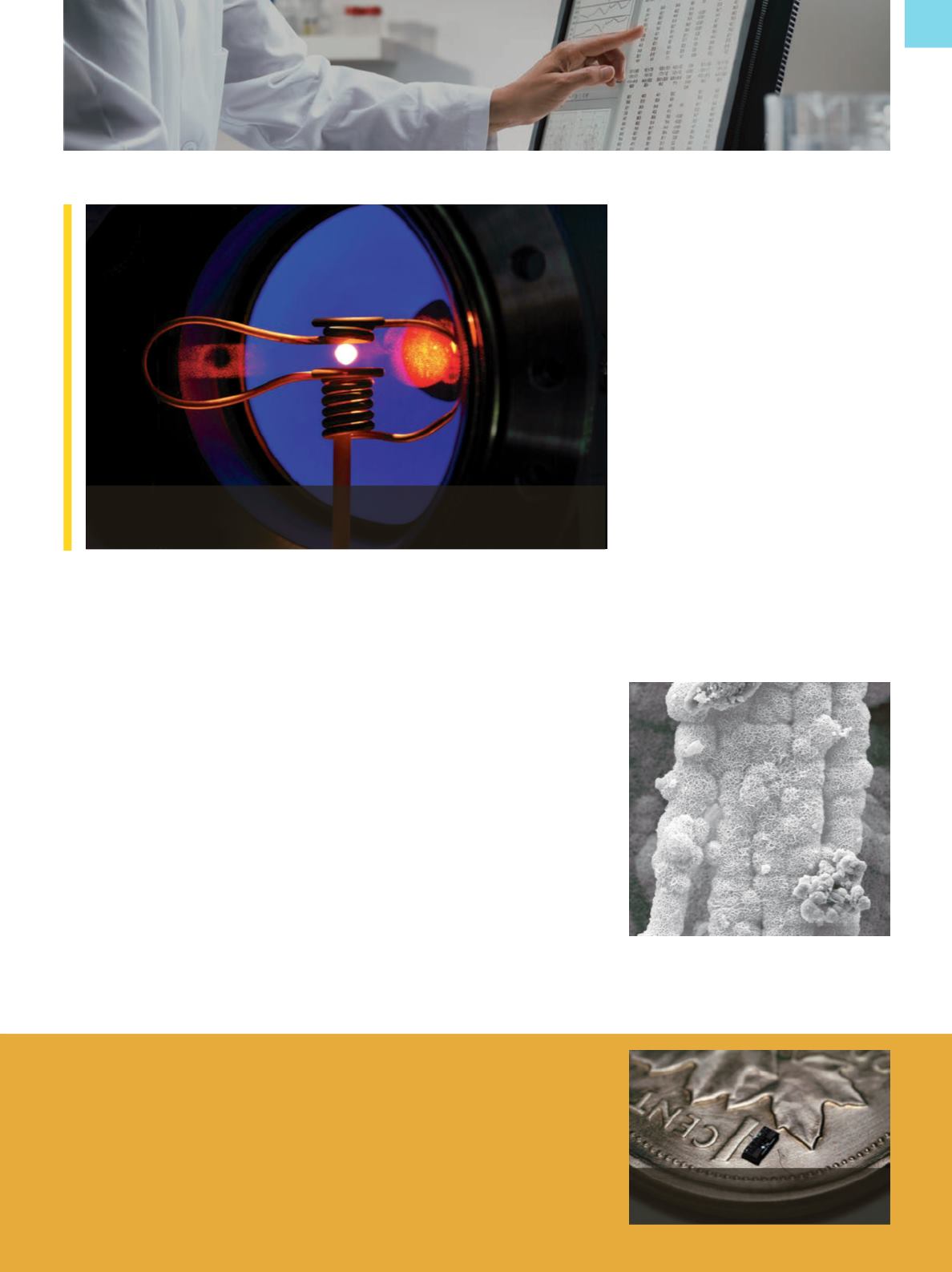
A new European Space Agency (ESA)
facility aboard the International Space
Station (ISS) will serve as a furnace
capable of levitating and heating
metals up to 3632°F. The microgravity
environment allows the observation of
fundamental physical processes that
occur as liquid metals cool. ESA’s final
Automated Transfer Vehicle (ATV-5)
mission to the space station delivered
the Materials Science Laboratory
Electromagnetic Levitator (MSL-EML) and
its first batch of new materials science
investigations. EML research will provide
insight into how liquid metals cool
without the influence of gravity or the
mold that encases the cooling metals.
EML processes one sample at a time. Each
sample is suspended in weightlessness,
supported by magnetic repulsion, and
then heated to liquefaction. No
containers are used to hold the metals
during experiments, so measurements
can be taken in the purest form. One
of the studies in this first batch of EML
investigations is called Thermolab. This
15-nation collaboration led by Hans
Fecht, a professor at Ulm University,
Germany, includes a number of samples
with multiple experiments per sample
occurring during the next two to five
years. Thermolab will investigate
temperatures and physical properties of
industrial alloys in the liquid phase to help
improve models of industrial casting and
solidification processes for materials used
in aerospace, automotive, and consumer
electronics applications.
www.esa.int.The new electromagnetic levitator aboard the ISS suspends liquid metals in
weightlessness as they cool and solidify in ESA’s Columbus laboratory. Courtesy
of German Aerospace Center, DLR.