


 10 / 58

BRIEFS
Momentive Specialty Chemicals Inc., Columbus, Ohio, won the People’s Choice
Award for the “Most Innovative Composite Part” at the Society of Plastics
Engineers Automotive Composites Conference & Exhibition. The winning
component was a lightweight, carbon fiber epoxy door and window frame profile
produced by Benteler-SGL for 2013 and later Porsche 911 GT3 Cup coupes.
momentive.com.
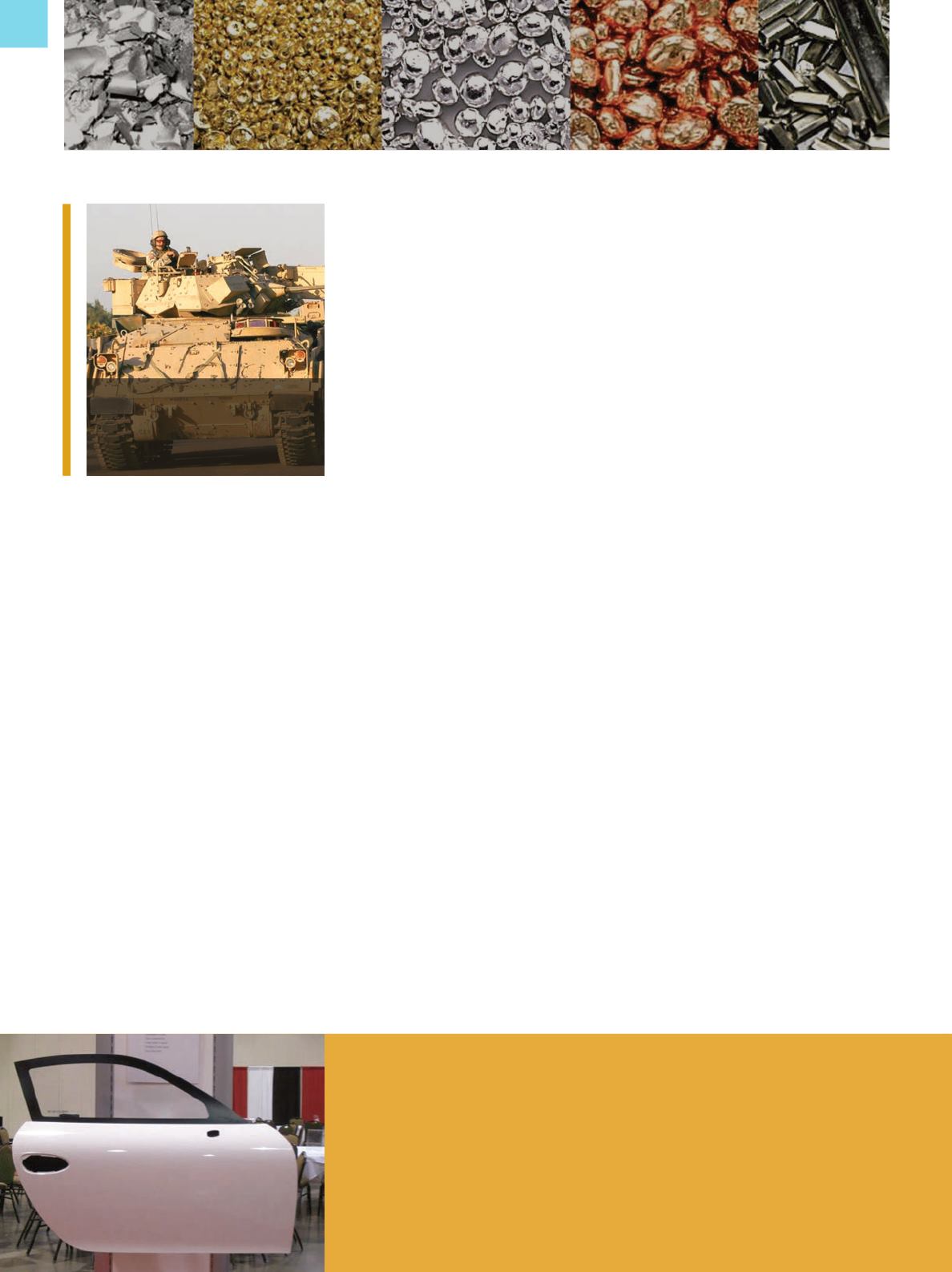
WORLD’S LARGEST SINGLE-
PIECE FORGEDALUMINUM
HULL PROTECTS TROOPS
Alcoa Inc., Cleveland, produced the world’s
largest single-piece forged aluminum
hull for combat vehicles to improve troop
protection as part of a joint initiative with
the U.S. Army. Alcoamanufactured the
single-piece part, which was codesigned
with the Army Research Laboratory, with the
goal of replacing today’s assembled hulls.
Based on early modeling and simulation,
single-piece underbody structures could
provide two times better protection
against blasts—such as those caused by
improvised explosive devices (IEDs)—than
traditional hulls, primarily by eliminating
welded seams. In addition to survivability
benefits, single-piece hulls can be
optimized to reduce vehicle weight and
assembly time, and therefore overall cost.
The Army is now blast testing the hull to
demonstrate its durability. If successful,
this initiative could open up numerous
opportunities for the military to apply
single-piece structures to large combat
vehicles and other applications.
alcoa.com,
arl.army.mil.
RADICAL POLYMERS
CONDUCT ELECTRICITY
An emerging class of electrically
conductive plastics called
radical
polymers
may bring low cost, transparent
solar cells, flexible and lightweight
batteries, and ultrathin antistatic coatings
for consumer electronics and aircraft.
Researchers have established the solid-
state electrical properties of one such
polymer, called PTMA, which is about 10
times more electrically conductive than
common semiconducting polymers. “It’s
a polymer glass that conducts charge,
which seems like a contradiction because
glasses are usually insulators,” said
Bryan Boudouris, an assistant professor
of chemical engineering at Purdue
University, West Lafayette, Ind.
The polymer is easy to manufacture
and resembles Plexiglas. To create it,
researchers use a procedure called
deprotection, which involves replacing a
specific hydrogen atom in the pendant
group with an oxygen atom, converting it
into a so-called radical group. The oxygen
atom in PTMA has one unpaired electron
in its outer shell, making it amenable
to transporting charge. “You have to
control the deprotection process very well
because it makes the conductivity vary
by orders of magnitude,” says Boudouris.
The deprotection step can lead to four
distinct chemical functionalities of
the radical polymer, two of which are
promising for increasing conductivity.
For more information: Bryan Boudouris,
765.496.6056,
boudouris@purdue.edu,
www.purdue.edu.
SHAPE-SHIFTINGMATERIAL TO
HELP CORRECT FACIAL DEFECTS
A newly developed shape-shiftingmaterial
that molds itself to fill gaps in bone while
promoting bone growth couldmore
effectively treat defects in the facial region,
according to researchers at Texas A&M
University, College Station. Melissa Grunlan,
associate professor in the university’s
Department of Biomedical Engineering,
is working with colleagues at Texas A&M
and Rensselaer Polytechnic Institute, Troy,
N.Y. Together they created a polymer foam
that is malleable after treating with warm
saline, allowing it to precisely fill a bone
defect before hardening into a porous,
spongelike scaffold that promotes new
bone formation.
The team envisions the material as a
treatment for cranio-maxillofacial bone
defects—gaps in bone occurring in the
head, face, or jaw areas. The polymer
foam acts as a scaffold while promoting
healing by allowing bone cells to migrate
into the area and repair damaged tissue.
Ultimately the scaffold dissolves, leaving
behind new bone tissue, says Grunlan.
For more information: Melissa Grunlan,
979.845.2406,
mgrunlan@tamu.edu,
www.engineering.tamu.edu/biomedical.Alcoa manufactured the world’s
largest single-piece forged
aluminum hull for combat vehicles
as part of a joint Alcoa-U.S. Army
initiative. Courtesy of U.S. Army.
A D V A N C E D M A T E R I A L S & P R O C E S S E S | J A N U A R Y 2 0 1 5
1 0
METALS | POLYMERS | CERAMICS