


 9 / 58

ANATOMICAL BODY PARTS
PRODUCEDBY
3D PRINTING
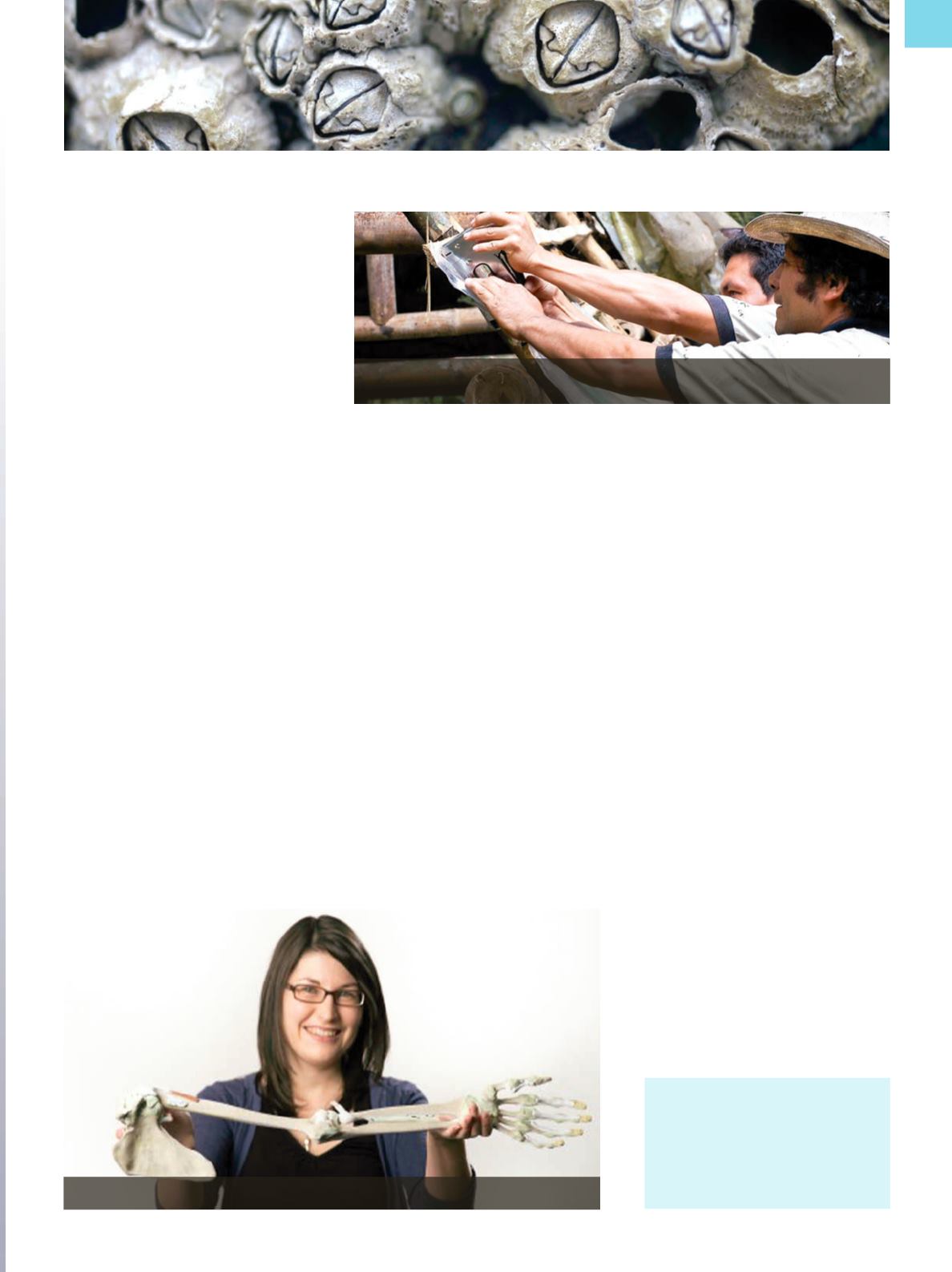
The 3D Printed Anatomy Series,
developed at Monash University,
Australia, is thought to be the first
commercially available resource of
its kind. The kit contains no human
tissue, yet provides all the major body
parts required to teach anatomy of the
limbs, chest, abdomen, head, and neck.
Professor Paul McMenamin says the
simple kit could dramatically improve
trainee doctors’ and other health
professionals’ knowledge and could
even contribute to development of new
surgical treatments.
After scanning real anatomical
specimens with either a CT or surface
laser scanner, body parts are 3D printed
either in a plaster-like powder or in
plastic, resulting in high resolution,
accurate color reproductions.
“Radiographic imaging, such as CT, is
a sophisticated means of capturing
information in very thin layers. By
taking this data and making a 3D
rendered model, we can then color that
model and convert it to a file format
that the 3D printer uses to recreate a
body part to scale,” says McMenamin
.
www.monash.edu.au.
PLASTICBOTTLES
RECYCLED INTOGREEN
ROOFS
David Saiia, a professor at Duquesne
University, Pittsburgh, came up with
an alternative to tin thatched roofs
commonly used in South America:
Plastic thatch, sourced from soda-
bottle waste. The tops and bottoms
of the bottles are sliced off and the
remaining body is flattened and cut
into strips, which are then adhered to
a cross-strip using ultrasonic sealing
machines. Plastic thatch combines the
waterproof qualities of tin with better
ventilation. It also allows light to filter
in and muffles sound. Further, it is
made of local waste materials and will
provide livelihood fabricating, selling,
and installing roofs, which are expected
to last more than a decade. Another
bonus, discovered by a pilot
in Maqui Pacuna, a nature preserve in
Ecuador, is that dust and dirt gradually
accumulates on the thatch structures,
turning them into naturally occurring
green roofs (NOGRs). The soil also helps
diffuse the direct sunlight and adds
years to the life of the roof.
duq.edu.
UNSTICKINGNATURE’S
STRONGEST GLUE
An international team of scientists
led by Newcastle University, UK, and
funded by the U.S. Office of Naval
Research, has unlocked the secret of
one of nature’s strongest adhesives—
barnacle glue, as seen along the top
of this page. Researchers have shown
for the first time that barnacle larvae
release an oily droplet to clear the
water from surfaces before sticking
down using a phosphoprotein
adhesive. Research associate Nick
Aldred says the findings could pave the
way for development of novel synthetic
bioadhesives for use in medical
implants and microelectronics. The
research will also be important in the
production of new anti-fouling coatings
for ships.
www.ncl.ac.uk.Are you working with or have you
discovered a material or its properties
that exhibit
OMG - Outrageous
Materials Goodness
?
Send your submissions to
Julie Lucko at
julie.lucko@asminternational.org.
A D V A N C E D
M A T E R I A L S
&
P R O C E S S E S | J A N U A R Y
2 0 1 5
9
Michelle Quayle is pictured with part of the 3D Printed Anatomy Series.
OMG!
Workers build a plastic thatch roof in Ecuador. Courtesy of Flickr, Reuse Everything
Institute.