


 30 / 58

spherical according to experimental observations
[19]
. By
assuming a shape-preserved growth, the precipitate’s
shape could be treated as a sphere. The conversion
method described by Zhang, et al.
[20]
, is used to
calculate the equivalent particle size. Figure 4(a) shows
that the calculated number density for the two Mg-
Sn alloys is in agreement with the experimental data.
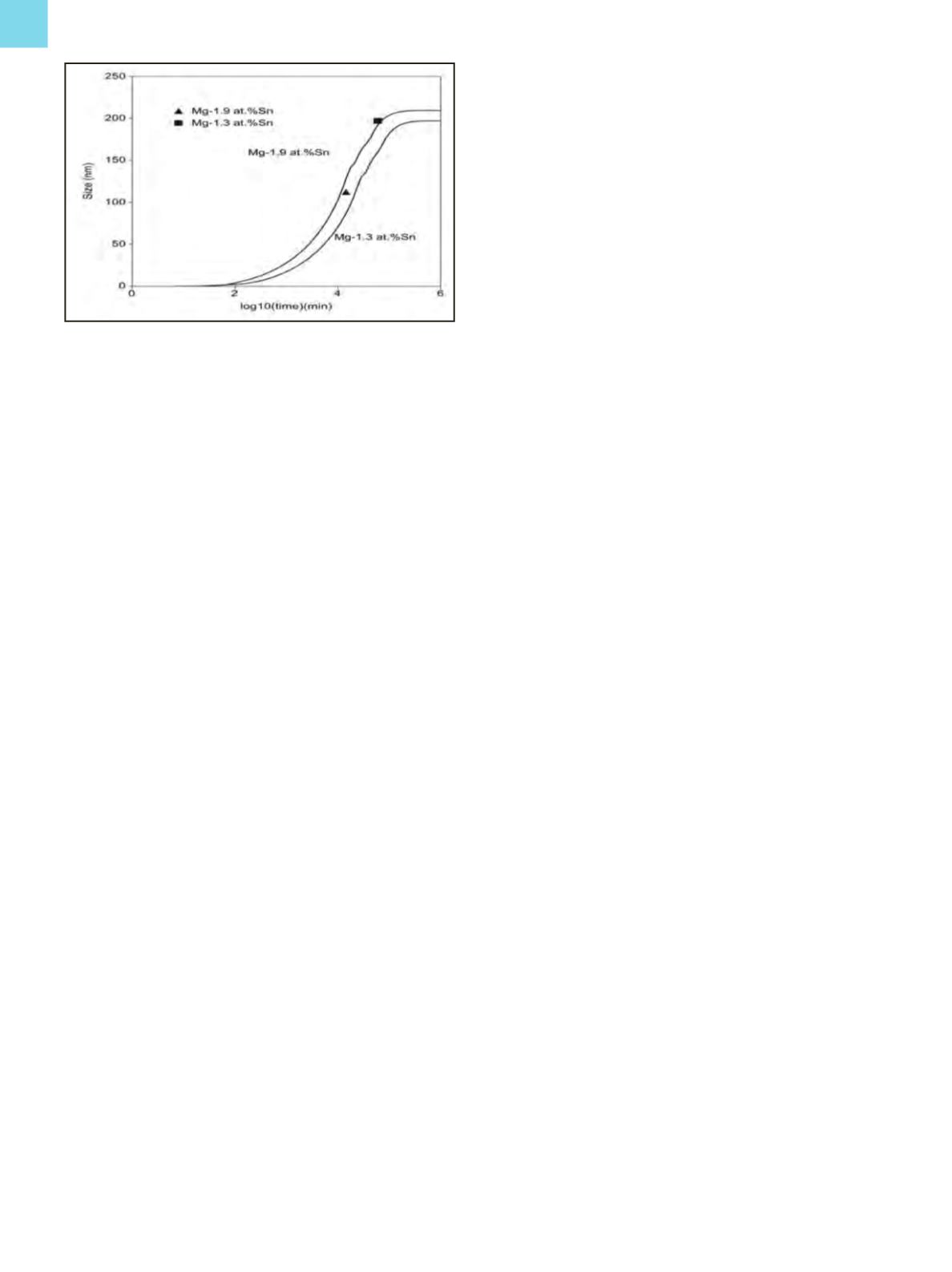
Figure 4(b) shows the predicted radius for Mg-1.9 at%
Sn alloy at 240 hours is 128 nm, which is consistent
with the experimental value of 112 nm. However, for
the Mg-1.3 at% Sn alloy, the simulated radius at
1000 hours is 160 nm, which is lower than the
experimental value of 197 nm, but still within the
experimental error range.
Summary
Computational thermodynamics and CALPHAD
modeling, when combined with critical experimental
validation, can be used to guide the selection
and development of new magnesium alloys. It is
demonstrated that Ca is more effective than RE elements
(such as Ce) in suppressing the formation of the
Mg
17
Al
12
phase in binary Mg-Al alloys and introducing
more thermally stable phases in the ternary alloys, thus
improving their creep resistance and strength at elevated
temperatures. AE44 alloy is used in engine cradle
applications and AX53 alloy is being developed by GM
for automotive powertrain applications.
The diffusion-multiple method, assembling several
metal/alloy blocks in a predesigned geometry,
allows many diffusion couples and triples in a single
sample and is a high-throughput technique for
extracting diffusivities for multicomponent alloy
systems. A preliminary atomic mobility database of
Mg alloys is established based on literature data and
estimation from empirical methods. A precipitation
simulation based on the classical KWN model has
been demonstrated in Mg-Sn alloys, showing good
agreement with experimental results.
~AM&P
Acknowledgments
The authors acknowledge the longtime collaboration with
Drs. Anil Sachdev andBobPowell of GeneralMotors Research
andDevelopment Center (Warren,Mich.). Drs. Chuan Zhang
andWeishengCaoof CompuThermLLC (Madison,Wis.)
provided support inmodelingwork usingPandat. This study
is based inpart uponwork supportedby theDOE’sOfficeof
Energy Efficiency andRenewableEnergy (EERE) under Award
Number DE-EE0006450. The views andopinions of authors
expressedhereindonot stateor reflect thoseof theU.S.
government or any agency thereof.
References
1. T.M. Pollock,
Science
, Vol 328, p 986, 2010.
2. A.A. Luo,
Int. Mater. Rev.
, Vol 49 (1), p 13, 2004.
3.A.A. Luo,B.R.Powell, andA.K.Sachdev,
Intermetallics
,Vol 24,
p22, 2012.
4. Y.A. Chang, et al.,
Prog. Mater. Sci.
, Vol 49, p 313, 2004.
5.
http://www.computherm.com.
6.W.E.Mercer II, SAETechnical Paper 900788, Society of
AutomotiveEngineers,Warrendale, PA, 1990.
7. P. Bakke and H. Westengen,
Magnesium Technology
,
TheMinerals, Metals &Materials Society (TMS), Warrendale,
PA, p 291, 2005.
8. A.A. Luo,
Proceedings of the 2nd World Congress
on Integrated Computational Materials Engineering
,
M. Li, et al., eds., TMS, Warrendale, PA, p 3-8, 2013.
9. J. Aragones, et al., SAE Technical Paper No. 2005-
01-0340, SAE International, Warrendale, PA, 2005.
10. A.A. Luo,M.P. Balogh, andB.R. Powell,
Metall. Mater. Trans.
A,
Vol 33, p567, 2002.
11. U.S. Department of Energy FundingOpportunity
Announcement (FOA) Number: DE-FOA-0000793, CFDA
Number: 81.086, 2013.
12. J.C. Zhao, Combinatorial Approaches as EffectiveTools
in the Study of PhaseDiagrams andComposition-Structure-
Property Relationships,
Prog. Mater. Sci.,
Vol 51, p557-631,
2006.
13. Q. Zhang and J.-C. Zhao,
Intermetallics
, Vol 34, p 132-
141, 2013.
14. F. Sauer andV.Z. Freise,
Elektrochem.
, Vol 66, p353, 1962.
15. C. Kammerer, et al.,
Magnesium Technology,
M.
Alderman, et al., Eds., TMS, Warrendale, PA, p 505-509,
2014.
16.S.Brennan,etal.,
Metall.Mater. Trans.A
,Vol 43(11),p4043-
4052, 2012.
17.K.N.KulkarniandA.ALuo,
J.PhaseEquilib.Diff.
,Vol34(2),p104-
115,2013.
18. R. Kampmann andR.Wagner, Decompositionof Alloys:
TheEarly Stages, Proceedings of the 2ndActa-Scripta
MetallurgicaConference; P. Haasen, V. Gerold, andR.Wagner,
Eds., PergamonPress, p91-103, 1983.
19. C.L. Mendis, et al.,
Phil. Mag. Lett.
, Vol 86(7), p 443-
456, 2006.
20. C. Zhang, et al.,
JOM
, Vol 66(3), p 389-396, 2014.
Fig. 4(b) —
Predicted radius of Mg
2
Sn precipitate in Mg-
1.3 at% Sn and Mg-1.9 at% alloys along with experimental
data
[19]
.
3 0
A D V A N C E D M A T E R I A L S & P R O C E S S E S | J A N U A R Y 2 0 1 5