


 35 / 58

3 5
A D V A N C E D
M A T E R I A L S
&
P R O C E S S E S | J A N U A R Y
2 0 1 5
Reduced weld distortion
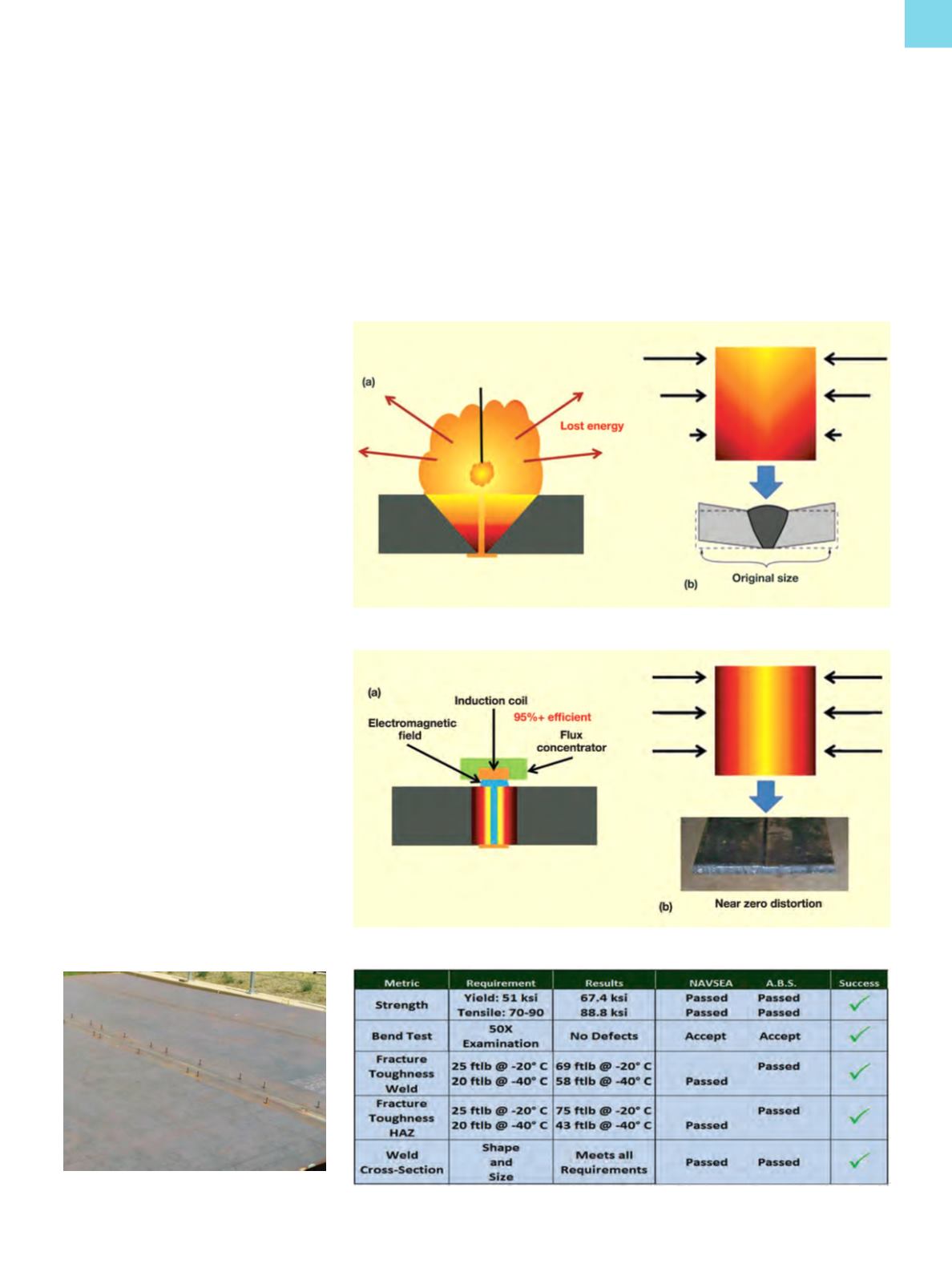
The primary heating
mechanism for the welding arc
is radiant heat transfer from
the arc plasma to the metal
components. A significant
amount of energy is lost to the
surrounding environment. The
surfaces of the weld closer to the
arc reach a higher temperature
than other areas of the weld
(Fig. 2a). When the weld cools,
the higher temperature regions
shrink more than the colder
regions (arrows in Fig. 2b), which
results in thermal strains called
weld distortions.
Induction heat is much
more uniformly distributed
in the weld joint, heating
surfaces nearly to the melting
point before the welding arc
arrives (Fig. 3a). By using an
independently controllable
heat source, the hybrid
approach offers significant
flexibility in the amount and
distribution of heat input to
the weld. The weld process
controller balances the weld
heating to provide nearly
uniform heating of the weld
joint. Induction power levels
available can easily equal or
exceed the heat energy of the
welding arc, which is difficult
and expensive to achieve with
other hybrid heat sources, such
as laser.
When the weld cools,
uniform temperature
distribution generates uniform
shrinkage resulting in nearly
equal distribution of thermal
strains (arrows in Fig. 3b), and
almost zero weld distortion.
The image shows a HiDep butt
weld that lays flat with nearly
zero angular distortion. Using
a 3- to 4-in. linear induction
coil, the process has been
applied to straight butt welds.
Balanced heating also virtually
eliminates longitudinal
distortion for welding large
steel plates (Fig. 4).
Mechanical properties
The HiDep welding process
demonstrates good mechanical
properties in butt welds on plain
Fig. 4 —
HiDep weld—two 8 × 20 ft steel
plates.
Fig. 5 —
Weld test results for qualification to shipbuilding standards.
Fig. 3 —
HiDep weld—low distortion.
Fig. 2 —
Arc welding distortion.