


 36 / 58

3 6
A D V A N C E D M A T E R I A L S & P R O C E S S E S | J A N U A R Y 2 0 1 5
carbon structural steels such as
ASTM A-36. In addition, weld
testing on plate thicknesses from
0.20 up to 0.75 in. of higher strength
marine (EH-36) and structural
(ASTM A709-Gr 50) steels exhibits
good strength, ductility, and fracture
toughness (Fig. 5). Hobart Metal Cor
6 welding wire was used during
testing, along with an argon-10%
CO
2
shielding gas mixture.
Processmodeling
Any new welding process
requires significant testing on a
variety of materials, thicknesses,
and joint designs. However,
HiDep involves different
operating characteristics than
conventional arc welding.
Consequently, significant work
has been done to develop
numerical models that will
provide the capability to apply
HiDep beyond application areas
that have been tested to date.
The main difference between
HiDep and traditional arc
welding is induction heating.
Numerical models were
developed by Gatekey
Engineering, Canal Winchester,
Ohio, to provide information
about the electromagnetic
field, as well as heat generation
and flow, in HiDep welds.
Fully coupled electromagnetic
and thermal models of butt
joint welds using HiDep have
been tested and verified with
laboratory data. A complete
model for butt welding of steel
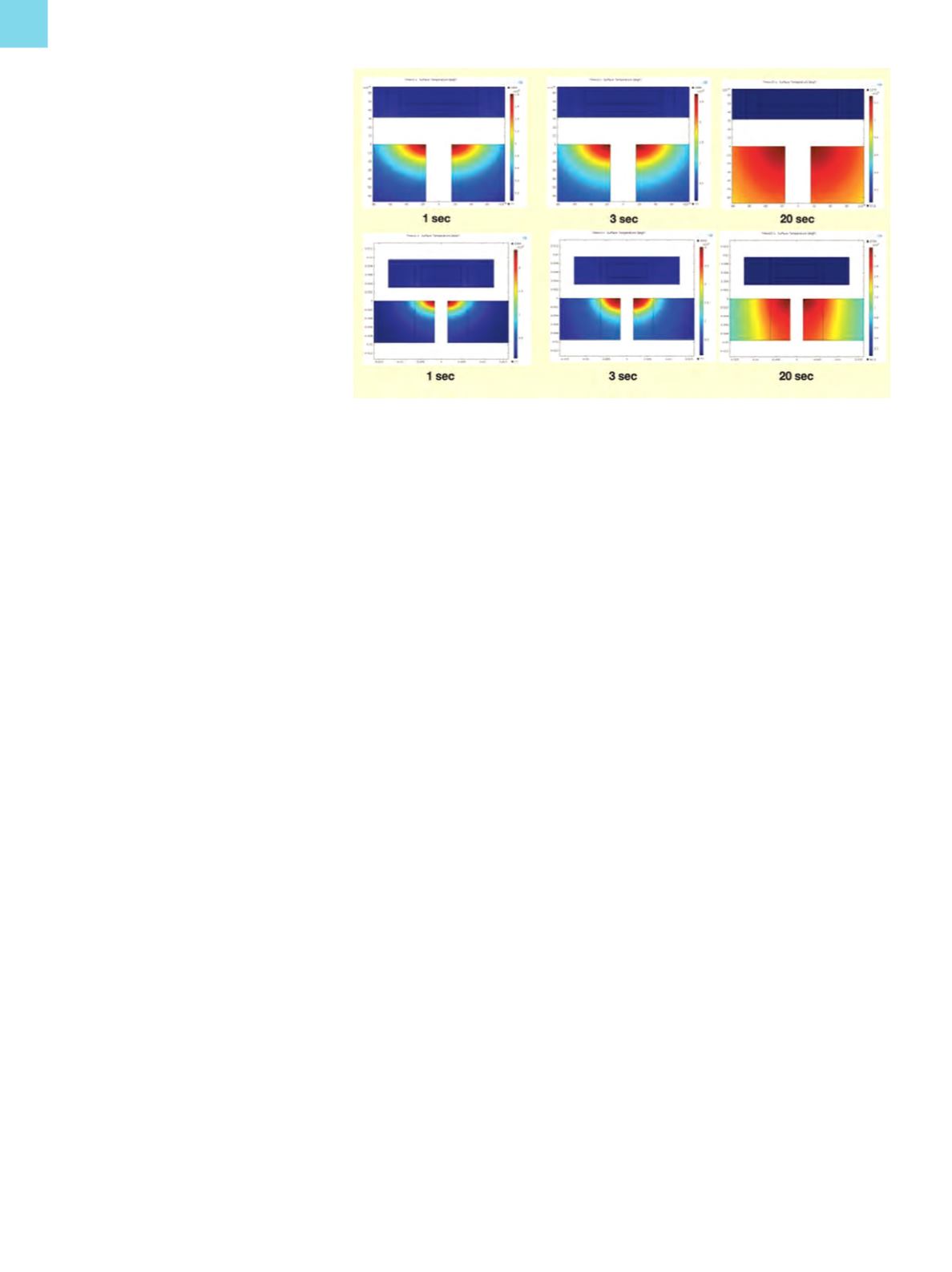
was also completed (Fig. 6).
In addition, models of T-fillet
weld joint configurations
are in progress. Testing and
verification of T-fillet HiDep
on selected thicknesses and
configurations for steel is
expected to be complete
by mid-2015. These models
include induction coils, weld
gaps, and standoff distances of
the induction coil from the weld
and the pieces being welded.
The library of numerical models
will eventually be expanded
with the goal to include models
for several different common
weld joints.
Welding equipment
Developers of the HiDep
process took advantage of
several features in the Miller
Auto-Axcess power supply,
which is the core of the
equipment. Over several years,
commercial portable induction
robotic systems for weld
distortion removal and metal
forming were developed and
deployed by the HiDep team.
These portable systems use
the ToccoTron 25 kW and Miller
ProHeat 35 kW induction power
supplies—equipment widely
specified within the welding
industry for both welding and
weld pre-heating. Consequently,
many industrial operations
already stock supplies and have
trained maintenance personnel
available for the primary HiDep
equipment. The HiDep controller
uses a standard Parker ACR9000
system for power, cooling, and
other controls.
Work to develop complete
systems, including options for
adaptive fill, seam tracking, and
coil height stand-off control
is ongoing. The welding and
induction power supplies and
other equipment can be fully
integrated into a new system
with robotic or mechanized
welding operation, or can be
retrofitted into an existing
system. Commercial systems
for butt seam welding of plate
will be available in late 2015,
and for other joint designs as
the process is developed and
tested. The induction coil is an
EnergynTech system integrated
with cooling and power.
Ruggedized coil configurations
are being tested for butt seam
welding.
Looking forward
Work is ongoing to develop
other induction coil designs for
curved path welding and for
other types of weld joint designs
including fillet welds. A new
Fig. 6 —
Modeling thermal output for 5/8 in. (top) and 3/8 in. (bottom) steel.