


 14 / 58

edfas.org
ELECTRONIC DEVICE FAILURE ANALYSIS | VOLUME 19 NO. 2
14
Doppler shift when more in-line. Positron spectroscopies
have been developed to examine each of these cases.
POSITRON SOURCES
Table 1 lists a number of radioactive sources used to
create positrons for slow positron beams. Virtually all
source-based beams use commercially available
22
Na
capsules.
22
Na has a long half-life, which means that the
capsule does not need to be replaced more than every
few years, and its high positron fraction helps mitigate
the lower count rate. A fewother details areworth noting.
11
C is often used in medicine because it has such a short
half-life.
58
Co canbemade by irradiating nickel in a reactor,
and it has an acceptable lifetime.
[9]
It has been chosen as
the source for use with the experiments discussed sub-
sequently.
64
Cu is another commonly created test source,
because it can easily be made with access to a nuclear
reactor, and it decays quickly.
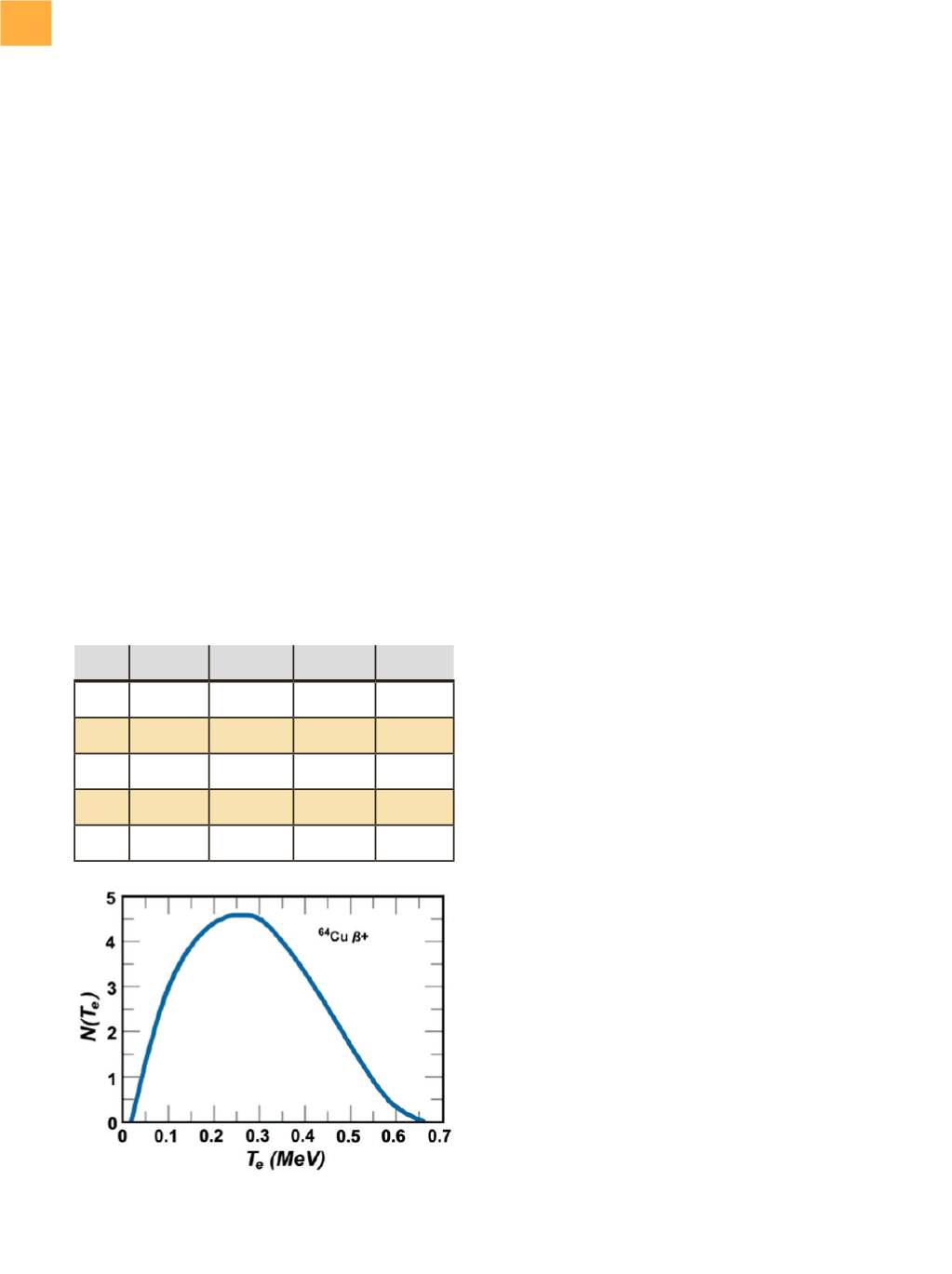
A positron is created when a proton decays into a
neutron, a neutrino, and a positron. Because this is a
three-body decay, the positrons are created with an
energy spectrum determined by the decaying atom. All
have a similar shape, as shown in Fig. 4. The endpoint
energy represents the highest-energy positron that can be
created from such a decay, but it is the energies near the
peak intensity that are important. These are the positrons
that will be slowed tomake the bulk of the beam. Another
significant detail from Fig. 4 is the positron fraction. This
represents the number of radioactive decays that will
result in creation of a positron. For atoms such as
22
Na,
which has a positron fraction of 0.91, most decays result
in a positron, but for
64
Cu, less than one-fifth of all decays
generate one. Furthermore, the half-life determines how
frequently the element decays and therefore how often
positrons will be generated.
Source geometry also plays an important role in
generating positrons, and it comes with some strict limi-
tations. The first is the thickness of the source. A thicker
source contains more radioactive material and thus will
generatemore positrons. However, as the source is made
thicker, fewer and fewer positrons are energetic enough to
penetrate through to the source itself to contribute to the
beamcount. The benefit of increasing the thickness of the
sourcediminishes until the absolute limit is reached, when
positrons generated farthest back all annihilate inside the
source itself. Positrons generated froma broad source run
afoul of the Liouville theorem when one attempts to use
electrostatic forces to focus them into a tight beam. The
Liouville theoremsays that phase space is conservedwhen
conservative forces are involved. A tight beamof particles
traveling parallel to one another cannot be created froma
broader beamby using only conservative processes, such
as electrostatic forces. One may focus such a beam into
a smaller region at the cost of it being a parallel beam.
Having a small parallel beam is important, however,
because the detectorsmust be placed far from the source
of the positrons, which necessitates beam transport for a
meter or more.
In the DFPG, the source is designed as a large ring
structure. This maximizes surface area whilemaintaining
a symmetry that allows the monoenergetic positrons to
be focused to a single point. At that point, a nonconserva-
tive process is introduced to reorient the positrons into a
parallel beam.
MODERATION
Themost significant limitation topositronbeam inten-
sity lies in the moderation step. Positrons emerge from a
radioactive source with a spectrumof energies. To obtain
an acceptable resolution, the positron beammust have a
Table 1 Various radioactive sources used for
positron production
Source Endpoint,
MeV Production Half-life Positron
fraction
11
C
960
11
B (
p
,
n
)
20 minutes
0.99
22
Na
540
24
Mg (
d
,
a
)
2.6 years
0.91
58
Co
470
58
Ni (
n
,
p
)
71 days
0.15
64
Cu
650
63
Cu +
n
12.8 hours
0.19
66
Ge
1880
66
Zn (
a
, 2
n
)
275 days
0.86
Fig. 4
Intensity distribution of positrons emitted by
64
Cu.
Source: Ref 10
(continued on page 16)