


 9 / 58

edfas.org
9
ELECTRONIC DEVICE FAILURE ANALYSIS | VOLUME 19 NO. 2
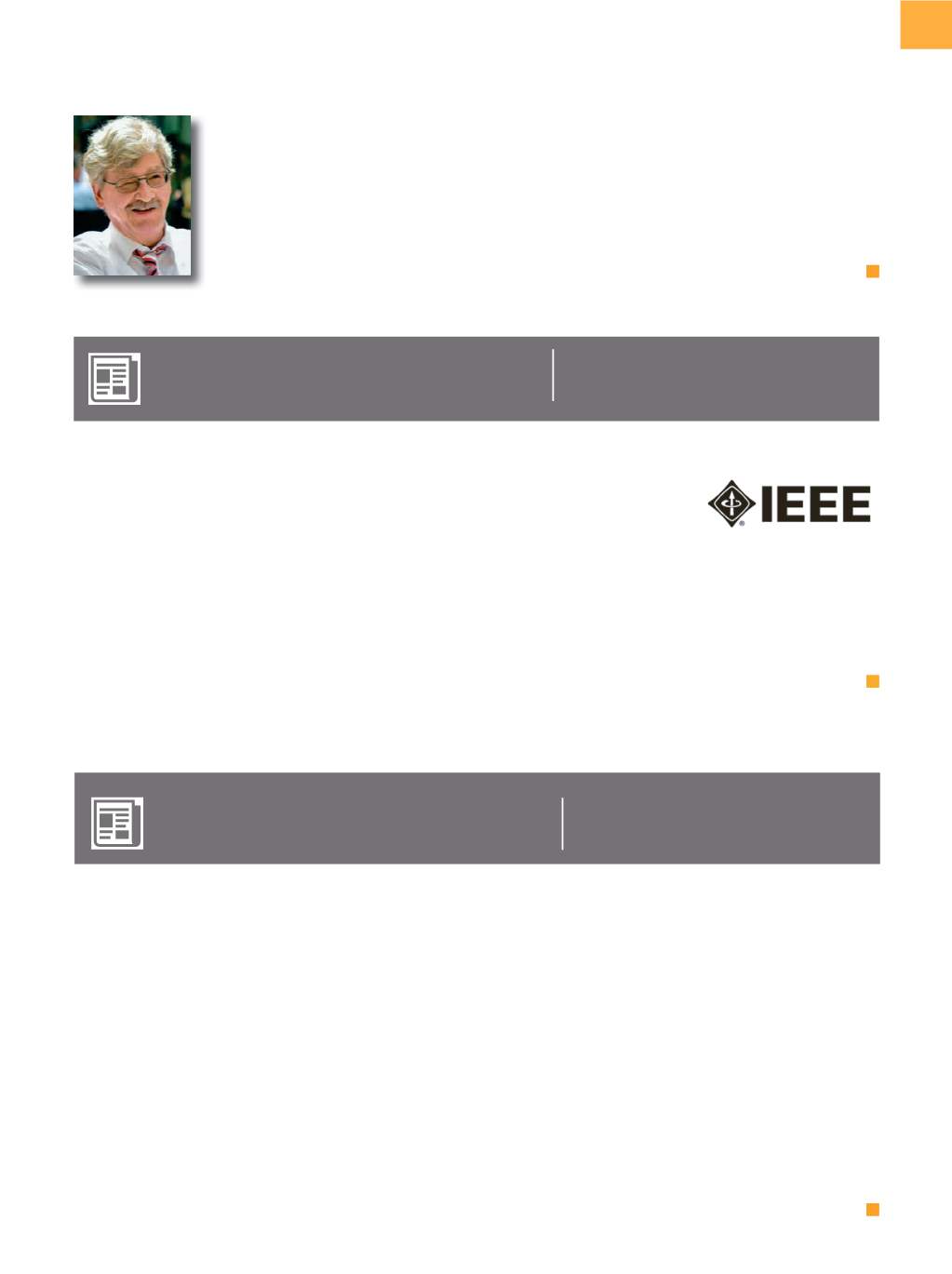
ABOUT THE AUTHOR
Gert Vogel
studied physics in Stuttgart. He has been with Siemens for more than 30 years. Dr.
Vogel was a semiconductor technologist in Siemens’ DRAM production in Munich and Regensburg
for seven years. He then moved to Siemens Amberg where, among other topics, he is a specialist
in failure analysis of electronic components on printed circuit board assemblies. He led a tutorial,
“Avoiding Flex Cracks inCeramic Capacitors,” at ESREF 2015. Thiswas followedby a tutorial, “Creeping
Corrosion of Copper on Printed Circuit Board Assemblies,” at ESREF 2016.
On the negative side, this can lead to monopolistic
traits. Prices can be high when there is only one source.
Also, the FA community is very good at feature creep.
Feature creep is often dealt with better by larger compa-
nies, but they are also very adept at adding costly extra
features to their products.
There is also a good chance that the larger companies
will earn higher profits. This is clearly good for the big
company, but does it alsoprovide a benefit toour commu-
nity? It can provide an opportunity for more investments
in new tools or applications. Small companies with a
single idea achieve success or go bust based on that idea.
A large company can accept a relatively small loss on a
promising concept, while the same loss will drive a small
company out of business. However, to offset the costs of
monopolistic suppliers, we can hope that much of the
increasedprofitwill be reinvested into tool improvements.
Speculative investments in tool development canbemade
with adequate fundingwithout risk to the company’s exis-
tence. It also makes it possible for the bigger companies
to be able to fund additional acquisitions of promising FA
technologies developed by entrepreneurs.
While there are obviously monopolistic issues with
some of the major M&A activity in FA tools, there are
equally as many advantages. Bigger companies can
provide better service in terms of cycle time and parts
inventory. They can provide better quality and reliability
based on better manufacturing controls. They can also
provide adequate funding for new technologies, both
internally and through acquisitions of startups.
GUEST EDITORIAL
CONTINUED FROM
PAGE 2
IPFA 2017
The 24th International Symposium on the Physical and Failure Analysis of Integrated
Circuits (IPFA 2017) will be held
July 4 to 7, 2017,
at the Intercontinental Chengdu Global
Center, Chengdu, China. The event will be devoted to the fundamental understanding of the
physical mechanisms governing failure in a large variety of advanced semiconductor devices and the electrical/physical
failure analysis techniques, methodologies, and tools used to reliably identify root-cause failure in these devices.
IPFA 2017
is organized by the IEEE Reliability/CPMT/ED Singapore Chapter, IEEE Electron Devices Society Chengdu
Chapter, and the University of Electronic Science and Technology of China.
The Symposium is technically co-sponsored
by the IEEE Electron Device Society and IEEE Reliability Society.
For more information, visit the IPFA website at ipfa2017.com/.
NOTEWORTHY NEWS