


 16 / 58

edfas.org
ELECTRONIC DEVICE FAILURE ANALYSIS | VOLUME 19 NO. 2
16
uniformenergy. Positrons either pass throughamoderator
(transmission) or penetrate into and then are re-emitted
from the same surface (reflection). Positrons with ener-
gies allowed by nuclear decay primarily lose energy via
inelastic collisions until they reach thermal equilibrium
with the material. Once thermalized, a positron diffuses
through the moderator. If a positron finds the surface of
the material, it is ejected perpendicular to that surface
withonly thework function energy. Otherwise, it will even-
tually annihilatewith an electron. There is a characteristic
diffusion length associated with each material. This is
the average distance that a positron will travel through
a pure, defect-free sample. Lower-energy positrons may
thermalize too far from the emitting surface, and higher-
energy positrons may reach the surface before they have
thermalized and leavewith their energy plus the contribu-
tion from the positronic work function. There is an ideal
moderator thickness that depends on the spectrum of
positron energies and the type of moderator.
Even under ideal circumstances, this thickness can
only be chosen tomoderate a small region of the positron
energy spectrum. Positrons of higher energy are not fully
moderated, and positrons of lower energy thermalize
too far from the emitting surface and annihilate within
the moderator. Because of this limitation, the primary
limitation on the intensity of positron beams lies in their
moderation. Table 2 lists many common moderators.
Moderation efficiencies less than 10
−4
tend to strugglewith
breaching. The most common moderator, tungsten, has
a moderation efficiency of 10
−3
, which is relatively good,
and it is the most stable when exposed to air, retaining
over 60% of its moderation efficiency.
[11]
Slightly higher
efficiencies can be obtainedby using some solid noble gas
moderators, but they are much more difficult to handle.
Virtually all tungsten moderators in use are foils. The
optimal thickness for a tungsten foil moderator when
used in combination with
22
Na is 1.8 µm. However, only
9 µm is commercially available. Efforts to uniformly etch
or flash lamp anneal these tungsten foils run into difficulty
due to 25% variance in thickness.
[17]
Annealing is impor-
tant to eliminate defects in the moderator that may trap
thermalized positrons and prevent them from reaching
the surface.
One strategy is to increase the useable moderator
surface area through the use ofmoderatormeshes. A stack
of tungstenmeshes would increase the percent of volume
within one positron diffusion length, allowing more ther-
malized positrons to escape. Epithermal positrons would
be capable of penetrating into additional wires and losing
energy until they too become thermalized. It is estimated
that this could improve moderator efficiency by an order
of magnitude.
[18]
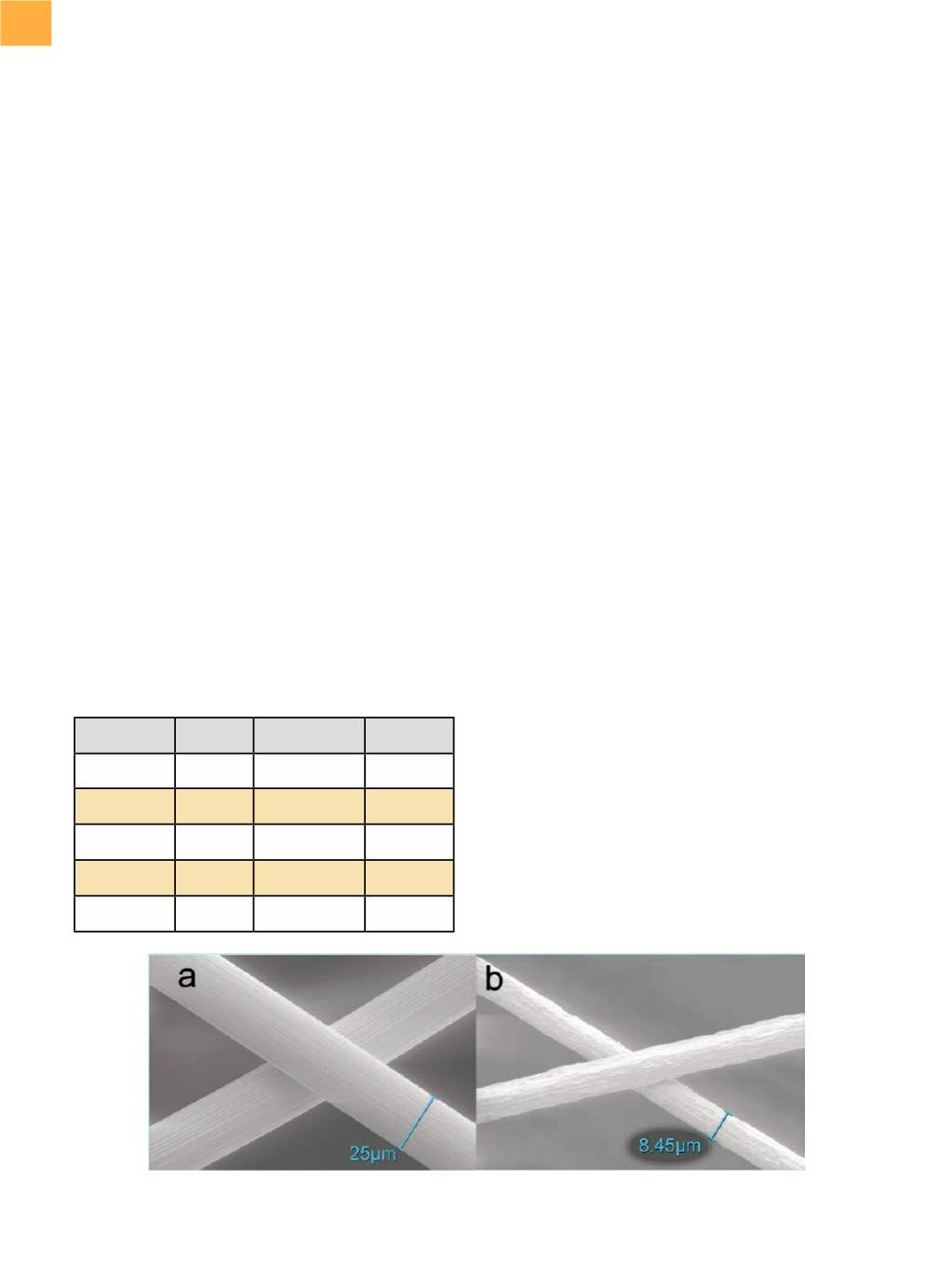
Work by the authors’ group has shown that tungsten
meshes can be etched slowly and with incredible preci-
sionby using a dilute solutionof sodiumhypochlorite. The
meshes are commercially available as 25-µm-diameter
wires spaced two per millimeter. This wire thickness is
well above optimum, but the authors have shown that
wire integrity down to 8.45 µm diameter thickness can
be maintained even as more than 80% of the mass is
removed, as shown in Fig. 5.
POSITRON BEAMS AS EFFECTIVE NONDESTRUCTIVE ANALYSIS TOOLS
(continued from page 14)
Fig. 5
(a) Tungsten mesh as-received. (b) Tungsten mesh after etching in sodium hypochlorite. Note that the wire integrity is
still intact even though most of the tungsten has been etched away.
Table 2 Assortment of moderators
Moderator Efficiency Energy spread,
eV
Reference
Cu (110) with S 10
−3
0.40
12
Pt with MgO 10
−5
1.20
13
Au
10
−4
0.30
14
W (110)
10
−3
1.5
15
Al
10
−5
0.15
16