


 24 / 70

A D V A N C E D M A T E R I A L S & P R O C E S S E S | J U L Y / A U G U S T 2 0 1 5
2 4
MODERNMATERIALS FOR
SPORTS ANDRECREATION
Beyond automotive, aerospace, and medical materials innovations, research and
development of advanced materials and processes for sports and recreation activities
is one of the most exciting areas for today’s materials scientists and engineers.
Compiled by Frances Richards and Julie Lucko
T
he following news department is
part of our special summer issue
highlighting materials used in
sports and recreation. This compilation
is not meant to be comprehensive, but
rather provide a lively snapshot of some
of the most interesting developments
and wide variety of efforts taking place
in the modern sports arena. From com-
petitive sailing and fishing to running
and cycling, materials matter in sports.
Whether it’s a slight performance edge
for elite athletes or a practical effort to
make sports equipment safer, today’s
materials scientists and engineers are
busy working on some amazing inno-
vations. Warning: If you’re a sports en-
thusiast, these stories might make you
want to change your day job.
3D-PRINTED HANDLEBARS
HELP CYCLISTS PUT THE
PEDAL TO THE METAL
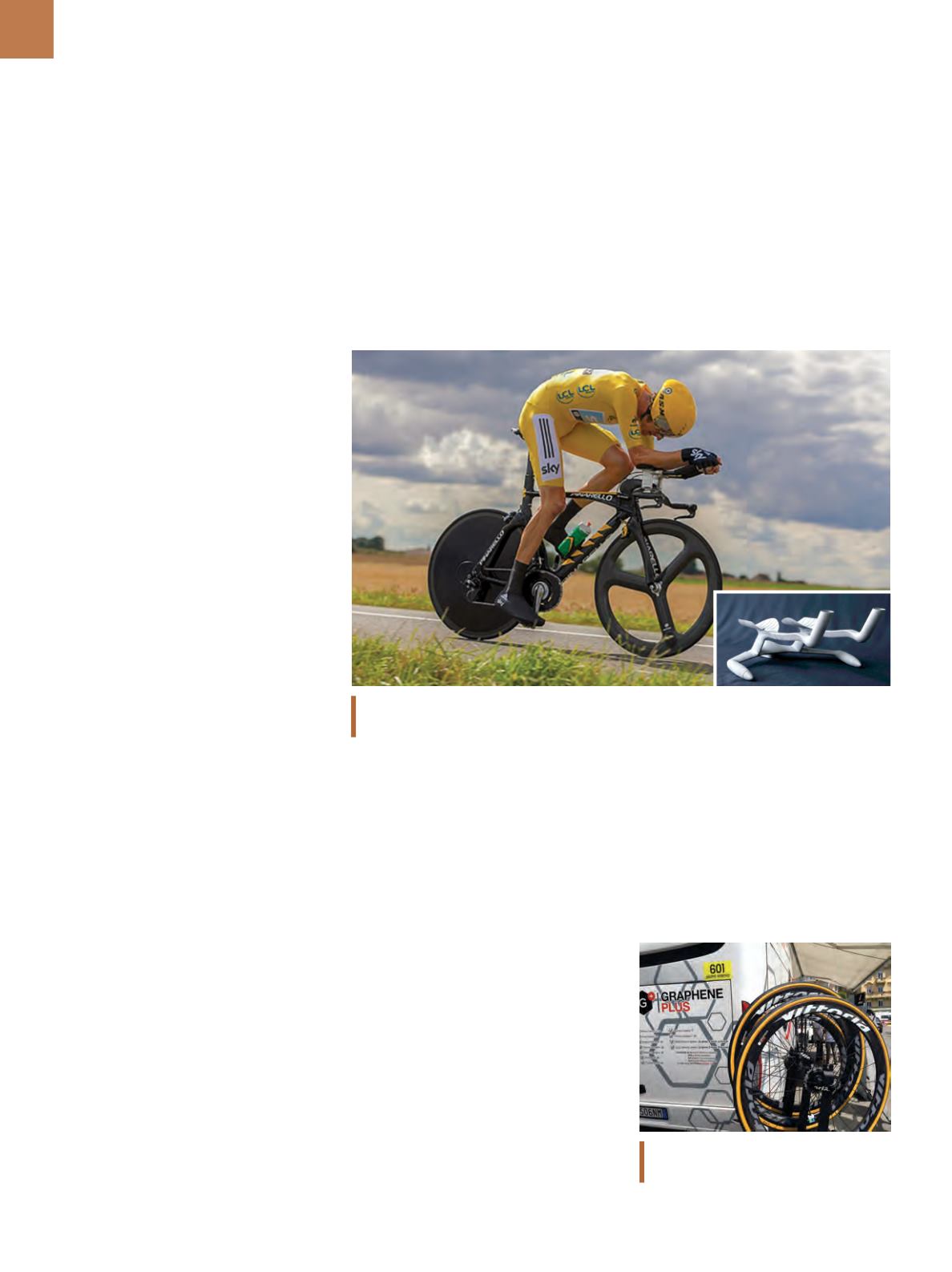
On June 7, Sir Bradley Wiggins
broke the World Hour Record with the
help of 3D-printed, super lightweight,
and aerodynamic handlebars devel-
oped at The University of Sheffield’s
Mercury Centre, UK, in conjunction
with Italian bicycle manufacturer Pin-
arello. Wiggins broke the world record
for the longest distance that a cyclist
has ridden within an hour on the track,
after spanning 218 laps—54.53 km—of
the Lee Valley VeloPark in London. The
record-breaking bicycle was produced
by Pinarello Lab, part of the technical
department of Pinarello, and designed
by Dimitris Katsanis, an aerodynamics
and composites expert who works for
British Cycling.
3D printing was used to develop
the titanium handlebars because it en-
abled the developers to create complex
designs and quickly produce a number
of versions in order to test which han-
dlebars best matched the body size and
cycling style of Sir Bradley. The handle-
bars were the only component of the
bike not made of carbon fiber, due to
a compressed timetable for bike pro-
duction and need for several proto-
types. Designers used an Arcam elec-
tron beam additive manufacturing
machine to make slight modifications
quickly, without having to build new
molds to fabricate individual pieces.
This saved time and allowed design-
ers to thoroughly test parts and make
necessary adjustments to the handle-
bars prior to the world record attempt.
www.sheffield.ac.uk.ITALIAN CYCLISTS RACE
AHEAD WITH GRAPHENE-
BASED WHEELS
A wheel produced by Vittoria, an
Italian supplier to the cycling industry,
is now available in three different sizes,
46, 60, and 84 mm. By incorporating an
Sir Bradley Wiggins sets World Hour Record with the help of lightweight 3D-printed handle-
bars. Courtesy of Radu Razvan/The University of Sheffield.
Graphene-based wheels. Courtesy of
Directa Plus.