



 25 / 70

A D V A N C E D
M A T E R I A L S
&
P R O C E S S E S | J U L Y / A U G U S T
2 0 1 5
2 5
innovative material made of pristine
graphene nanoplatelets provided by
Directa Plus, Vittoria has rapidly trans-
formed from a traditional manufactur-
er to a high-tech innovation company.
Graphene increases material strength,
flexibility, and lateral stiffness. The ad-
vantages for a wheel include heat dissi-
pation (15°-30°C lower), an increase in
lateral stiffness (more than 50%), and
puncture reduction—especially around
the valve area. Two wheels weigh
1250 grams together and cost around
$1800. At Giro d’Italia, an international
cycling competition held in June, sev-
eral professional cyclists tried out the
new wheels.
vittoria.com.
INTERNATIONAL CONSORTIUM
CHAMPIONS CARBON
COMPOSITES
Nanyang Technological University
(NTU), Singapore, set up an interna-
tional consortium to develop innova-
tive materials and processes for sports
products. Besides NTU’s Institute for
Sports Research (ISR), the four founding
members include Arkema (France), tex-
tile and composites company Chomarat
(France), tennis racquet maker Babolat
(France), and bicycle manufacturer
Topkey (Taiwan). The new consortium,
known as the Innovative Composites for
Sports Products (I-Comp Sports), will
benefit from ISR’s research and testing
facilities housed at NTU’s School of Me-
chanical and Aerospace Engineering. It
will also leverage ISR’s strong industry
links, including NTU’s plans to invest
millions in specialized machinery for
manufacturing composite materials
using automated fiber placement. The
consortium will jointly develop new
carbon composites materials, parts de-
sign, and manufacturing technology for
sports products such as racquets and
bicycle frames. The research will bene-
fit not only the sports product industry,
but also industries such as aerospace,
renewable energy, and materials engi-
neering, say NTU sources.
ISR’s first product made its debut
at the Sochi Winter Olympics 2014. ISR
worked with Skis Rossignol, France, to
develop its new Infini range of dynamic
compression garments for cross coun-
try skiing. Apart from collaborating with
multinational companies, ISR is also
partnering with international sports
federations. For example, together with
the International Table Tennis Federa-
tion, ISR engineered a unique prototype
machine to test the bounce of table ten-
nis racquets toensure theymeet compe-
tition standards. At the same time, ISR
is also working with the Badminton
World Federation on equipment, es-
pecially in shuttlecock development.
www.ntu.edu.sg.SMART BLADES SHED LIGHT
ON FIGURE SKATING FORCES
An ice skating blade that informs
figure skaters of the stresses imposed
on their joints was developed by a
group of researchers at Brigham Young
University, Provo, Utah, and Ithaca Col-
lege, N.Y. The lightweight device is built
to measure the force that figure skaters
exert on the ice when performing jumps
and spins and could be used by skat-
ers and their trainers to avoid injuries,
as well as help to design new skating
boots. Figure skaters are continually
putting their body under stress, per-
forming anywhere between 50 and 100
jumps per daily practice session. Sim-
ulations outside of the ice rink suggest
that skaters exert a force magnitude of
up to six times their body weight when
taking off and landing from a jump.
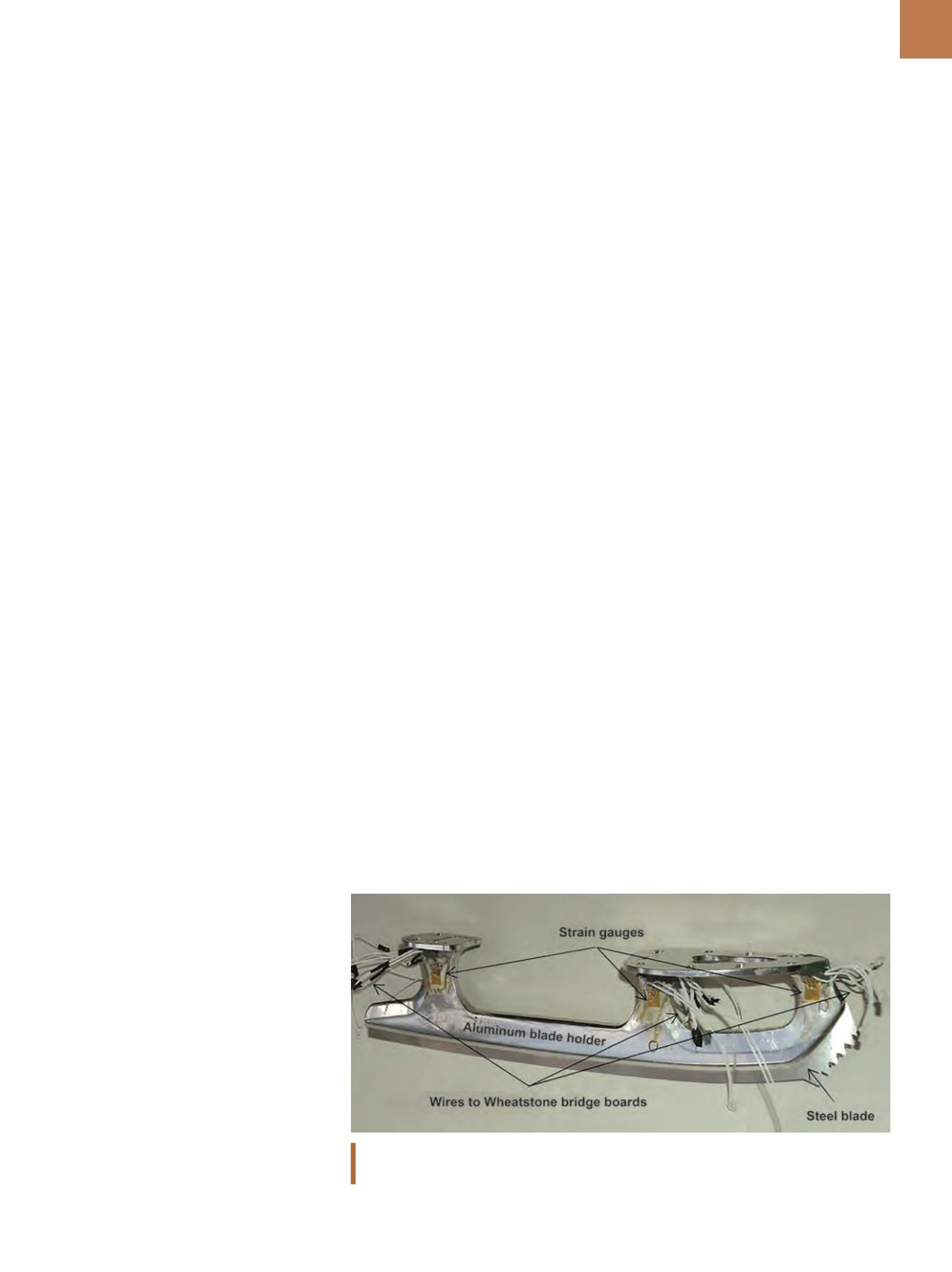
Researchers created a special
blade and fitted it with strain gaug-
es, which are attached directly to the
stanchions where the blade connects
to the boot, and when the stanchions
deform due to the force induced by the
ice skater, the strain gauges deform as
well. Once deformed, the electrical re-
sistance of the strain gauge changes.
This change is measured by a device
called a Wheatstone bridge and a cen-
tral control system is used to calculate
the overall force that was imparted.
To test the device, researchers
mounted an instrumented blade onto
an artificial leg and foot and applied
14 vertical loads between 0 and 236 kg
to the leg. The instrumented blade was
then fitted to an experienced skater
who was asked to jump from a 20 cm
high box onto the floor while measure-
ments were taken from the device.
These results were then compared with
measurements from a different experi-
ment, where the skater wore a normal
ice skating blade and landed onto a
force plate.
“It was encouraging to see that the
device performed very well for vertical
loads, which is where our initial focus
has been,” says professor Deborah King
of Ithaca College. “We also worked on
the wire packaging. So far it all looks
promising and we are planning to col-
lect data to study the forces at take-off
and landing of double jumps at the end
of the summer.”
byu.edu, ithaca.edu.
WILLOW WORKS WONDERS
FOR CRICKET BATS
Scientists from the Australian Na-
tional University (ANU) sought advice
Hybrid skate with strain gauges and wires leading from gauges to Wheatstone bridge boards.
Courtesy of IOP Publishing.