


 20 / 70

2 0
A D V A N C E D M A T E R I A L S & P R O C E S S E S | J U L Y / A U G U S T 2 0 1 5
NITRO SNOWBOARDS CARVES
OUT NEW LEVELS OF QUALITY
From the company founder to
members of the design team, at Nitro
Snowboards, Seattle, there is recogni-
tion that being part of the culture sup-
ports product development that will
perform in demanding environments.
It is this commitment that motivates
company investment in a global team of
riders. Dispersed in locations from Chile
in the southern hemisphere to some of
the most challenging mountains in Eu-
rope, Nitro boards are field tested year
round.
Snowboarding as a sport contin-
ues to evolve as riders explore new
horizons. These explorations contin-
ue to drive changes in board design,
introducing new materials based on
high-tech engineering principles. In ad-
dition to the board’s primary element—
wood—new combinations of compos-
ite materials such as glass and carbon
fiber were introduced to offer greater
stability and better handling character-
istics. The emergence of new types of
riding such as high speed, powder, and
unique forms of freestyle have tremen-
dous influence on materials as well
as shape. Another factor contributing
Nitro’s unique camber designs determine the amount of surface area in contact with the
mountain, rail, or halfpipe, enabling the rider to control the board. Flexural strength and flex-
ural modulus are key performance elements that influence ride quality and can be validated
through testing.
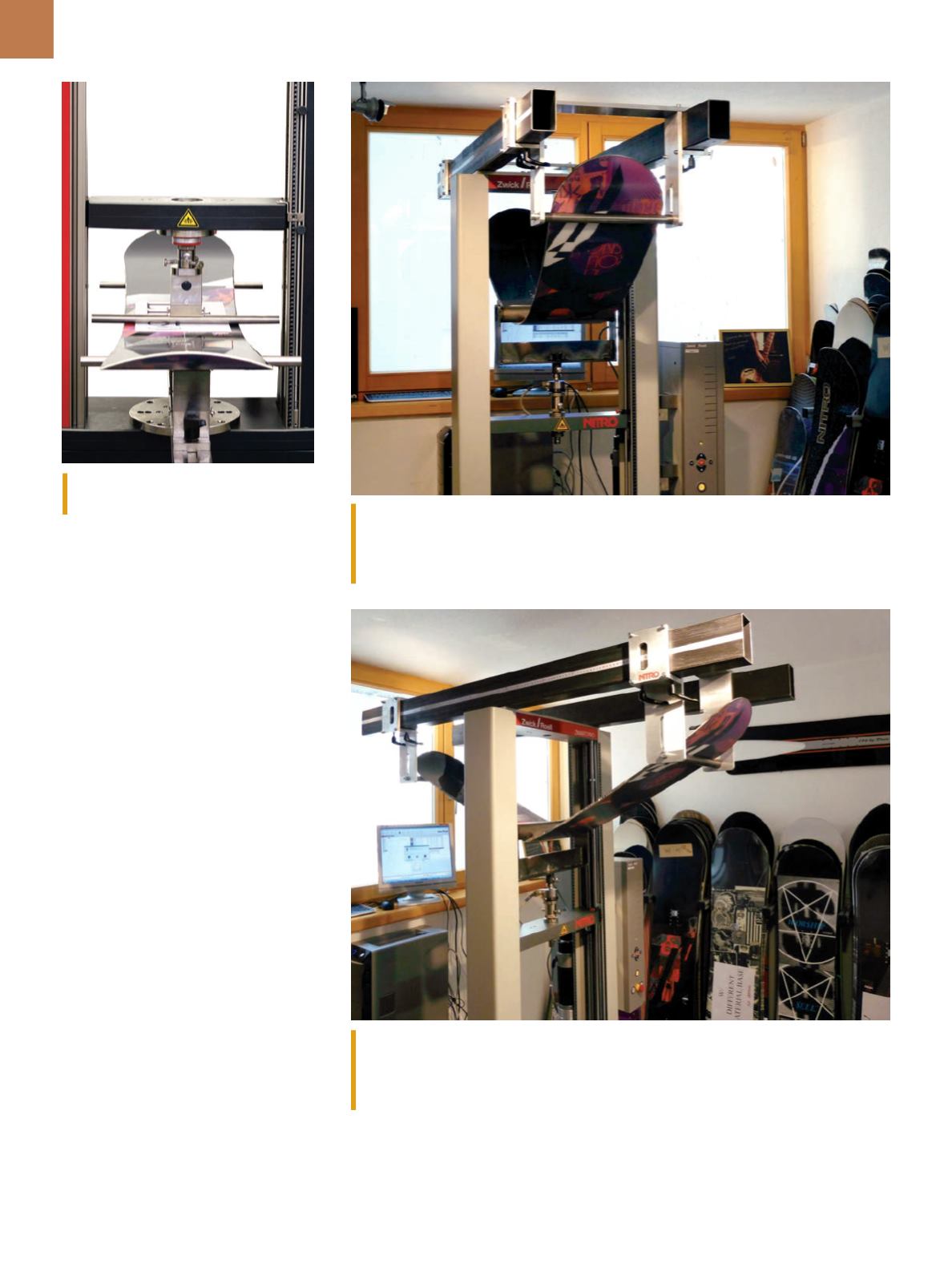
A Nitro snowboard undergoing a 3-point
flexural test.
Nitro snowboards are comprised of multiple materials, enabling higher flexural strength and
strain to failure. Layup processes layer the traditional element, wood, with glass and carbon
fiber to create a board that matches modern riding styles. Carbon fiber imparts strength at
high levels of strain, enabling riders to develop new tricks.
to the level of engineering involved in
commercializing new snowboards is
the availability of novel manufacturing
processes. In each case, testing offers
quantifiable results that support criti-
cal decision making.