


 26 / 70

A D V A N C E D M A T E R I A L S & P R O C E S S E S | J U L Y / A U G U S T 2 0 1 5
2 6
maintains the final shape. Custom-
ers confirm the fit and then decide to
purchase the footwear or not. If they
choose not to purchase, shoes are
heat treated in a customization box to
regain their shape. The whole process
can be repeated many times on a par-
ticular shoe. The critical components
of the shape memory material are Ni-
tinol wires, which are inserted into the
material in a specific pattern. Because
metallic filaments are much stiffer than
textile yarns, they cannot be used in a
conventional knitting process. Machin-
ery is required to operate the loom due
to the metal wires.
instantshoe.com.3D PRINTING PUTS RUNNERS
ON FAST TRACK
No two runners are the same,
and this is especially true for athletes
competing at the highest levels. Their
foot-strike patterns, degrees of prona-
tion, and braking and propulsion forces
are all unique. However, the extent to
which most running shoe models vary
is limited. As a result, there are some
who believe that personalizing a run-
ner’s shoes, specifically the spike plate
that provides traction on the shoe’s
underside, can help these athletes be-
come faster on the track.
One proponent of this trend
is New Balance Athletic Shoe Inc.,
from wicket-keeper Brad Haddin for
high-tech research into cricket bats. Re-
searchers are studying English willow
at the cellular level to understand what
makes a top quality bat and to see if
other types of wood might one day rival
the legendary performance of willow.
Haddin, who played for the ANU
cricket club in the 1990s, tested an En-
glish willow bat and then one made
of Kashmir willow, considered to be
an inferior bat material. After hitting
a number of balls, he sawed one of
the bats in half and gave it to the re-
searchers. Willow samples were ana-
lyzed using an extremely accurate CT
scanning technique and processed by a
National Computational Infrastructure
supercomputer.
Top quality bats are made from
only one particular female species of
English willow tree. The team examined
the cellular structure of the wood to
unlock the secrets of the willow’s suc-
cess as a light and strong bat material.
“We would love to find an alternative to
English willow, which would make top
quality bats more accessible to kids in
developing countries,” says lead scien-
tist Mohammad Saadatfar. “There is
no reason why every kid in the world
shouldn’t play with a top quality crick-
et bat.”
For more information: Moham-
mad Saadatfar,
mohammad.saadatfar @anu.edu.au, www.anu.edu.au.
IF THE SHOE FITS, WEAR IT
A consortium of European Union-
funded project Demo ShopInstantShoe
developed a novel, modifiable female
shoe using a unique shape memory
composite made of Nitinol and leather.
The material is adjusted using a ma-
chine called Shoptool, which finishes
the shoemaking process in the store.
The compact tool is lightweight and
can be assembled onsite for immediate
customization. InstantShoe comes with
the shaping system, smart configura-
tion software, a sophisticated machine
featuring three different lasts for every
size range, and the foot scanner DOME,
constructed by the Biomechanics Insti-
tute of Valencia, Spain.
The shoe’s upper part is made
from a shape memory composite that
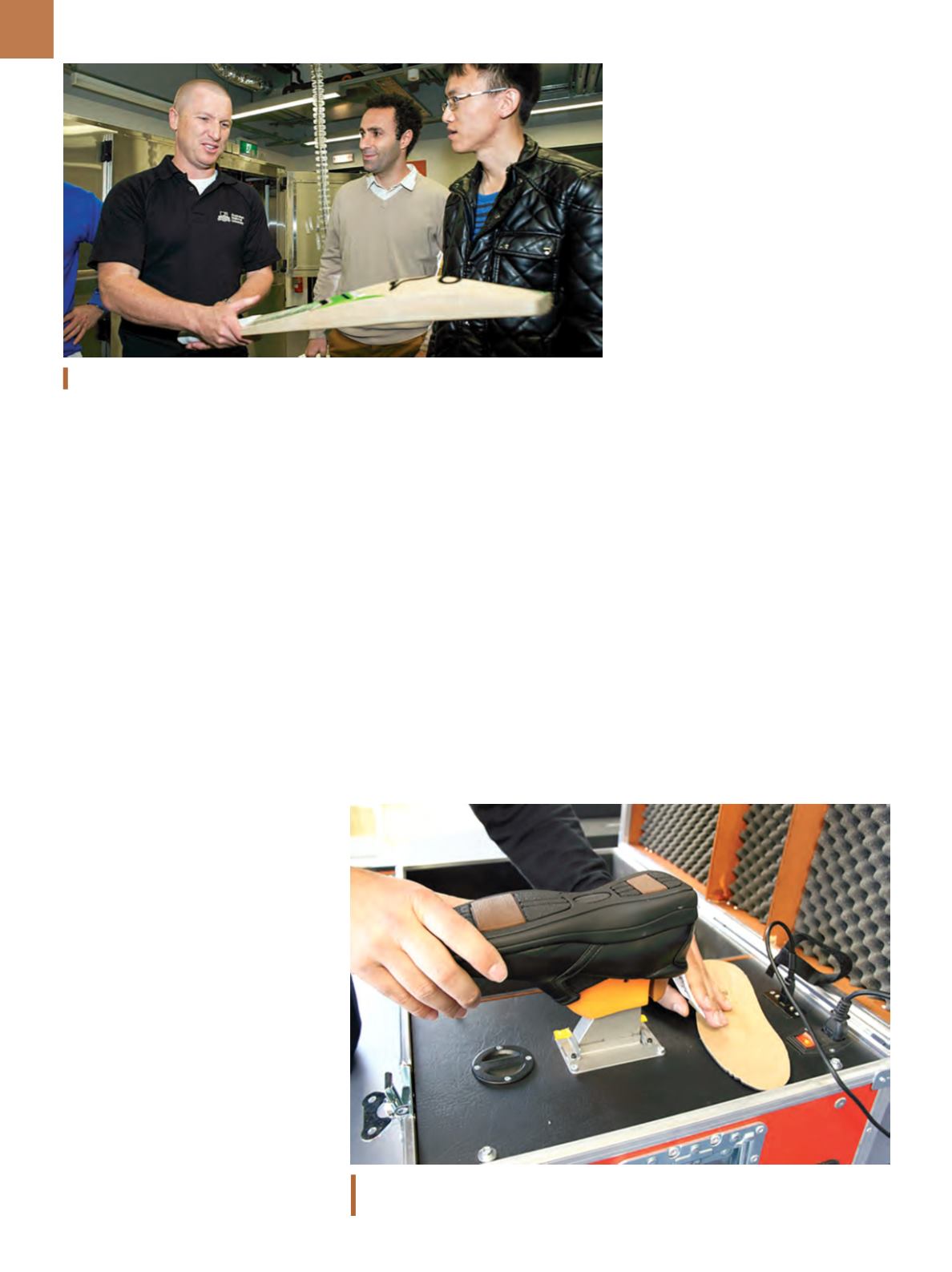
Brad Haddin with Mohammad Saadatfar and Ph.D. student Jin Tao. Courtesy of ANU.
InstantShoe combines Nitinol and leather to find the perfect fit. Courtesy of Biomechanics
Institute of Valencia.