


 21 / 70

2 1
A D V A N C E D
M A T E R I A L S
&
P R O C E S S E S | J U L Y / A U G U S T
2 0 1 5
The quality of the ride in snow-
boarding is directly related to the
board’s capacity to move and respond
to rider-initiated direction. Control and
response are important features that
may be assessed through testing proce-
dures as Nitro seeks to design products
that offer optimized flexural strength as
well as torsional flexure. The company
uses a Zwick two-column test machine
to assess this, as well as other proper-
ties, in its snowboards. According to
Florian Lang, Nitro’s head developer,
customers look for boards with varying
degrees of flexure that match their rid-
ing style. “Riders want a certain level of
control and at the same time, the board
has to return energy. When a board is
flexed, it absorbs a great deal of energy
and that energy must be returned. This
is what we look to quantify in testing,”
says Lang.
A three-point flexure test is used
to examine the flex and shape proper-
ties of snowboards. The board is load-
ed to breaking point in a special flexure
test kit and the characteristic values
obtained are channeled directly into
product development. The test is also
used to monitor current production
batches. In addition to snowboards, Ni-
tro also performs a wide range of tests
on bindings, boots, and laces. Peel tests
on composite materials and fabric tear
tests also represent areas of interest.
Applying the dual testing areas of the
Allround-Line, Nitro is able to perform
these other types of tests in addition to
flexure testing.
“We find that the testXpert II soft-
ware offers value in support of the de-
sign cycle as well as our quality control
programs. We have set up a routine that
allows us to test certain product specifi-
cations with a high degree of reliability,”
says Lang.
ALPINESTARS INTEGRATES
STYLE AND FUNCTION
While Alpinestars, Torrance, Calif.,
began as a manufacturer of footwear for
motorcycle racing, the company has ex-
panded to become a complete provider
of protective gear and apparel in mo-
torsports. Leather remains a primary
material in a large number of the com-
pany’s products. The demands of rac-
ing and the drive to increase safety
motivate the designers and engineers
at Alpinestars to devote ample time to
materials testing.
Assessing the suitability of var-
ious types of leather is a chief con-
sideration, as treatments during the
tanning process can have a dramatic
impact on material properties. Among
the assessments conducted at the
company’s development laboratory in
northern Italy are UV exposure tests,
abrasion tests, tensile, compression,
and tear strength tests. Alpinestars
uses a Zwick testing machine to con-
duct compression tests on boots in
accordance with EN13634. The test as-
sesses the amount of force required to
compress the portion of the boot that
surrounds the ankle.
Leather testing represents a ma-
jor share of the analyses performed at
Alpinestars’ development laboratory.
Grades of leather that have undergone
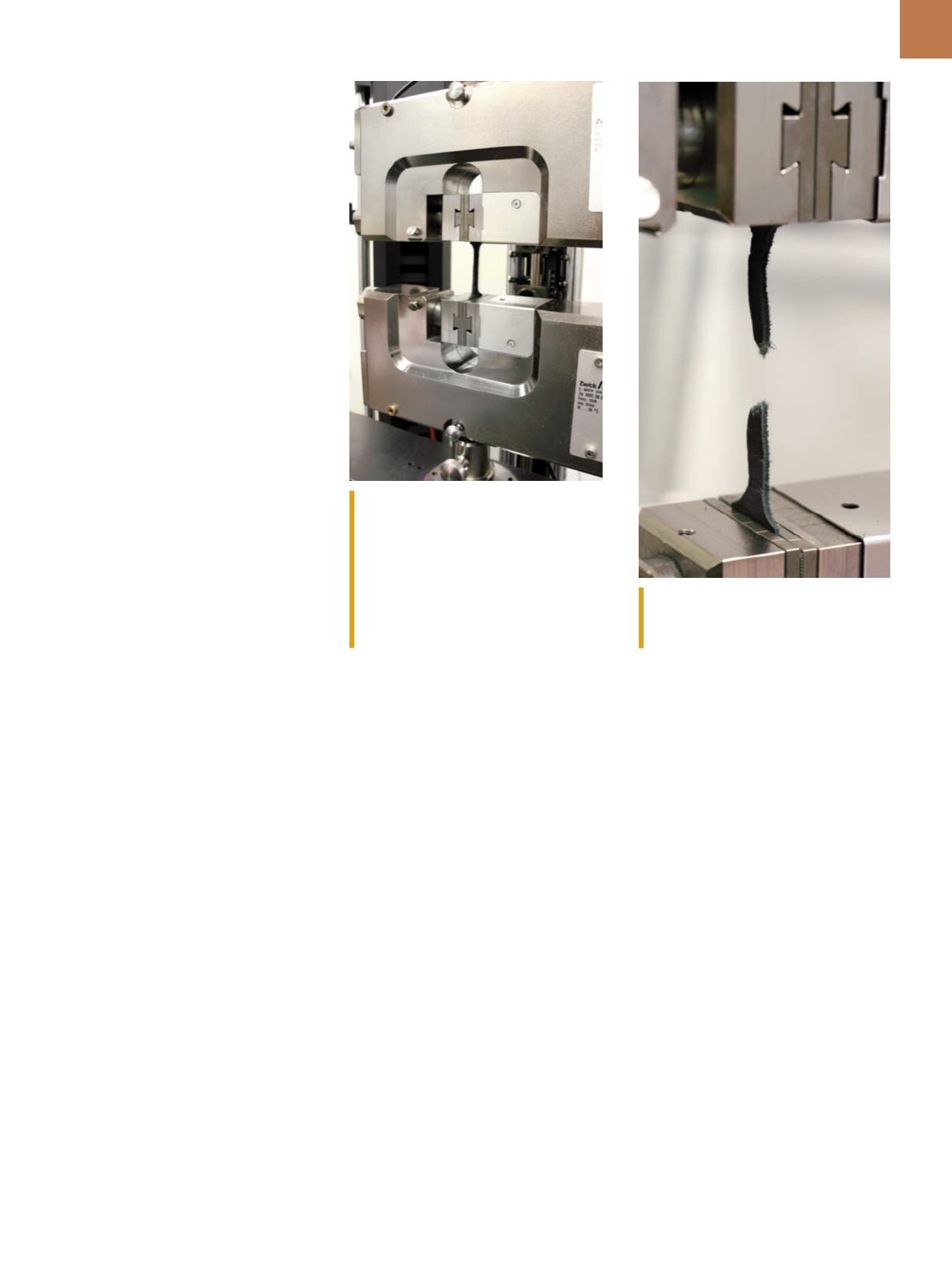
A sample from a leather road racing suit
is tested to failure on an Allround-Line
testing system.
Alpinestars designs protective gear for
motorcycle racing and action sports,
using leather as a primary material in the
company’s jackets, pants, gloves, and
boots. Pigments can influence material
performance, so testing determines the
ultimate tensile strength of treated leath-
er and supports design decisions.
the addition of brightly colored pig-
ments exhibit reduced strength due
to weakening of the fibers. Tensile and
tear strength tests are performed on all
forms of leather and on all fabrics the
company incorporates into finished
products. The Zwick testing machine is
one of the busiest machines in the lab-
oratory because every fabric and every
type of leather must be evaluated by
it. Offering valuable insight into ap-
plication suitability, materials testing
plays a vital role in the development
of sporting gear, protective wear, and
apparel. As high performance sports
continue to grow in popularity, it is an-
ticipated that demand for testing and
the insights it offers will increase as
well.
~AM&P
For more information:
Boris Plach is
product manager, testing machines,
Zwick/Roell,
August-Nagel-Str.
11,
D-89079 Ulm, Germany, +49.7305.100,
info@zwick.de, www.zwick.com.