


 19 / 70

1 9
A D V A N C E D
M A T E R I A L S
&
P R O C E S S E S | J U L Y / A U G U S T
2 0 1 5
I
n the sport and leisure industry, per-
formance sets products apart and
connects companies with consumers.
In both cases, testing represents a vital
element in product enhancement. In ad-
dition to classical materials testing, com-
ponent testing is now an integral part of
product engineering due to the continu-
ous development of sports equipment
and the ever-increasing role of technol-
ogy. Investigation of mechanical proper-
ties is of particular importance, with com-
panies suchasOakley, NitroSnowboards,
and Alpinestars using sophisticated test-
ing machines for this purpose. This ar-
ticle provides a snapshot of what these
leading sports equipment companies do
regardingmaterials testing initiatives.
OAKLEY SETS SIGHTS ON
ADVANCED EYEWEAR
Oakley Inc., Foothill Ranch, Ca-
lif., continues to develop cutting-edge
sports eyewear and apparel with a fo-
cus on both performance and design.
The company takes a unique approach
to design, translating the functional re-
quirements demanded by each sport
into products that offer security as well
as visual appeal. Oakley has long em-
phasized technology, employing novel
molding techniques to optimize lens
stiffness and curvature for various ap-
plications. Perhaps less widely known
is the priority Oakley places on safety
and the connection it draws between
product integrity and performance. The
company’s testing laboratory assesses
a wide range of properties to support
new product design. Among the charac-
teristics explored are impact resistance
and compressive strength, according to
Wayne Chumbley, vision performance
testing manager.
Maintaining a close connection
with the sports to which it supplies vi-
sion solutions, Oakley set out to design
a goggle for motocross applications
that addresses issues associated with
lens penetration, ejection, and col-
lapse. As the design team evaluated
materials as well as prototypes, testing
played a significant role in the process.
Oakley manufactures motocross lenses
with a specific thickness and molded
arc that impart both safety and visual
acuity. The company then tests the re-
sulting product to standards such as
those developed by ANSI and the U.S.
military. ANSI Z87 standards prescribe
the testing procedures to quantify high
velocity impact resistance. These tests
involve shooting a quarter-inch steel
ball at the lens and frame at a velocity
of 250 ft/s from a distance of just under
10 in. The U.S. military standard MIL-
PRF-31013 calls for using an irregular-
ly-shaped projectile that more closely
simulates operational conditions. The
projectile is shot at the lens at a veloc-
ity of 650 ft/s, substantially higher than
that prescribed by ANSI.
Oakley also uses a compression
testing procedure that quantifies the
force required to cause the lens to im-
pact the rider’s face. For this test, Oak-
ley uses testXpert II measurement and
control software from Zwick/Roell, Ger-
many, which compares results for the
Oakley Mayhem Pro goggle with a com-
peting product. “This is something we
use the data from to support the design
of our goggles—to improve chassis de-
sign and to use better materials in our
products,” says Chumbley.
The compression test not only
evaluates the compressive strength of
the lens, but the performance of the
lens and chassis together. Reviewing
the data in the software, Chumbley
confirms that the strength value of
more than two times that of the com-
peting product and the shape of the
curve both indicate how well the May-
hem Pro goggle performs as a unit. “We
are designing goggles and lenses to
truly work together. We see a really con-
sistent lens-frame interface through-
out the curve in the test results,” adds
Chumbley.
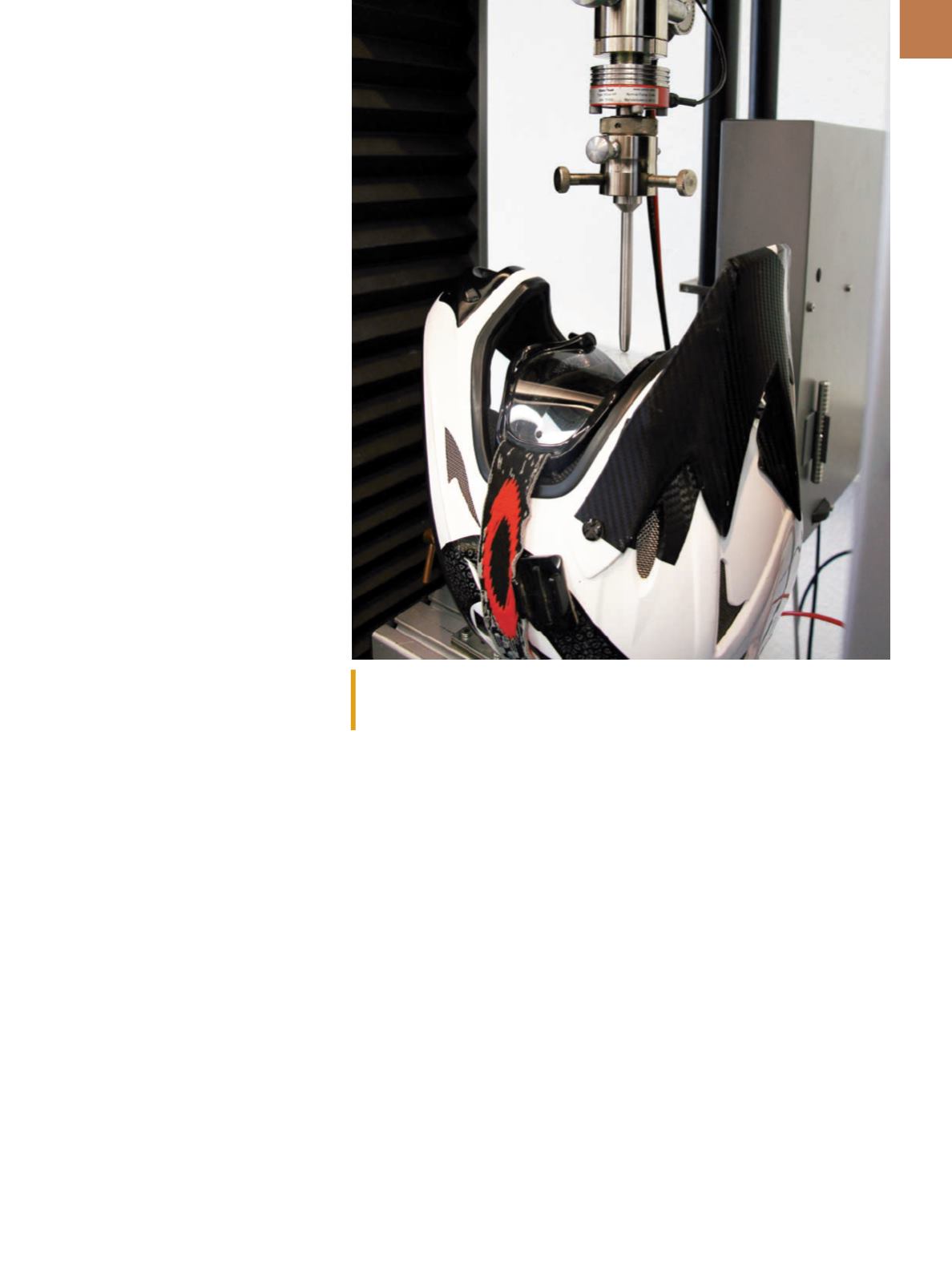
When commercializing its line of MayhemPro goggles, Oakley evaluated impact resistance
and compressive strength to simulate performance in the rugged, off-road conditions faced
by motocross riders.