



 16 / 70

A D V A N C E D M A T E R I A L S & P R O C E S S E S | J U L Y / A U G U S T 2 0 1 5
1 6
NANOTECHNOLOGY
BUTTERFLY WINGS INSPIRE
ANTIREFLECTIVE SURFACES
Hendrik Hölscher and colleagues
at Karlsruhe Institute of Technology,
Germany, found that irregular nano-
structures on the surface of butterfly
wings create low reflective surfaces.
In theoretical experiments, research-
ers reproduced the effect, which holds
potential for mobile phone and laptop
displays, for example. Transparent ma-
terials such as glass always reflect part
of incident light. Some insect surfaces
such as moth eyes reduce reflection,
but only when the view angle is verti-
cal to the surface. Glasswing butterfly
wings, however, maintain very low re-
flection even under higher angles.
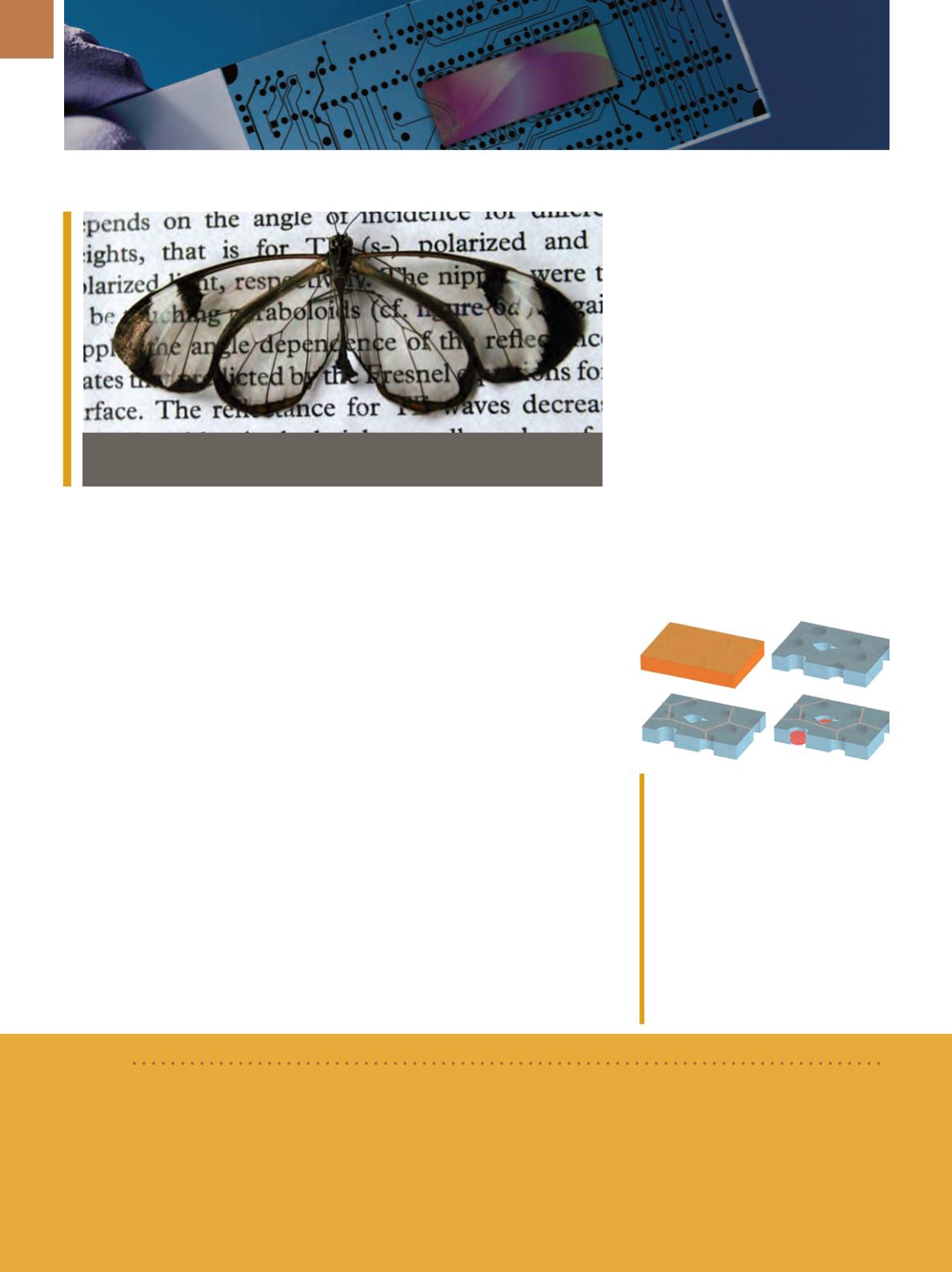
Scientists examined glasswing
butterflies using scanning electron mi-
croscopy. Earlier studies show that reg-
ular pillar-like nanostructures are used
by other insects to reduce reflection.
Scientists also found these nanopillars
on the butterfly wings, although they
are arranged irregularly. In simulations,
researchers mathematically modeled
the irregularity of the glasswings’ nano-
pillars and found that the estimated
amount of reflected light exactly corre-
sponds to the actual amount at variable
view angles.
kit.edu/english.
GRAPHENE ENHANCES
WATER FILTERS
For faster, longer-lasting water
filters, some scientists are looking to
graphene to serve as ultrathin mem-
branes, filtering contaminants to quickly
purify high volumes of water. Graphene’s
unique properties make it a potentially
ideal membrane for water filtration or
desalination. But there has been one
main barrier to its wider use: Making
membranes in one-atom-thick layers of
graphene is a meticulous process that
can tear the thinmaterial.
Now engineers at Massachusetts
Institute of Technology, Cambridge, Oak
Ridge National Laboratory, Tenn., and
King Fahd University of Petroleum and
Minerals, Saudi Arabia, devised a process
to repair these leaks, fill cracks, and plug
The wings of the glasswing butterfly (
Greta Oto
) do not reflect much light and could
inspire new lenses or mobile device displays. Courtesy of KIT.
BRIEF
Researchers at the
University of Arkansas,
Fayetteville, received a $438,317 grant from the
National Science Foun-
dation,
Arlington, Va., to identify and characterize the fundamental mechanisms of a core-shell nanoscale structure.
Discovered by Min Zou, professor of mechanical engineering, the structure is a new type of material that can be used
to improve the mechanical integrity of electro-mechanical systems in computer hard-drive discs and a wide range of
other electronic devices.
mzou@uark.edu, www.uark.edu.holes using a combination of chemical
deposition and polymerization. Com-
bining these techniques, researchers
engineered a defect-free graphenemem-
brane about the size of a penny.
Membrane size is significant: To be
used as a filtration membrane, graphene
would have to be manufactured at a
scale of centimeters or larger. In exper-
iments, water was pumped through a
graphene membrane treated with both
defect-sealing and pore-producing pro-
cesses. Water flowed at rates compara-
ble to current desalination membranes.
Graphene filtered out most large-
molecule contaminants, such as mag-
nesium sulfate and dextran.
For more
information: Rohit Karnik, 617.324.1155,
karnik@mit.edu,
www.web.mit.edu.In a two-step process, engineers success-
fully sealed leaks in graphene. Graphene
was fabricated on a copper surface (top
left)—a process that can create intrinsic
defects, shown as cracks on the surface.
After lifting the graphene and depositing
it on a porous surface (top right), the
transfer creates further holes and tears.
Atomic layer deposition (bottom left) was
used to deposit hafnium (in gray) to seal
intrinsic cracks, while remaining holes
(bottom right) were plugged with nylon
(in red) via interfacial polymerization.