


 13 / 70

A D V A N C E D
M A T E R I A L S
&
P R O C E S S E S | J U L Y / A U G U S T
2 0 1 5
1 3
PROCESS TECHNOLOGY
BRIEFS
Aleris, Cleveland, offers a new 7017 aluminum alloy in North America for commercial plate and defense uses. After extensive
review and testing, the U.S. Army Research Lab issued MIL-DTL-32505 for use in armor applications. 7017 offers high strength,
good weldability, and corrosion resistance. It is currently used in Europe and Asia on combat vehicles to achieve superior ballistic
protection.
aleris.com.
LPW Technology Ltd.
a d
Metalysis,
both in the UK, will coll b rate to
dev lop an al ernative suppl chain for spherical tantalum and tungsten
p wders for quality- ritical applic tions. It will combine Metalysis’ tech-
nology, using electrolysis to make metal powder directly from oxide, with
LPW’s spherodization and post-processing capability.
lpwtechnology.com,
metalysis.com.varying thicknesses—key to producing
auto parts that are light yet retain the
required strength.
The new process is also 10 times
faster than current FSW techniques, rep-
resenting production speeds that meet
high-volume assembly requirements for
the first time, say researchers. The two-
phase, six-year project is funded by the
DOE’s Office of Energy Efficiency and Re-
newable Energy with contributions from
participating companies. With more
than two years of funding left, the team
continues to collaborate, with a focus
on even faster weld speeds and the abil-
ity to maneuver around the contours of
complex aluminum parts, for which laser
welding is not commercially feasible. The
team is also modifying FSW to join dif-
ferent alloys, such as automotive-grade
aluminum alloys with light, ultra-high
strength alloys currently reserved for
aerospace applications.
pnnl.gov.GRAPHENE NANORIBBON
ASSEMBLY PROCESS
MAKES PROGRESS
Researchers at the University of
Tokyo produced graphene nanorib-
bons by taking advantage of the phe-
nomenon that inorganic nanomaterials
self-assemble into regular structures on
graphene. Professor Shoji Takeuchi and
assistant professor Won Chul Lee found
that gold cyanide nanowires grow di-
rectly on pristine graphene in aqueous
solution at room temperature, the mol-
ecules aligning themselves with the zig-
zag lattice directions of the graphene.
The team then fabricated graphene na-
noribbons with zigzag-edged directions
by employing the synthesized nano-
wires as an etching mask. Ribbons were
10 nm in width and as thin as a single
carbon atom. Both the nanowires and
graphene nanoribbons formed along
the zigzag lattice, offering a potential
method for controlling the formation
direction of the ribbons.
The research is a collaboration be-
tween the University of Tokyo, University
of California at Berkeley, Ulsan National
Institute of Science and Technology,
Harvard University, Konkuk University,
and Lawrence Berkeley National Labo-
ratory.
www.u-tokyo.ac.jp/en.
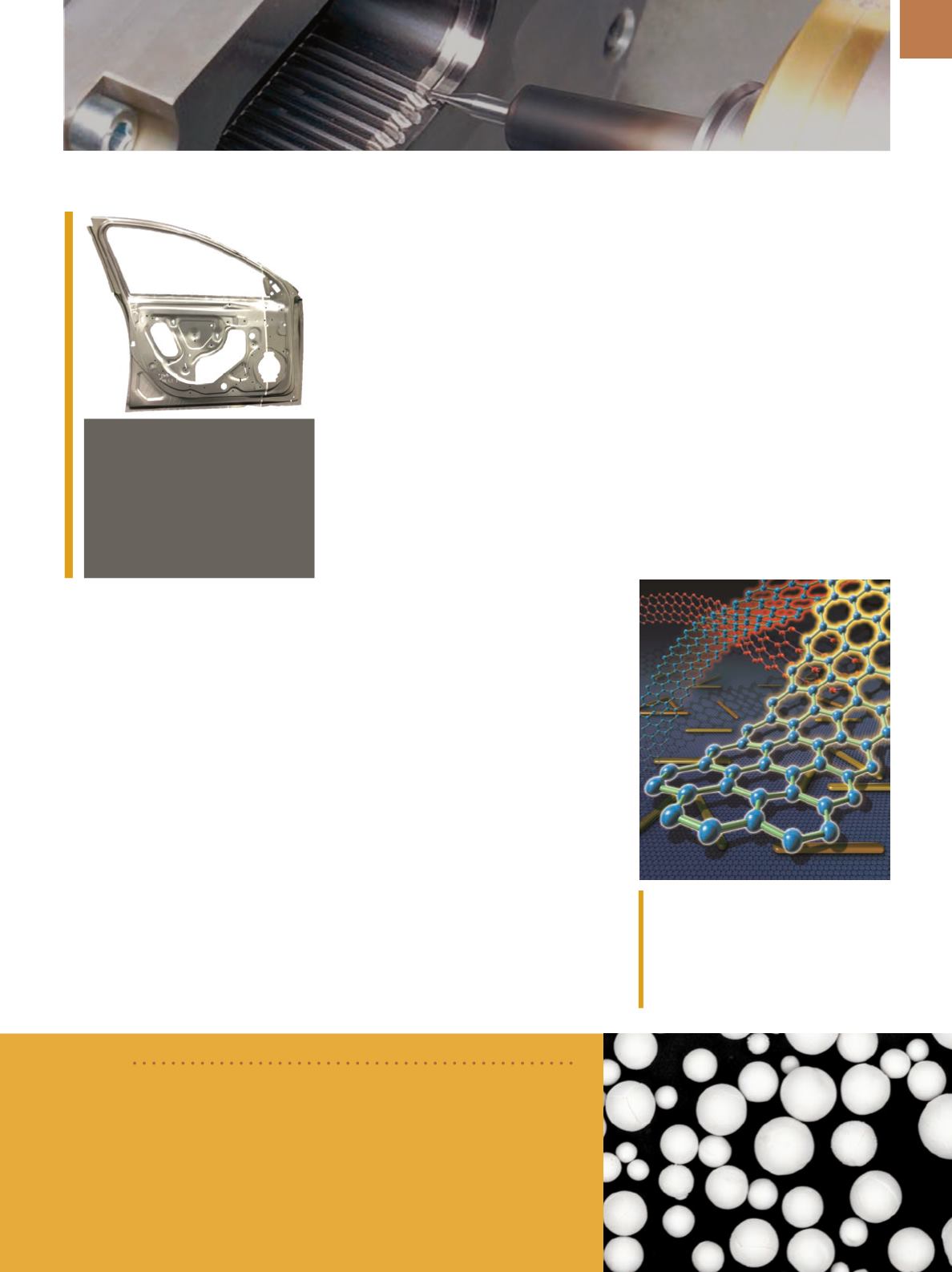
PNNL’s process joins (white line)
a thicker gauge of aluminumnear
the door hinge, where additional
strength is needed, to a thinner
gauge used throughout the rest of
the door panel, resulting in a 62%
weight reduction. Image courtesy
of TWB Co.
NEW FRICTION STIR WELDING
METHOD IS 10 TIMES FASTER
Researchers recently demonstrat-
ed a new process for the expanded use
of lightweight aluminum in cars and
trucks at the speed, scale, quality, and
consistency required by the auto indus-
try. The process reduces production
time and costs while yielding strong
and lightweight parts, for example de-
livering a car door that is 62% lighter
and 25% less expensive than that pro-
duced with traditional manufacturing
methods. In partnership with Gener-
al Motors, Alcoa, and TWB Company
LLC, researchers from the DOE’s Pacific
Northwest National Laboratory trans-
formed the joining technique of friction
stir welding (FSW). The technique can
now be used to join aluminum sheets of
Inorganic nanowires self-assemble on
graphene and graphene nanoribbons
fabricated using those nanowires. Both
the nanowires and the nanoribbons are
aligned in zigzag-edged directions. Cour-
tesy of Aki Sato.