



 10 / 70

A D V A N C E D M A T E R I A L S & P R O C E S S E S | J U L Y / A U G U S T 2 0 1 5
1 0
TESTING | CHARACTERIZATION
BRIEFS
Aleris, Cleveland, offers a new 7017 aluminum alloy in North America for commercial
plate and defense uses. After extensive review and testing, the U.S. Army Research
Lab issued MIL-DTL-32505 for use in armor applications. 7017 offers high strength,
good weldability, and corrosion resistance. It is currently used in Europe and Asia on
combat vehicles to achieve superior ballistic protection.
aleris.com.
NEW IMAGING METHOD
HOLDS PROMISE FOR
CORROSION RESEARCH
Researchers from Northwestern
University, Brookhaven National Lab-
oratory, Lawrence Berkeley National
Laboratory, and the University of Mel-
bourne, Australia, developed a new
imaging technique that uses atomic
resolution secondary electron images in
a quantitative way to determine the ar-
rangement of atoms on the surface.
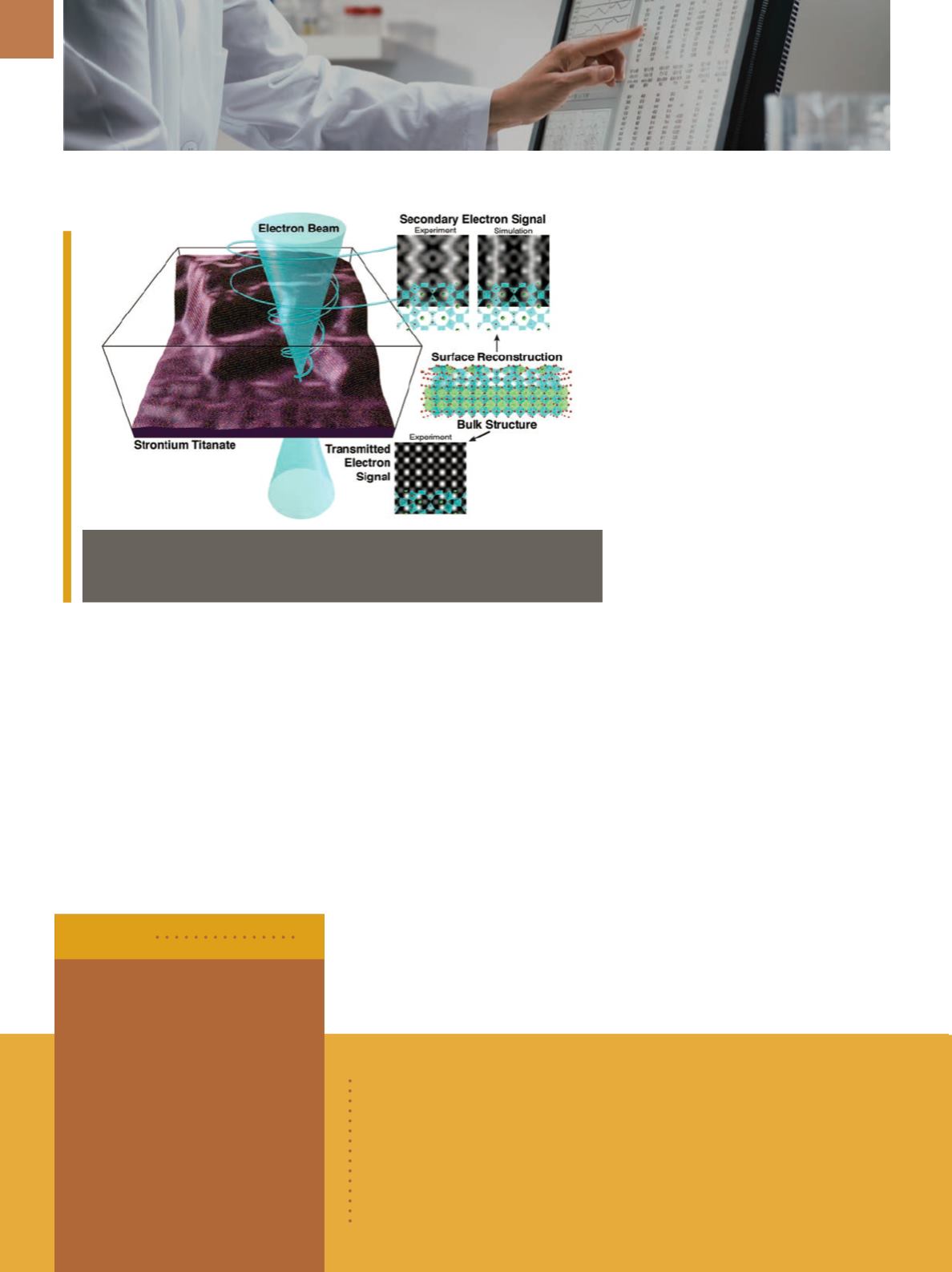
A highly promising technique called high-resolution SEM extends scanning micros-
copy to the atomic scale and provides information on both surface and bulk atoms
simultaneously. Courtesy of Berkeley Lab.
surface roughness is not that important.
Until recently, instruments could not
obtain clear atomic images of surfaces
until a group at Brookhaven managed
to get the first images that seemed to
show the surfaces very distinctly, in
2011. However, it was not clear to what
extent they were able to image the sur-
face, as there was no theory for the im-
aging and many uncertainties existed.
The new work answers all these
questions, says Marks, providing a de-
finitive way of understanding the sur-
faces in detail. What was needed was
to use a carefully controlled sample of
strontium titanate and perform a large
range of different types of imaging to
unravel the details of how secondary
electron images are produced.
“We started this work by investi-
gating a well-studied material,” says
Jim Ciston, a staff scientist at Lawrence
Berkeley National Laboratory who ob-
tained the experimental images. “This
new technique is so powerful that we
had to revise much of what was already
thought to be well known. This is an
exciting prospect because the surface
of every material can act as its own
nanomaterial coating, which can great-
ly change the chemistry and behavior.”
Les Allen, who led the theoretical
and modeling aspects of the new im-
aging technique in Melbourne, notes,
“We now have a sophisticated under-
standing of what the images mean. It
will be full steam ahead to apply them
to many different types of problems.”
northwestern.edu.
“We are excited by the possibilities
of applying our imaging technique to
corrosion and catalysis problems,” says
Laurence Marks, professor of materials
science and engineering at Northwest-
ern. “The cost of corrosion to industry
and the military is enormous, and we do
not understand everything that is taking
place. We must learn more, so we can
produce materials that will last longer.”
To understand these processes, it
is vital to know how atoms are arranged
on surfaces. While there are many good
methods for obtaining this information
for flat surfaces, most tools are limited in
what they can reveal when surfaces are
rough. Scanning electron microscopes
(SEMs) are widely used to produce im-
ages of many different materials and
Ametek Inc.,
Berwyn, Pa., will
acquire
Cognex Corp.’s Surface
Inspection Systems Division
(SISD), Hayward, Calif., for approxi-
mately $160 million. SISD develops
and manufactures soft are-
enable vision systems used to
inspect surfaces of continuous-
ly processed materials for flaw
and def cts. End mark ts include
metals, paper, nonwovens, plastics,
and glass.
ametek.com.
BRIEFS
Teledyne Technologies Inc.,
Thousand Oaks, Calif., acquired
Industrial Control
Machines
(ICM), Belgium, a supplier of portable x-ray generators for nondestruc-
tive testing and complete x-ray imaging systems for security screening. Founded
in 1993, ICM designs and manufactures lightweight x-ray sources for inspecting
materials and structures, ranging from light alloy aviation parts to thick steel
pipelines.
teledyne.com.