


 14 / 70

A D V A N C E D M A T E R I A L S & P R O C E S S E S | J U L Y / A U G U S T 2 0 1 5
1 4
SOLAR ARRAYS POWER
SPACE STATION
The International Space Station
is a microgravity laboratory in which
an international crew of six people live
and work while traveling at a speed of
five miles per second, orbiting earth ev-
ery 90 minutes. Crew members spend
about 35 hours each week conducting
research in many disciplines to advance
scientific knowledge in earth, space,
physical, and biological sciences. It is
powered by more than an acre of solar
arrays, which contain a total of 262,400
solar cells and cover an area of about
27,000 ft
2
(2500 m
2
). The solar array’s
wingspan of 240 ft (73 m) is longer than
a Boeing 777’s wingspan. Altogether,
the four sets of arrays can generate
84 to 120 kW of electricity—enough to
provide power to more than 40 homes.
The solar arrays produce more power
than the station needs at one time for
systems and experiments. When the
station is in sunlight, about 60% of the
electricity that the solar arrays generate
is used to charge the station’s batteries.
At times, some or all of the solar arrays
are in the shadow of Earth or part of the
station. The batteries power the station
when it is not in the sun.
nasa.gov.
HARVESTING ENERGY FROM
ELECTROMAGNETIC WAVES
Researchers from the University
of Waterloo, Canada, reported a novel
design for harvesting electromagnet-
ic energy based on the full absorption
concept, which involves use of meta-
materials tailored to produce media
that neither reflects nor transmits any
power. This enables full absorption of
incident waves at a specific range of fre-
quencies and polarizations.
Since the inception of collecting
and harvesting electromagnetic en-
ergy, classical dipole patch antennas
have been used. “Our technology in-
troduces
metasurfaces
that are much
better energy collectors than classical
antennas,” explains Omar M. Ramahi,
professor of electrical and computer
engineering. Metasurfaces are formed
by etching a material’s surface with an
elegant pattern of periodic shapes. The
particular dimensions of these patterns
and their proximity to each other can
be tuned to provide near-unity energy
absorption. This energy is then chan-
neled to a load through a conducting
path that connects the metasurface to
a ground plane. The key significance of
the researchers’ work is that it demon-
strates for the first time that it’s possi-
ble to collect essentially all of the elec-
tromagnetic energy that falls onto a
surface.
https://uwaterloo.ca.
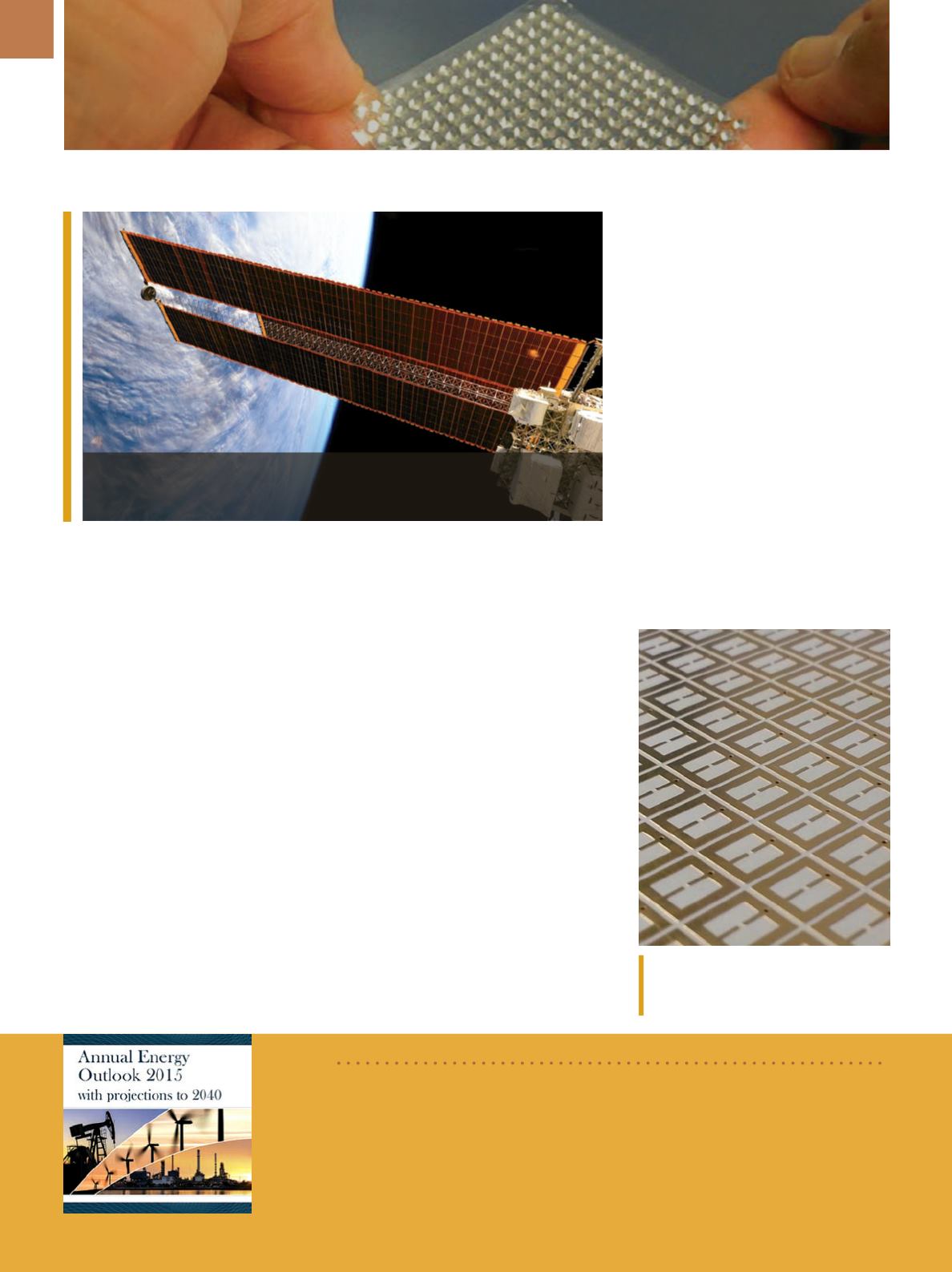
Expedition 43 Flight Engineer Samantha Cristoforetti of the European Space
Agency (ESA) photographed the giant solar arrays on the International Space
Station in February. Courtesy of ESA/NASA.
BRIEF
The
U.S. Energy Information Administration
released the
Annual Energy Outlook
2015
(AEO2015), which presents long-term projections of energy supply, demand, and
prices through 2040. The analysis focuses on six cases: reference, low and high econom-
ic growth, low and high oil prices, and high oil and gas resources. AEO2015 is a shorter
edition under a newly adopted two-year release cycle in which full editions and shorter
editions will be produced in alternating years, allowing the EIA to focus more resources
on rapidly changing energy markets both in the U.S. and abroad.
eia.gov.
ENERGY TRENDS
Metasurface used for collecting electro-
magnetic energy. Courtesy of O. Ramahi/
U. Waterloo.