


 22 / 70

A D V A N C E D M A T E R I A L S & P R O C E S S E S | J U L Y / A U G U S T 2 0 1 5
2 2
TECHNICAL SPOTLIGHT
CUSTOMMULTIAXIAL FABRICS ENABLE USE OF RESIN INFUSION TO
ACHIEVE CHALLENGINGWEIGHT SPECIFICATIONS.
MULTIAXIALMATERIALS ACHIEVEWEIGHT
SAVINGS INCARBON YACHT DESIGN
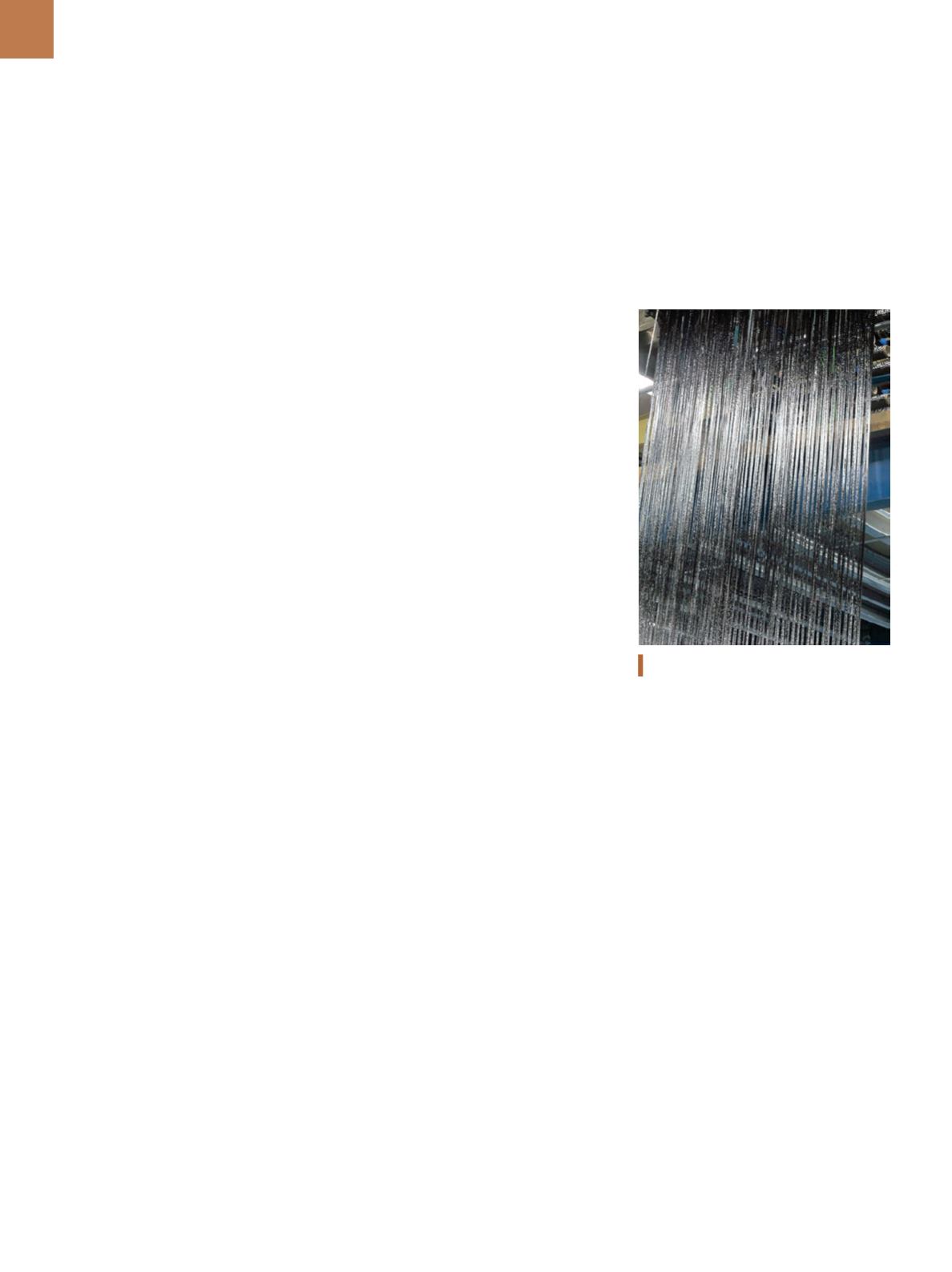
Formax carbon fabric.
F
romnaval ships to recreational sail-
boats, materials play a significant
role in vessel design and perfor-
mance. This article provides a case study
of how one materials supplier worked
with a yacht builder to achieve weight
and cost savings by using both innova-
tive materials and a unique manufactur-
ing process. For the B53 all-carbon racer/
cruiser, Formax, UK, partnered with Gold
Coast Yachts (GCY), U.S. Virgin Islands, to
develop custom multiaxial fabrics that
enable resin infusion use.
The B53 was designed by Paul
Bieker of Bieker Boats LLC, known for
engineering the AC72 foils for the 2013
America’s Cup winner, Oracle Team
USA. The B53 is complete and was suc-
cessfully launched in June. In addition
to serving as a competitive racing boat,
the B53 is also amodern, well-equipped
cruiser. It has an overall length of
16.3 m, is 8 m wide, and has a draft of
0.4 m to 3 mwith foils down. It has a dis-
placement of 5500 kg, including most
of the equipment. GCY built the main
structure, with the mast, rigging, and
foils—also made of carbon—supplied
by other companies.
Since its inception in 1985, Gold
Coast Yachts has built 113 custom one-
off multihulls for the private yacht,
commercial ferry, and day charter mar-
kets with many models in the 12-30 m
range. Over the years, the company has
transitioned from wood/epoxy con-
struction, to E-glass/foam core/epoxy
composites using either resin infusion
or wet bagging (vacuum bagging) tech-
niques, and more recently, has been
incorporating more carbon compos-
ite parts. The B53 was GCY’s first all-
carbon build.
INFUSION-OPTIMIZED
FABRICS
The B53’s development team con-
sidered a number of composite build
techniques. They did not think it was
possible to meet the weight and panel
engineering requirements of the boat
using wet bagging, but they were con-
cerned that carbon could not be vacuum-
infused successfully. Carbon fiber is sig-
nificantly more difficult to infuse with
resin than glass due to its smaller fiber
diameter, which means carbon fibers
pack together more tightly, reducing
fabric permeability. However, prepreg
(a fabric reinforcement method that
uses pre-impregnation with a resin sys-
tem) is very expensive, requiring cost-
ly materials, tooling, and production
equipment, plus higher labor costs.
Formax’s director of business
development for North America, Phil-
ip Steggall, helped Gold Coast Yachts
decide which manufacturing process
could best deliver the laminate prop-
erties (weight, strength, and stiffness).
This effort involved a collaborative,
three-month testing program. Formax
fabrics were used to build identical
laminate panels with wet bagging and
infusion techniques. A typical laminat-
ing resin was used for the wet bag test
panels, and an infusion-specific resin
for the infusion samples. Panels were
tested at laboratories in the U.S. and
Canada and results demonstrated the
superior properties of the infused pan-
els, including a 15% increase in com-
pression strength.
With this data, GCY was able to
prove it could meet the B53’s weight
and engineering specifications using
infusion, with relatively low-cost molds
and lower post-curing temperatures
than required for prepreg. Key to this
success was Formax’s ability to develop
custom multiaxial fabrics optimized for
the infusion. For the B53, it engineered
new infusion-specific versions of its
+45°/-45° biaxial carbon fiber fabrics
of 400 g/m² and 300 g/m² and a 0°/90°
biaxial of 300 g/m².
Stitched multiaxials perform bet-
ter in infusion than woven or hot-melt
bonded fabrics because they offer a
z
axis for air to escape through the thick-
ness, resulting in fewer voids. Formax
also stitched “microweb” between the
plies of the biaxial carbon fabric, which
enhances the infusion and overall me-
chanical properties. Microweb is a poly-
amide random monofilament web that
offers a path for air to escape and resin
to flow between multiple layers of car-
bon reinforcement.