


 28 / 70

A D V A N C E D M A T E R I A L S & P R O C E S S E S | J U L Y / A U G U S T 2 0 1 5
2 8
Runner-specific spike plates are
currently only available for Team New
Balance athletes, but this will eventu-
ally change. “Design-driven additive
manufacturing holds promise for more
on-demand production and more cus-
tomized design,” says Katherine Pe-
trecca, business manager. “These spike
plates are the first step we’ve taken with
our athletes to prove that out. As mate-
rial options and our proficiency with the
technology expands, and as capacities
for additive manufacturing grow, we be-
lieve we will be able to bring 3D-printed
products, in some format, to the every-
day consumer.”
newbalance.com.HUT, HUT, HIKE A 3D-PRINTED
FOOTBALL
Before the North Carolina State
University home football game last April
in Raleigh, engineers at the Edward
P. Fitts Department of Industrial and
Systems Engineering (ISE) presented
NC State Chancellor Randy Woodson
with a 3D-printed titanium football
replica. The full-size football, bearing
the NC State logo, was created in ISE’s
Center for Additive Manufacturing and
Logistics by Professor Tim Horn. It is
made of medical-grade titanium and
took 24 hours to produce. The titanium
football is now displayed in Chancellor
Woodson’s office alongside three real
footballs presented to him by Wolfpack
head coach Dave Doeren and former
coach Tom O’Brien commemorating
gridiron victories over rival UNC-Chapel
Hill.
camal.ncsu.edu.MIMICKING NATURE TO
PROTECT THE BRAIN
Designing gear to better protect
against severe impacts requires a de-
tailed understanding of how soft tissues
in the body respond to such impacts,
whether from concussions, ballistic at-
tacks, or blast wounds. Massachusetts
Institute of Technology, Cambridge, re-
searchers are developing new synthetic
polymer-solvent gels, called tissue sim-
ulant gels, which mimic the response of
natural tissue.
Biological engineering graduate
student Bo Qing is studying the impact
of traumatic force on brain tissue from
rodents and modeling synthetic sub-
stitutes to enable better insight into
preventing such injuries. “If we can de-
sign a material that mimics this impact
response, it would be very helpful to
serve as an injury model to assess new
protective equipment that can mini-
mize this harm,” says Qing.
He is studying multilayered poly-
dimethylsiloxane-based (PDMS) gels,
which are stretchy and transparent, as
models for brain tissue. The group pre-
viously identified specific cross-linked
PDMS gel compositions that closely
matched the impact response of heart
tissue. “These are, essentially, a PDMS
chemically cross-linked network that’s
loaded with a PDMS solvent. There are
a lot of different variations of these gels
where we can basically tune the cross-
linker-to-polymer-base stoichiometric
ratio, the molecular weight of the PDMS
solvent, and the amount of solvent that’s
used for these different type of gels,”
explains Qing.
For more information: Kry-
styn Van Vliet, 617.253.3315,
krystyn@mit. edu, www.web.mit.edu.HEAD HEALTH CHALLENGE
BATTLES BRAIN INJURIES
In January, the NFL, GE, and
Under Armour joined with the National
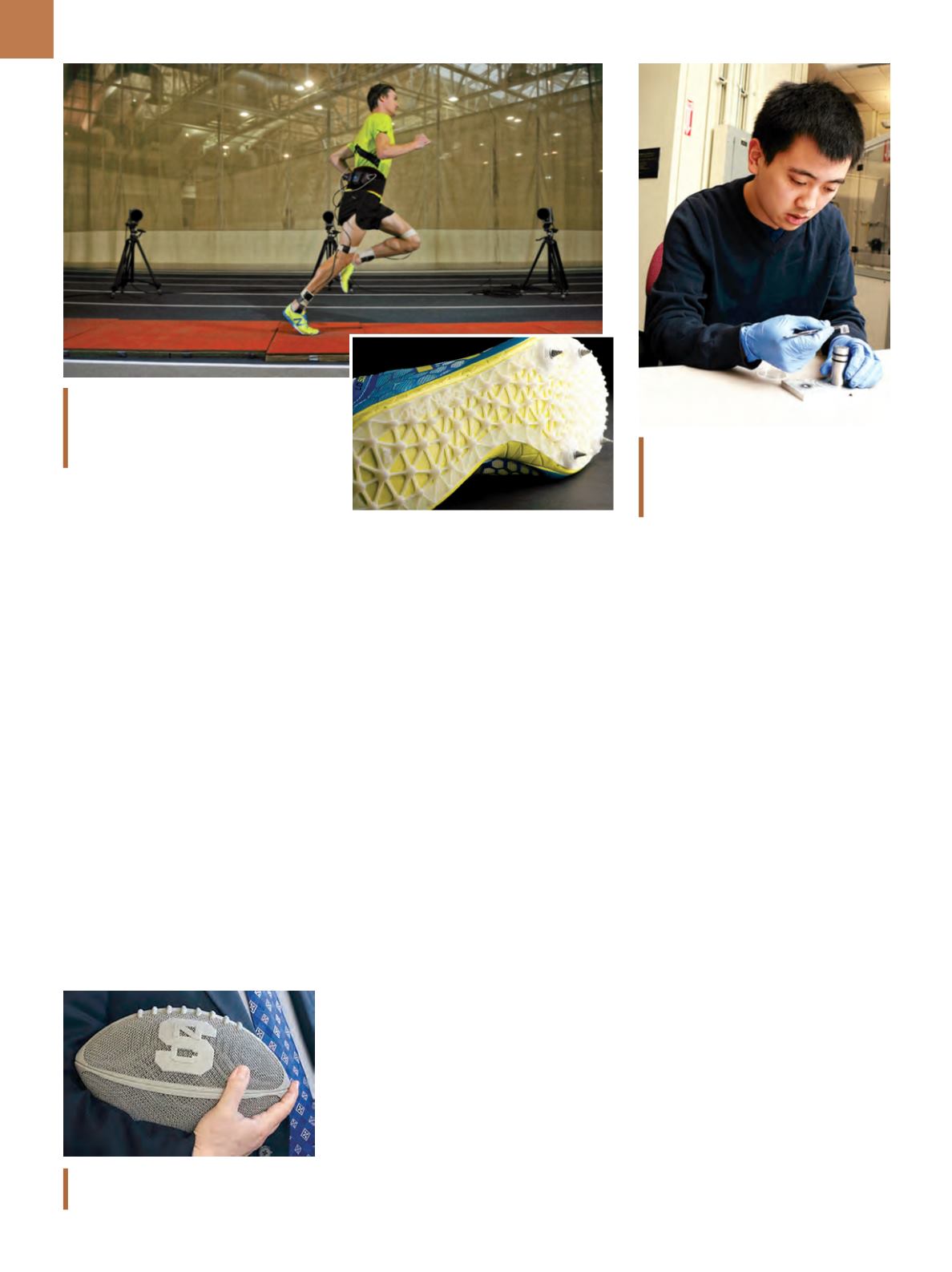
New Balance uses design-driven manufactur-
ing for 3D printing of custom spike plates for
elite athletes, based on an individual runner’s
biomechanics.
Titanium football replica produced via 3D
printing. Courtesy of NC State.
Bo Qing loads a polydimethylsiloxane
gel onto a post used in a nanoindenter
to measure the gel’s impact response.
Courtesy of Denis Paiste.